
Intelligent power conversion for smart grids
Smart grids are evolving due to the new demands on our energy supply. Smart grid development is closely linked to the integration of renewable energy sources (RES) and electric vehicles (EV) into distributed generation (DG) or distributed energy resources (DER) in the national supply grid. This integration poses challenging compliance demands upon the new generating units. Most of these specifications are regulated and enforced by national regulators.
Balancing supply and consumption is a complex task in a distributed smart grid. This is where Danfoss supports OEMs and system integrators with certified intelligent power conversion solutions, saving time, cost and effort in testing and certification.
To achieve the required balance of supply and consumption, compliance with local regulations and standards is one of the main considerations when designing a smart grid. Compliance demands relate to safety, EMC, and grid codes. Such codes, standards and regulations govern the design, construction, installation, commissioning and operation of the whole, aiming to protect the public health, safety and welfare.
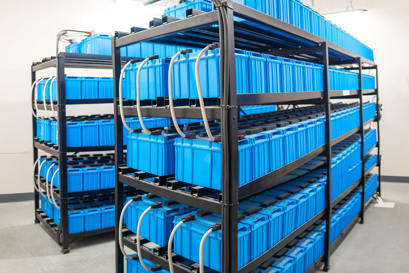
One of the newest trends in smart grids is the integration of the ‘missing link’: energy storage. Energy storage enables the grid to smoothly accommodate unpredictable consumers and energy production sources. Often, storage is implemented in the form of batteries, or battery energy storage systems, BESS. Of course, energy storage systems are also subject to local compliance demands.

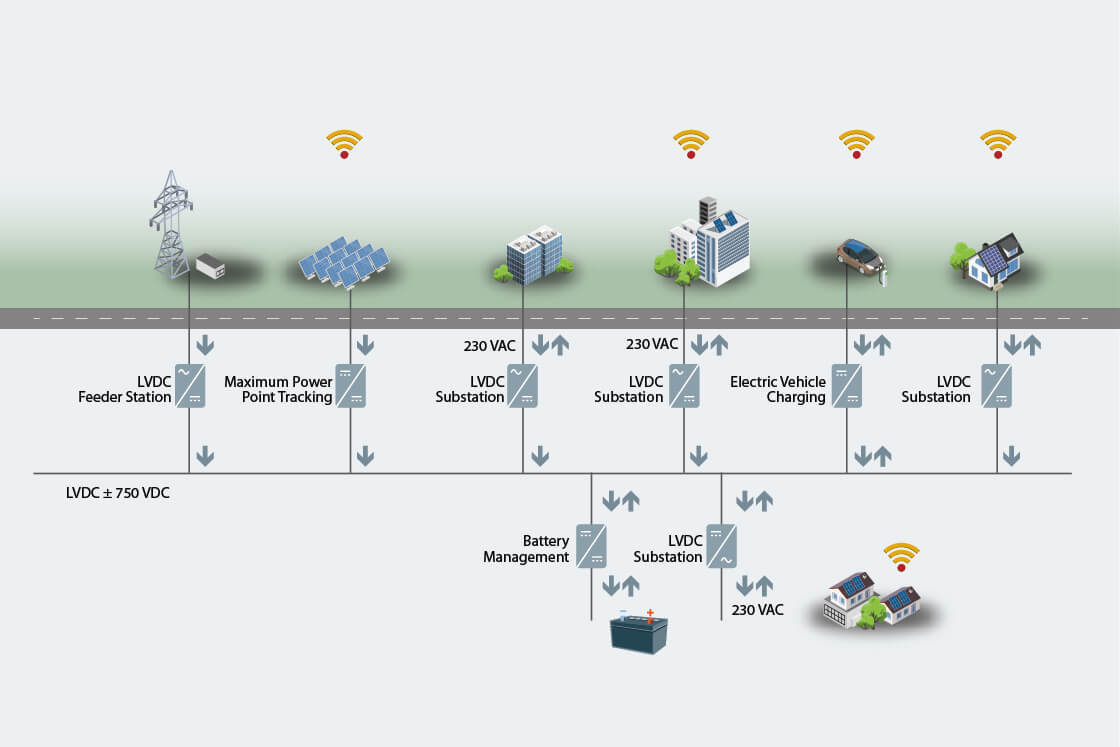
Smart grid with energy storage
Smart grids with integrated energy storage facilitate energy supply time shift to overcome the intermittent nature of many renewable energy sources. They also provide back up supply in the event of power outage and handle peaks, allowing designers to downscale equipment to lower ratings to cope with regular loads, not peak loads.
In a distributed grid, energy supply and consumption variations result in many power peaks and troughs. Energy storage smooths the peaks and troughs, so the grid supply can operate consistently at the average power demand, which is usually relatively low. This means the grid can carry much more energy with smaller cables, therefore enabling lower capital investment.

At the same time the energy storage system can also provide back-up power in the event of energy scarcity from the supply, for example due to load shedding or unplanned blackout.
During power-down, support from energy storage enables consumers to maintain operation for a period of time.

Time shifting redistributes energy to optimize cost, by storing energy during times when energy costs from the grid are low and supplying energy from the storage medium when energy costs are high. Time shifting is also used to achieve the most efficient use of diesel generators, so they can run at full power and store excess energy to battery.

Smart grid enabler
Smart grids with integrated energy storage facilitate energy supply time shift to overcome the intermittent nature of many renewable energy sources.
See how in this animation
How energy storage improves power quality
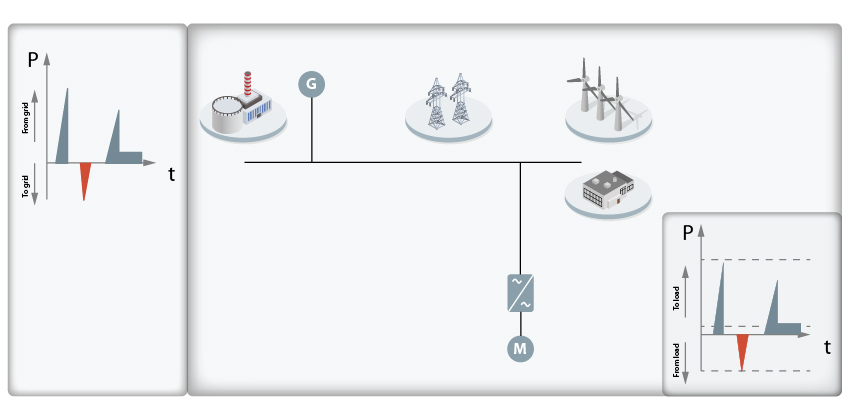
Traditional grid: The consumer load creates peaks on the supply network.
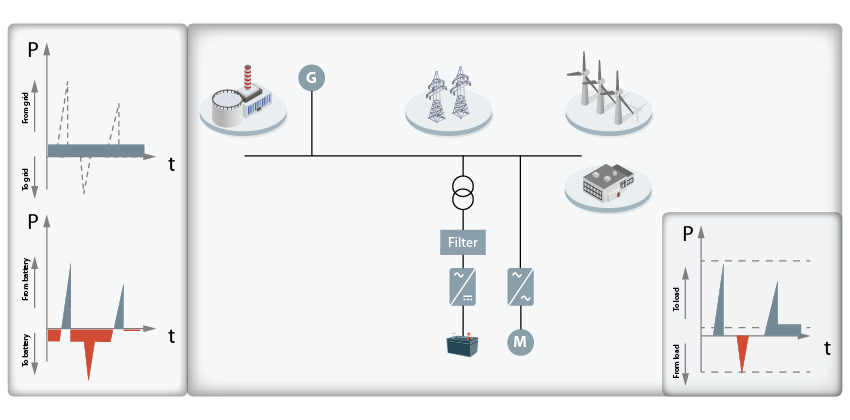
Smart grid: Battery storage removes the power peaks on the supply network, so the consumer load causes virtually no disturbance to the grid. This results in good power quality and ideally enables us to scale down the distribution infrastructure, saving cost.
Smart grids
Power networks which include intelligent energy storage offer us highly sustainable solutions for the future
Discover more about smart grids
Perfectly balancing supply and demand
Improve performance by making better use of energy

Containerized power conversion
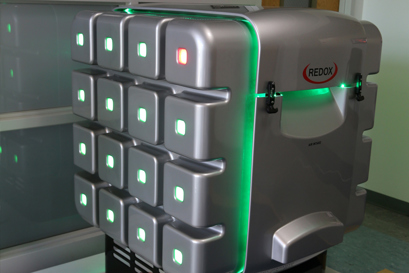
Smart grids are complex systems by nature. They are commonly implemented in remote locations such as islands or remote communities, based on a local energy resource.
In these environments, containerized power conversion solutions provide a good level of system integration, equipment protection and logistic benefits for the customer.
Danfoss supports system integrators (SI) in designing systems with freedom to optimize performance based on their preferred components. Our aim is to help customers gain the winning edge in bidding on projects by providing tools and reference designs to make their system design easier. For instance, Danfoss can provide configurable 3D models as well as 2D general arrangement drawings from our product offering.
For more information
Please contact your local sales office for reference designs, configurable models and drawings


Competitive electrification through power conversion
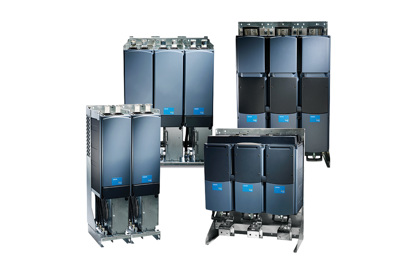
When integrating diverse energy sources into the grid, intelligent power conversion solutions from Danfoss improve grid performance whilst reducing CAPEX. Check out our approach, helping you achieve more efficient and competitive electrification.
Convert to electric