
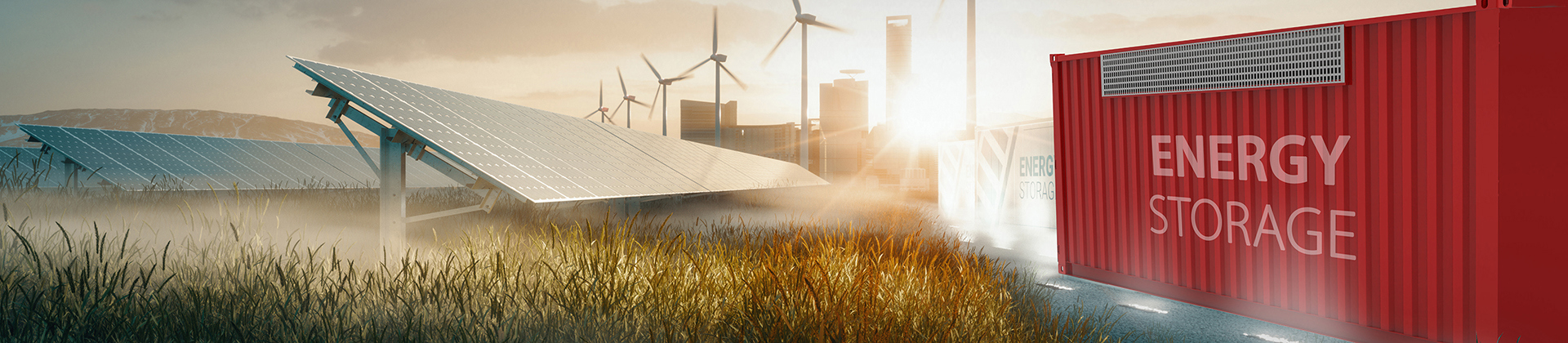
Decarbonize with energy storage solutions
Transition to renewable energy is recognized as a vital step in decarbonization. However, renewables offer us an intermittent supply, quite different from the nonstop nature of supply from fossil sources. Therefore, to transition successfully, we must surmount the challenges of balancing supply and demand. When we source power from renewable origins, the peaks and troughs in energy generation differ greatly from the pattern of consumption.
Energy storage solutions – supporting renewable energy
We need energy storage to bridge the gap between disparate levels of energy supply and demand at specific times of day. For example, at noon solar PV energy production is at its peak, and at nighttime there is none. The energy consumption curve can be diametrically opposite: peak demand occurs in the evening and early morning, whereas demand is low at noon.
When we understand that energy storage is key in enabling supply to match consumption, then it’s a small step to realizing its significance in reaching our climate targets. To decarbonize adequately, it is vital for society to take the giant step of implementing energy storage at multi-gigawatt scale. Only this volume of storage is capable of enabling a renewables-based grid to deliver supply reliable enough to match the stability of a traditional fossil-fuel-based grid.
How to ensure a stable and reliable grid supply when integrating renewable energy sources
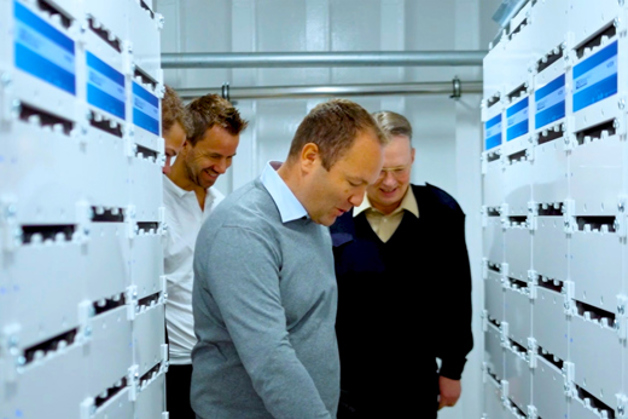
At Danfoss Drives, we're committed to supporting the green transition. One major challenge for our customers is managing the integration of different energy generators and storage systems into a single grid. This can lead to power quality issues and grid instability. That’s why we at Danfoss Drivees offer efficient power converters to combat inconsistencies and ensure a stable and reliable grid supply.
Danfoss technology is a proven enabler in consistent power supply and grid-friendly solutions. We supply a wide range of products to support your energy storage offering. Danfoss delivers grid-friendly power conversion solutions with impressive energy efficiency, specifically designed for energy storage solutions.
With low harmonic distortion, adjustable power factor, and other grid-friendly features, support from Danfoss solutions ensures that the power supply is competitive and grid-compliant. Long experience in power conversion for energy storage solutions, combined with a leading position in the world, means that Danfoss is your ideal partner when investing in energy storage technology.
Want to learn more about how power conversion solutions from Danfoss can help you ensure grid stability and compliance while reducing CAPEX?
Grid support
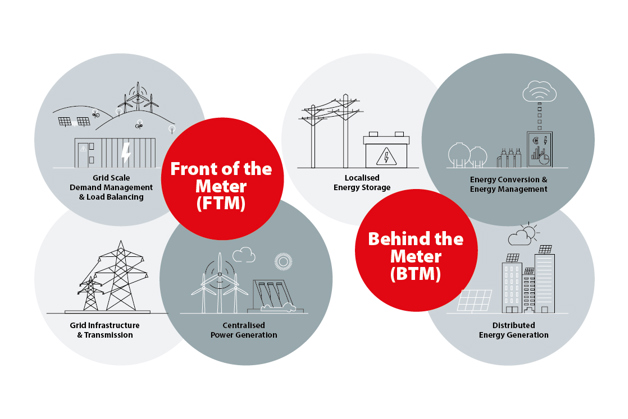
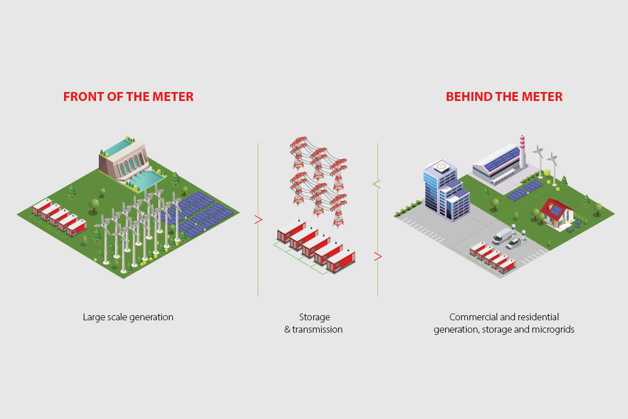
Behind-the-meter and front-of-the-meter
In a traditional energy market, the electricity network comprises two players. The first player is the sole owner and manager of the power generation plant and transmission network.
The second player is the consumer, a factory or homeowner who owns the local microgrid on his own premises.
The split between the two occurs at the energy meter. In front of the meter (FTM) are the generator and transmitter. Behind the meter (BTM) is the consumer.
However, the energy market has rapidly evolved since the 1990s and today, many countries operate a liberalized energy market.
In a liberalized market, separate companies own the energy production and transmission network, respectively. FTM is divided in two groups of actors: the grid operator who has a monopoly on transmission infrastructure, and the energy generators who operate in a free market.
How energy storage supports prosperity and energy security
We have explained why energy storage is essential in establishing renewables as the dominant source in the power supply: Energy storage overcomes disparity between energy supply and demand at varying times throughout the day.
But not only does energy storage support a sustainable-based power supply for decarbonization. Energy storage also facilitates a prosperous modern lifestyle with the convenience of mobility in the form of electric trucks, electric vessels, accessories like battery-powered laptops, and personal forms of transport such as electric vehicles and bicycles. Society cannot imagine doing without these conveniences and will not be motivated to decarbonize, if they cease to be available.
Without storage, it’s not possible to maintain prosperity and energy security in society. Without storage, our only alternative is fossil-fuel-based power, such as gas-powered generation and petrol-powered transport. Society already knows from long experience that a fossil-fuel-based power supply requires import across borders, leaving nations vulnerable to energy security risks. Neither does fossil-based supply support the decarbonization we need to fighting climate change while still maintaining a prosperous convenient lifestyle.
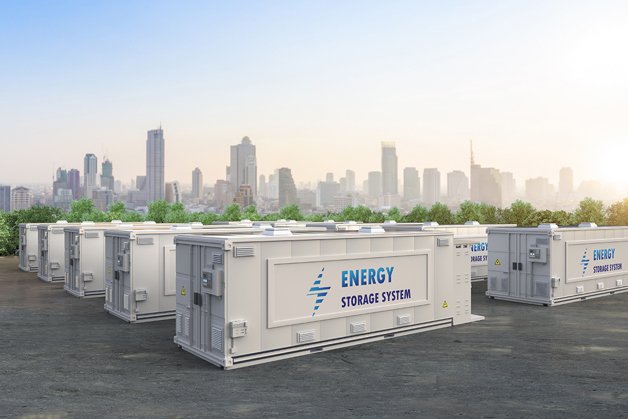
How energy storage maintains power quality, quantity, and reliability
By ensuring flexible, reliable, and clean energy solutions, energy storage plays a crucial role in enabling the transition to a more sustainable, resilient, and efficient energy system. Energy storage enhances the grid in flexibility, reliability, and power quality:

Flexibility in power supply, so if there is an outage or other unplanned event, we can quickly transfer to an alternative energy source.
Enhanced grid reliability in distributed networks, so power is always available for critical infrastructure such as hospitals or water supply.
Enhanced power quality for a clean grid, free of distortion and disturbances.
Remember voltage quality for a stable network
We use energy storage to bridge the gap between intermittent energy production and consumption. However, when implementing energy storage, it’s not enough to establish adequate power quantity. High power quality is also essential to ensure that the distributed network remains stable and efficient for both grid following and grid forming. To ensure an acceptable voltage quality, all parties in a renewable network must share the burden. This burden is normally shared with the use of grid code in a large power system, or so-called nationwide grids. Danfoss supports network stability and flexibility by offering both grid following control with grid codes as well as grid forming control modes.
For smaller grids, or intentional island grids, the same fundamentals must be in place. The grid must have an acceptable voltage quality, enough short circuit current, acceptable levels of harmonic and supra harmonic components. In addition, controllers in the network must not create instability. Some of the factors contributing to good power quality are:
Ensure harmonic distortion compliance in terms of total harmonic distortion (THD) levels, supra harmonics and short circuit injection.
Ensure the short circuit protection system functions reliably, when disconnected from the main grid. Simulation using the DigSilent Power Factory tool is used to investigate short circuit behavior for storage in existing networks.

The market and regulatory directions are trending towards power converters capable of grid forming
How battery energy storage generates revenue streams
Smart grids with integrated energy storage facilitate energy supply time shift to overcome the intermittent nature of electricity generation from many renewable energy sources. The energy storage system can provide backup power in the event of energy scarcity from the supply, for example due to load shedding or unplanned blackout.
Battery energy storage systems introduce alternative power sources to the distributed grid, or an industrial or maritime DC grid. In over-supply situations, the system can direct energy toward storage. When demand levels are high, the storage medium can be accessed to provide an additional source of energy to
- Reduce operating expenses (OPEX)
- Improve system efficiency
- Increase system availability

Smart grid enabler
Smart grids with integrated energy storage facilitate energy supply time shift to overcome the intermittent nature of many renewable energy sources.
See how in this animation
Energy storage systems not only stabilize grid fluctuations but also serve as backup power sources during energy scarcity or blackout events – either due to load shedding or unplanned events. Drawing upon energy storage systems in the event of unreliable supply or power outage ensures
- Maximum uptime of industrial processes
- Reliability of vital services
- Uninterrupted operation for consumers
In a decentralized grid system, the fluctuations in energy supply and consumption often lead to peaks in energy production and troughs in power levels. These variations are typical for solar and wind power. Energy storage solutions help to stabilize these fluctuations, allowing the grid to operate consistently at the average power demand, which is typically lower than the peak levels. Designers can downscale equipment to lower ratings to cope with regular loads, which in turn reduces the level of capital investment required.

Time shifting redistributes energy to optimize cost, by storing energy during times when energy costs from the grid are low and extracting energy from the storage medium when energy costs are high. Storage can be combined with green fuels such as hydrogen, e-ammonia and e-methanol, so they can run at full power and store excess energy to battery.
Using an energy storage system connected to intelligent system management, the stored energy can be used or sold later by arbitrage, at the optimal time when the electricity price (or cost) is high. This strategy of exploiting the price difference is known as arbitrage.
Learn how smart operation including energy storage ensures flexible power and energy consumption at Flexheat in Copenhagen, Denmark.
Learn more about peak shaving, time shifting and back-up power: Intelligent power conversion for smart grids | Danfoss
Solutions
Energy storage solutions (ESS)
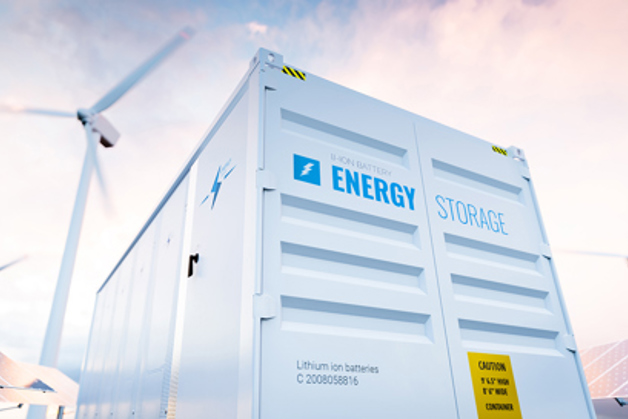
Energy storage systems capture surplus energy generated during periods of low demand or high availability of solar power and wind power - or other renewable energy source - and store it for future use. Energy storage is a key factor in the energy security of distributed networks, as it secures access to energy sources on a timely, sustainable and affordable basis.
Energy can be stored in different forms, including electrical energy in battery energy storage systems or capacitors, mechanical energy in flywheels or pumped hydro storage, lithium-ion batteries, thermal storage, flow battery, or compressed air energy storage.
Stored energy can be put to work when electricity demand often exceeds supply or during peak periods, providing additional power or services to the grid or specific applications.
Smart Grid enabler
Smart grids with integrated energy storage facilitate energy supply time shift to overcome the intermittent nature of many renewable energy sources. The energy storage system can provide backup power in the event of energy scarcity from the supply, for example due to load shedding or unplanned blackout. During power-down, support from energy storage enables consumers to maintain operation for a period.
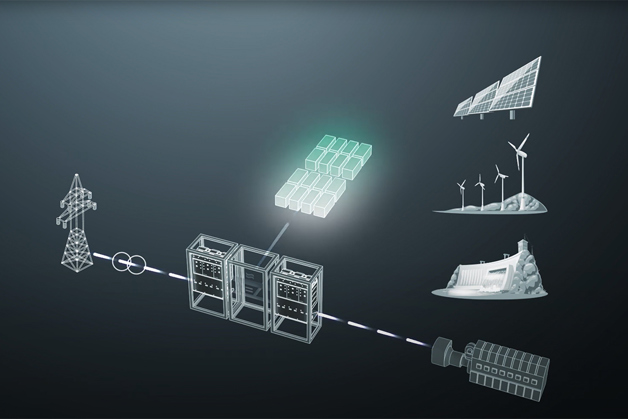
Industrial DC back-up
Use energy storage to stabilize power supply during unexpected irregularities. We can solve the problem at different levels of BTM applications. In this example, Industrial DC backup serves to ensure constant power supply to specific critical applications in a factory.
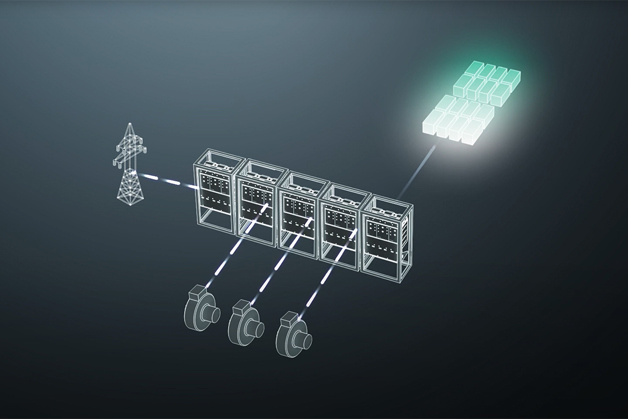
Energy storage battery systems can
- Enhance grid flexibility and resilience, allowing for better management of supply and demand fluctuations, peak shaving, and load shifting
- Improve overall system efficiency by capturing and utilizing excess energy that would otherwise be wasted
- Boost the reliability and stability of electricity supply in the form of back-up power, which reduces the risk of blackouts and improves grid performance
Energy storage therefore provides businesses and utilities with competitive opportunities:
- Minimize or delay capital expenditures (CAPEX)
- Optimize system sizing to avoid excess capacity
- Postpone investments in infrastructure
- Support decentralized energy generation
- Mitigate energy fluctuations, for example in solar and wind power
- Facilitate the integration of renewable energy sources into the grid system
Applications
Smart grids rely on energy storage: Solar and wind power
When integrating energy storage technology and diverse energy sources into the distributed grid, intelligent power conversion solutions from Danfoss improve grid performance and reduce capital investment requirements, thanks to pre-certified compliance with stringent grid codes.
This Norwegian ferry route uses intelligent management of energy and battery storage systems to optimize fast charging and reduce carbon footprint.


Electrification of transport
Decarbonization means we will consume much more electrical energy in future, in all sectors. In total, we need 200-300% more energy to flow through electric energy infrastructure, and the transport sector is a significant contributor to this demand.
Despite our decarbonization ambitions, we must accept that the grid infrastructure we have today is not yet dimensioned for the need of future EV and truck chargers. With increasing demand at peak periods, the stability of vehicle charging is limited by the capacity of the local transformer. To ensure stability, use an energy storage system to support the grid during peak demand. For the grid owner, energy storage is a better choice than the alternative mitigation solution: to increase capacity of the transmission lines.
What are the benefits of mastering grid stability for reliable fast charging?
- Reduce or defer capital expenses (CAPEX). By actively controlling, monitoring, and supporting the grid from local batteries you can achieve the high peak power crucial to fast charging without investing in grid infrastructure. This is done by using local batteries with peak shaving functionality. Peak shaving optimizes the energy flow between the incoming supply and local storage to meet spikes in demand without disrupting the supply grid. Excess energy can be stored when demand and costs are low.
- Reduce operating expenses (OPEX). Draw upon green electricity to charge a battery energy storage system (BESS) supplying the charging system. When this green energy is produced and consumed locally, the OPEX is minimized.
ESS support for DC grids
DC grids offer several benefits over traditional AC grids. They are more efficient and use less copper. Additionally, DC grids are easier to operate, reducing the need for UPS capacity and allowing for the use of different types of batteries. They also minimize the impact of breakdowns, ensuring stable operation of servers and systems with reliable protection. Additionally, DC grids enable fast startup of backup power generators. Energy storage systems (ESS) using power converters from Danfoss enhance your DC grid with these benefits:
- Lower OPEX and CAPEX due to fewer components, and less copper
- Increased energy efficiency
- Regenerative and redundant capabilities
- Ability to utilize excess heat from a liquid-cooled system
The modularity of DC grids shortens installation and commissioning time, provides flexibility for capacity expansion, and saves space. Furthermore, they harmonize the integration of all drives in the DC system, including chillers, fans, and pumps, through centralized AFE supply, resulting in a total harmonic distortion (THDI) of less than 5%.

Short circuit protection using simulation tools
When a large number of power converters are connected to a DC grid, it is necessary to conduct short circuit studies. Danfoss DCGuard facilitates fast disconnection and full selectivity between multiple DC grids, providing semiconductor protection that detects and cuts off faulty DC currents within microseconds. This ensures stability of the DC grid, protects surrounding equipment, and allows uninterrupted operation. The device also enables correct system selectivity, prevents overvoltage spikes at current cut-off, and can connect two different DC grids with voltage differences.
DCGuard allows for simulation of short circuits and selectivity studies, with the ability to place short circuits at different points in the DC grid and study the behavior of converters, bus bars, and fuses. Simulations provide automated reports with information about the short circuit current schematics.

The future of renewable energy: hydrogen and other green fuels
In maritime applications, battery energy storage is ideal for powering propulsion over shorter distances, whereas green fuels (methanol, compressed hydrogen, liquid hydrogen or ammonia-based fuel cells) are suitable for longer voyages. Combining these technologies extends the ship's range. Fuel cells can drive propulsion but cannot store excess energy, which can instead be stored in a battery energy storage system, preventing waste. This integration presents a promising solution for the future of the shipping industry.
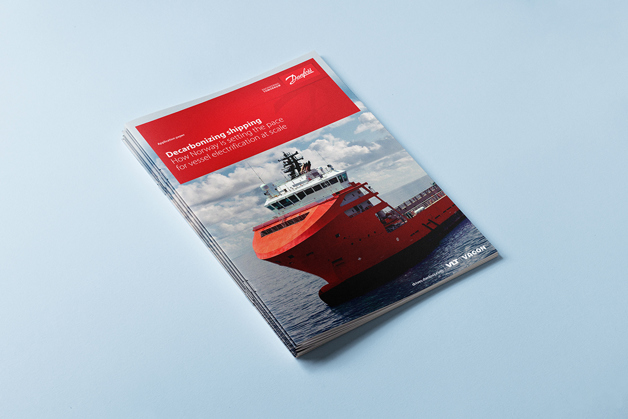
How do energy storage systems benefit the marine industry? To learn more, read the whitepaper.
Read the whitepaper
Energy storage for shore supply
While an energy storage system is important onboard vessels, it is also highly relevant for onshore applications such as shore power.
Shore power, also known as cold-ironing, is the process of providing electrical power from the shore to a ship while docked, thereby allowing a ship’s auxiliary engines to be turned off and the burning of diesel fuel to cease. It has one purpose: to bring power from the national power grid (or a local grid) to berthed vessels, rendering diesel powered generators unnecessary. The evidence in favor of shore power is overwhelming. For example, when a vessel is connected to shore power, overall pollutant emissions can be reduced by up to 98% when utilizing power from the regional electricity grid.
For ports, shore supply is not only about decarbonization, but also about elimination of air pollution (NOx, SOx, particulate matter) and noise while vessels are berthed.
What are the opportunities for using energy storage technologies, including battery energy storage, within shore supply? Find them in the whitepaper: “Decarbonizing the shipping industry”.



Highlighted products
Open up for intelligent power conversion.
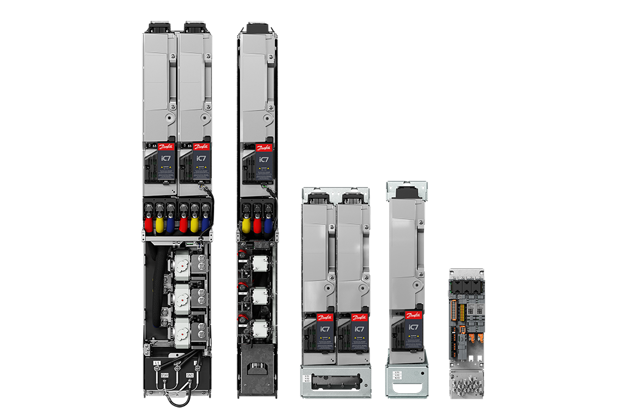
iC7-Hybrid is optimized for all power conversion applications and has an unrivaled power density with new filter technology.
Learn more
Case stories
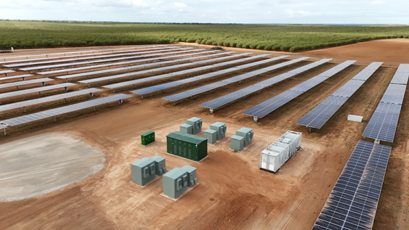
AUSTRALIA: In the semi-arid inland climate of the Riverina Region of New South Wales, where irrigation is essential to farming, the operator of Cadell Orchards faced a significant energy challenge. In its off-grid operation spanning 1,690 hectares, the Sunraysia almond orchard sustains more than 500,000 almond trees.
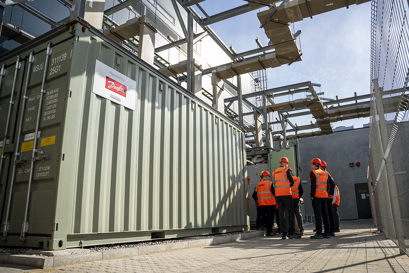
DENMARK: The Everfuel HySynergy facility produces green hydrogen with the help of iC7-Hybrid power converters for efficient, cost-effective electrolysis.

NETHERLANDS: Retaining 80% capacity after 8000 cycles, SmartGrid smart battery containers promise 21 years of daily discharge and recharge without performance concerns.
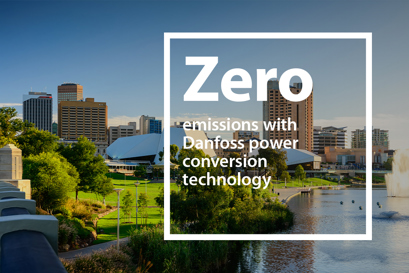
AUSTRALIA: Jeffries Group supports the city of Adelaide by using the biochar byproduct of green waste to generate renewable energy, driven by VACON power conversion. There's enough power to run their entire green waste operation and feed surplus energy back into Adelaide’s power grid — with zero emissions.
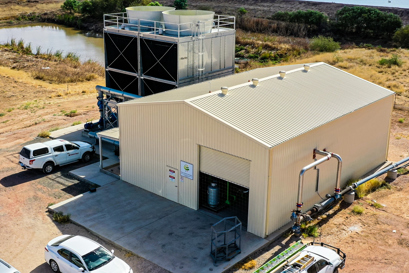
AUSTRALIA: A geothermal power station recovers energy during the bore water cooling process then uses it to generate power for the local community, with the help of VACON® drives.
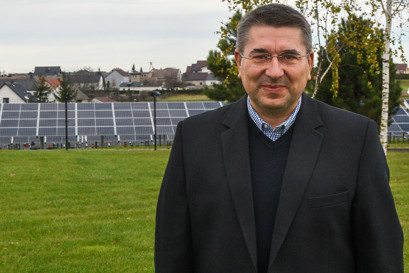
An institute in Kamień Śląski, Poland, is pioneering climate neutral energy consumption. Danfoss helps store electricity from the sun. Savings on electricity bill and CO2 emissions are the main drivers.
News

Fossil Free Future project is running on full steam with different projects, innovation work and co-operation. The BEACON project is a collaborative research initiative aimed at accelerating the electrification of Non-Road Mobile Machinery (NRMM).
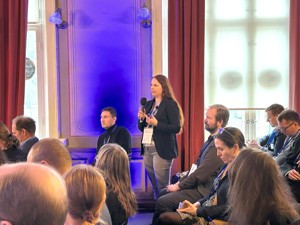
The Ideal4Green project aims to address climate change and the global shift towards sustainable energy systems. It focuses on developing and integrating microgrids to manage the variety of renewable resources and achieving decarbonization targets.
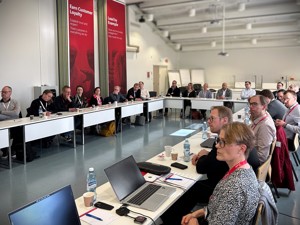
On 9th of April 2024, a remarkable event unfolded at Danfoss Vaasa premises, bringing together the Veturi companies in Vaasa region: Wärtsilä, Mirka and Danfoss under one roof for a collaboration event