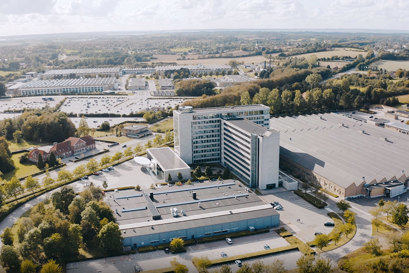
Our journey to engineering a better future began on September 1, 1933, when Mads Clausen founded Danfoss in his parents’ farmhouse in Nordborg, Denmark. Since then, the business has grown from a solo enterprise into one of the world’s leading suppliers of innovative and energy-efficient solutions that increase machine productivity, reduce emissions, lower energy consumption, and enable electrification.
Explore the digital story
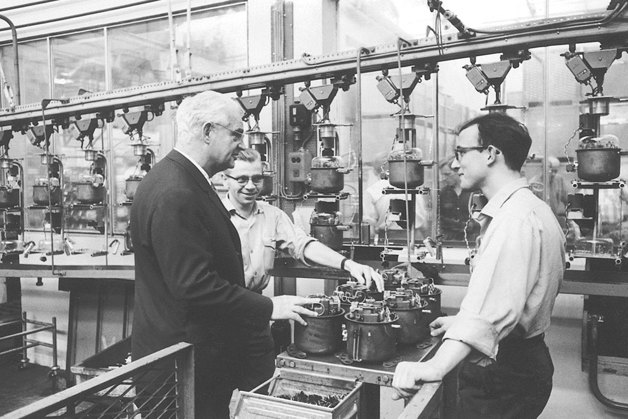
Mads Clausen
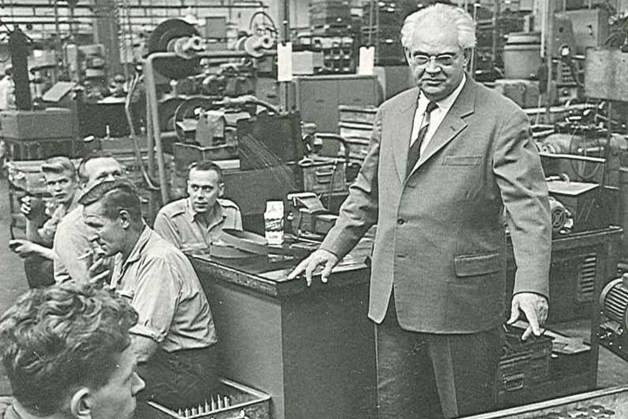
From a single valve and an unquenchable desire to succeed, Danfoss founder, Mads Clausen, created a global business that still sets the standard for innovation today.
Born into a farming family in 1905 on the island of Als in Denmark, Mads Clausen ran the company for its first 30 years from his childhood bedroom. Danfoss' headquarters are still located right next door to the family farm which now houses the Danfoss Museum.
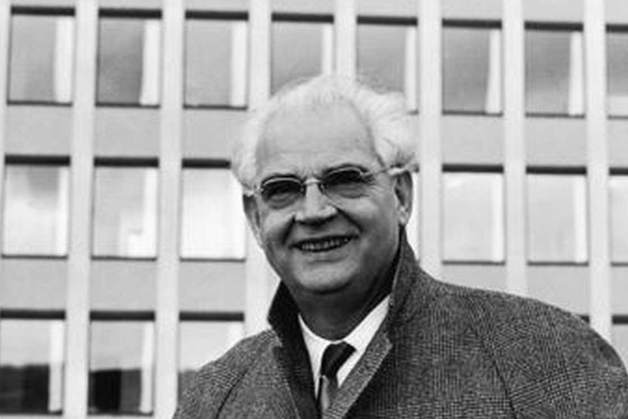
If others can do it, so can we - if others can't , we still have a chance.
Our name, our legacy
The Danfoss name combines "Dan" for Denmark and "foss," the Scandinavian word for river. Our founder Mads Clausen chose this word in 1946 because the pressure in his expansion valves reminded him of a "fossing" — or flowing — river. Since then, our logo has only been through small refinements.
Our legacy remains the same, but our look evolves to match our transformation.
Watch the video to learn more about our name and logo.
Explore our timeline and key highlights from different decades
1930s
One person's passion sparks global innovation
Milestones: Mads Clausen sets up his own company, "Dansk Køleautomatik og Apparatfabrik" in 1933.
Key innovations: First thermostatic expansion valves - water valves, thermostats, pressure switches, filter driers, and more.
Global Presence: First partnership established with distributor Itho-Schiedam in the Netherlands.
The team: 26 people employed by 1939.
1940s
Building a business and an international presence
Milestones: Exports exceed 30% in 1941 and the company is renamed Danfoss in 1946.
Key innovations: Radiator thermostat prototyped as one of the first in the world. Controls and nozzles for oil burners introduced.
Global presence: In 1949, the first sales company set up in Argentina.
The team: By Danfoss' 10th anniversary, Danfoss employs 179 people.
1950s
Optimizing production and forging a global network
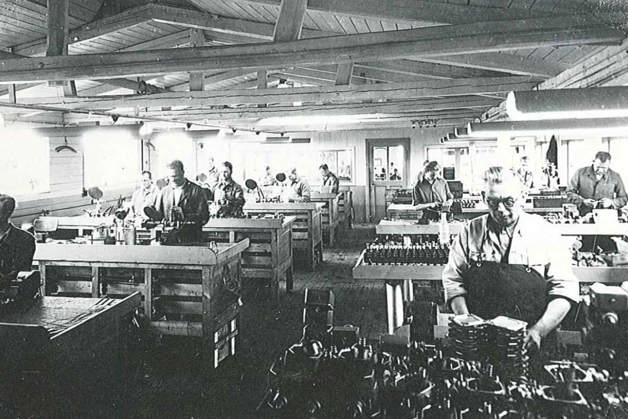
Milestones: In its first year of production, Danfoss sells 5,000 Danfoss compressors - 10% of company sales turnover alone.
Key innovations: Thermostatic radiator valves go into series production. An early digital milestone is reached when Danfoss gets its own punch-card department.
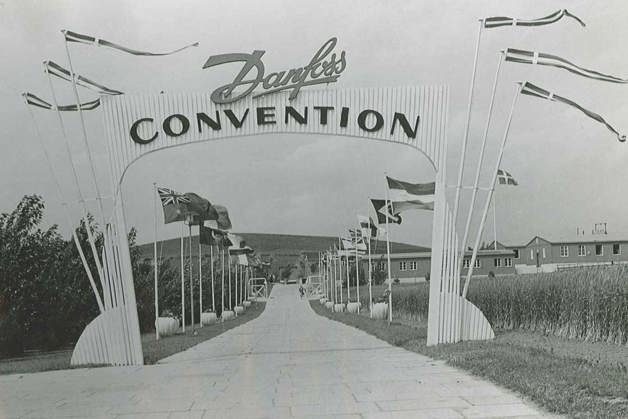
Global Presence: Agents from 21 countries meet for the `Danfoss Convention 1950´ in Nordborg.
The team: 3,000 employees celebrate Danfoss' 25th anniversary in 1958.
1960s
The death of the founder heralds the birth of a legacy
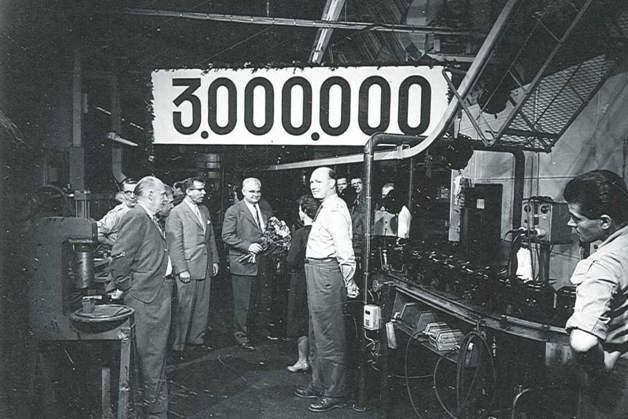
Milestones: Mads Clausen dies in 1966, but his legacy lives on with 305 patent applications being filed between 1965 and 69. In 1961, Danfoss purchased the first EDP system and in 1969 installed the biggest computer in Danish industry. The 3,000,000th Compressor leaves the factory, and manufacturing of hydraulic components begins (licenses from Char-Lynn). Danfoss moved into its newly constructed headquarters in 1962. Until then, Mads Clausen had run a company with over 5,000 employees from his childhood room in an old farmhouse. Mass production of frequency converters began in 1968 with the VLT® 5.
The team: Mads Clausen’s widow, Bitten, becomes chair of the board and the first chairwoman in Denmark.
1970s
Energy efficiency in focus
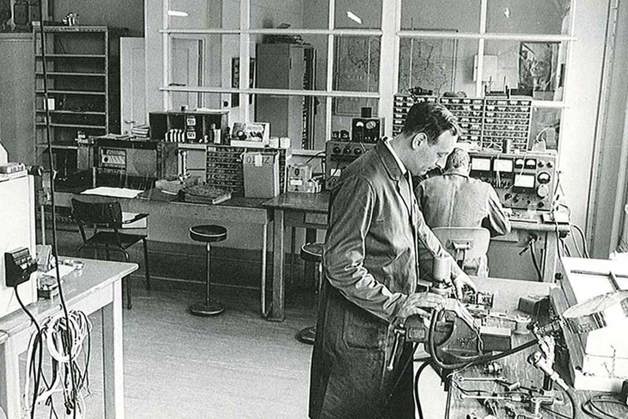
Milestones: A test field for hydraulics is established in Nordborg, and the company’s first electron-scanning microscope is put to use. The hydraulic motor ORT wins the 'IF 75' Design Award.
Key innovations: Oil pre-heaters are launched, and in 1974, VLT® frequency converters control the transfer lines at Audi. SONOFLO® ultrasonic flowmeters are introduced.
The team: By 1977, there were over 11,000 employees: 7,800 in Denmark and 3,400 around the world.
1980s
Leading the way in the computer age
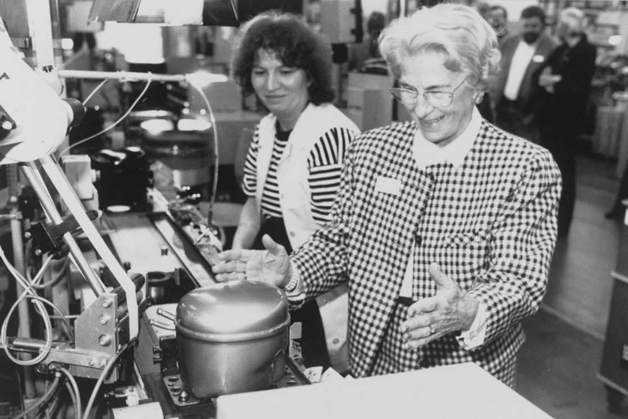
Milestones: Computer-aided design (CAD) was put into use in 1982, and in 1986 electronics represented 10% of sales. A wastewater neutralization plant in Nordborg opens in 1985; later, Danfoss wins the `Excellent Environment Administration´ award. In 1989, Danfoss produced 100 million compressors.
Key innovations: The ECT weather compensation control panel and ADAP-KOOL® control system are introduced.
The team: In 1986, Danfoss had 13,285 employees, including 9,275 in Denmark.
1990s
Setting a course for sustainability
Milestones: Danish factories achieve ISO 9001 quality certification and Danfoss signs ICC’s international declaration of sustainable development. More than 1,000 PCs were installed in 1990. Danfoss acquired Maneurop Compressors in 1993. Factories were established in Russia (1993) and China (1996). In 1995, the Danish Environment Minister awarded Danfoss with the EU Environmental prize, in the ‘Green Products’ category. In 1997, ‘The Green Diploma’ is given to the Transmission Division in Gråsten, Denmark, which is certified according to the British standard BS 7750.
Key innovations: Nessie® Water Hydraulics, called `The Innovation of the Century'. EVITA® Oxygen Meters are launched.
The team: In 1996, Jørgen Mads Clausen, Mads Clausen’s son, became the President of Danfoss. By 1999, Danfoss employed almost 19,000 people.

2000s
Expanding the Danfoss family
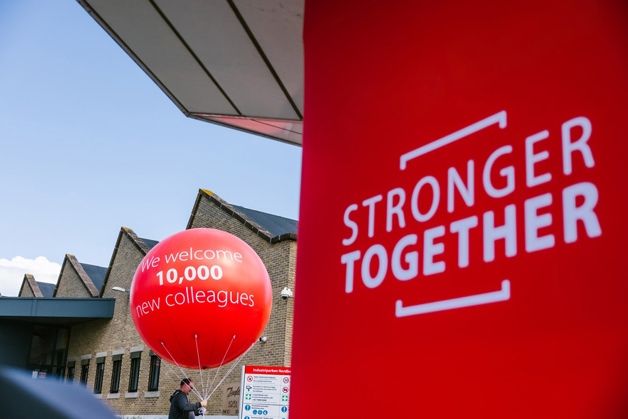
Milestones: Danfoss Fluid Power A/S merges with Sauer Inc. to become Sauer-Danfoss Inc. Production starts in India and Brazil. Danfoss joins the UN Global Compact. Danfoss acquires several heating technology companies, including DEVI, Thermia and LPM. A survey puts Danfoss among the world’s most ethical companies.
Danfoss inaugurates more than 100.000 m2 facilities across China, Russia, France, Poland and Romania.
The team: By 2008, Danfoss had almost 32,000 employees and net sales of 2,979m EUR.
2010s
Engineering tomorrow, today
Milestones: Danfoss and Sauer-Danfoss come out of the global financial crisis stronger than ever. AURELIUS AG buys Danfoss Household Compressors. In 2013, Danfoss Turbocor® Compressors and Sauer-Danfoss became 100% owned by Danfoss.
This is truly a decade where Danfoss invests to get ahead. Danfoss acquires 18 companies to further strengthen the core business (Vacon®, Sondex® and Artemis Intelligent Power Ltd) build leading positions within digitalization (Leanheat, Kavlico, and IKUSI Velatia) and electrification (Visedo, UQM Technologies, and Axco Motors).
Key innovations: In 2012, Danfoss was the first to integrate variable speed technology in commercial air-conditioning. Danfoss Link™ smart heating is introduced. In 2014 alone, 213 new patents were granted. In 2019, Danfoss established an IoT collaboration with Microsoft to bring domain expertise in Refrigeration and HVAC to the cloud.
The team: Sales turnover doubles from 2006-2016, with a 22% increase in employees.
2020s
Danfoss has never been more relevant
Milestones: Danfoss launches the next strategic phase Core & Clear 2025 to continue its green growth transformation. On September 1st, 2023, Danfoss celebrated its 90-year anniversary as a company that is stronger than ever and ready for the future.
In February 2020, Danfoss set an ambitious target to become carbon-neutral in all the company’s global operations by 2030 based on science-based targets. In 2022, Danfoss' largest production facility in Nordborg, Denmark, became carbon neutral.
Danfoss continues to expand it’s portfolio with impactful acquisitions (Eaton Hydraulics, Palladio, BOCK, Hydro Holding Spa, SEMIKRON and Danfoss joins forces).
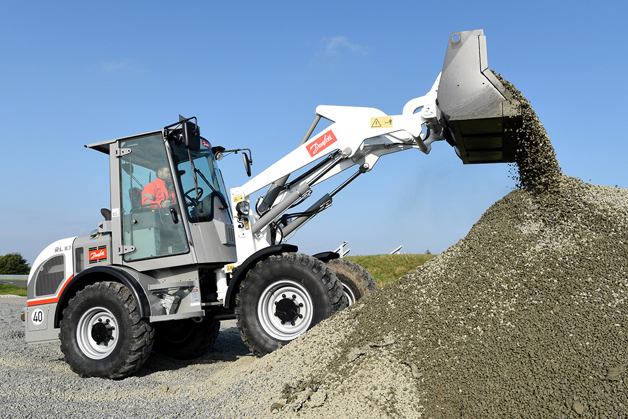
Key innovations: With bold investments, Danfoss continues to improve its offering of best-in-class technology and solutions to drive the green transition through energy efficiency, machine productivity, lower emissions, and electrification.
In 2025, the new strategy, LEAP 2030, was launched. This marked the next era of growth and value creation, following the implementation of the new operating model.
The team: 39,000 highly engaged employees.
Learn more about Danfoss