
District heating transfer stations provide the interface between district heating suppliers and customers’ systems. They incorporate the necessary equipment to tailor the supplied heat to the needs of the object premises as specified in the heating supply contract. In this they need to comply with all applicable standards and with the supplier’s technical connection conditions.
Our District heating substations are suitable for almost any domestic hot water and heating or cooling systems and provide a very high degree of comfort and operational performance. The systems are customizable to suit your specific requirements. And the fact that a wide range of recommended components are used gives you several advantages.
Selecting the right district heating substation makes commercial sense
No matter what kind of district heating or cooling substation you need, Danfoss will find a match in our comprehensive range of substations and heat transfer solutions.
Each building has its specific heat demands, every district heating company has its technical connection requirements, and each resident have individual heating habits. These criteria influence on the selection of substations for heat distribution in buildings and villages as well as in small and large district heating networks.
The size of a substation is determined by the heat demand of the apartment or the building which needs to be heated. Temperature and pressure of the primary power supply determine whether a substation is operated directly or indirectly.
In addition, many district heating networks specify special technical connection conditions, which require special control components. And finally, the number and type of heating circuits as well as the form and function of the domestic hot water will influence the needed equipment.
Danfoss offers a complete program of district heating stations and flat stations for ranges starting from 15 kW up to more than 4 MW, for direct or indirect operating mode with one or more heating circuits and primary or secondary side domestic hot water heating as flow, storage tank or anti-legionella system.
The substations can either be pre-defined or pre-ordered custom build solutions. Danfoss has a significant project track record in handling large and small heating and district heating projects, so contact us, and our highly qualified and experienced team will help you to find and dimension the right substations for your requirements.
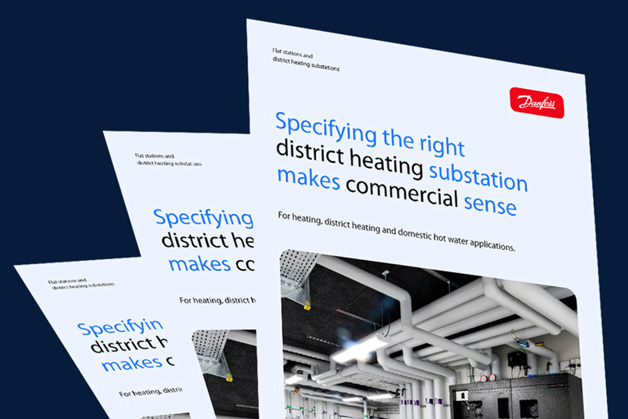
The right district heating substation makes all the difference in efficiency, comfort, and reliability. Discover how choosing the right solution can reduce costs and optimize performance.
Download now
Features and benefits
-
Comprehensive range of substations from a single supplier
-
Integrated components ensure safe operation, increases durability and minimize whole life costs
-
Benefit from optimized heat transfer and system control performance

Usually, the substations for this type of buildings have indirect heating circuit, dividing the building installation from public network, but in some cases direct or direct with mixing loop heating could be applicable.
Domestic Hot Water can be produced instantaneously or in a water cylinder connected primary or secondary in the substations.

There are two kind of installations in this type of buildings: decentralized with flat stations or centralized. In both cases a common substation, dividing the building installation from public network is required.
Domestic Hot Water can be produced instantaneously in both variants of installation or by using storage/charging water systems.

The substations for Commercial buildings require indirect heating circuit, Domestic Hot Water circuit based on instantaneous principle of hot water preparation or centralized storage/changing hot water systems. Very often cooling circuit is also applicable.
Product range

Substations for indirect heating have a heat exchanger separating the primary flow from the secondary flow. Indirect substations are recommended where separation between the network and individual circuits is needed. Separation is recommended for pressure and/or temperature reducing as well as creating individual circuits where safety and/or quality of heating medium in one side is a concern.

Indirect substations with primary connections for water cylinder are recommended where separation between the network and individual circuits is needed, and water cylinder for Domestic hot water preparation needs to be connected directly to the network.

Indirect substations with secondary connections for water cylinder are recommended where separation between the network and individual circuits is needed, and water cylinder for Domestic hot water preparation needs to be connected after separation from the network. Separation is recommended for pressure and/or temperature reducing as well as creating individual circuits where safety and/or quality of heating medium in one side is a concern.

Indirectly connected substations for heating and instantaneous DHW Heat from the district heating network is transferred to the building installation by the district heating substation. The substation supplies heating and domestic hot water to the building’s residents.
This type of substations have a heat exchanger separating the primary flow from the secondary flow for indirect heating, and a heat exchanger for preparation of domestic hot water instantaneously and only as it is needed.

Substations have a heat exchanger separating the primary flow from the secondary flow for indirect heating, and a heat exchanger for a storage charging cylinder featuring high performance and simple operation. The heating circuit and the storage charging cylinder temperature is controlled by electronic temperature controller Danfoss ECL 310.

Direct heating substations are applicable for systems where pressure and temperatures are relatively low, and separation between network and building installation is not necessary. Domestic hot water preparation is based on instantaneous principle and only as it is needed.

Direct heating substations with mixing loop are applicable for systems where the heating temperature is controlled by a mixing shunt, and separation between network and building installation is not necessary. Domestic hot water preparation is based on instantaneous principle and only as it is needed.
Tools and apps

Danfoss Heat Selector
The Danfoss Heat Selector is a best-in-class online selection tool that optimizes planning process for heating application experts.
Learn more about Heat Selector
FAQ
General information
What will I find inside the substation's instruction and guide?
- technical data for station (BOM, Flow Chart, main data, HEX calculation e.g.)
- safety notes
- commissioning notes
- service requirements
- information’s about transport, hauling e.g.
certificates - contact persons
Where can I find the substation's warranty? What are the conditions of payment?
In the sales contract (see order confirmation) and/or official price list.
What does it mean that the substation has a CE mark?
It means that substation fulfils all requirement for goods sold on the European market according to related EU rules and directives e.g.
Do you have a price list?
Yes - please contact your local Danfoss sales office to get a copy.
Whom should I call to get an order confirmation?
Please call our order handling department in your country or the local sales responsible or department.
Which certificates are available for Danfoss substations?
Declaration of conformity according PED/MD-guideline.
Can Danfoss substations be delivered with other kinds of accessories like boilers, T&S-HEX etc.?
Depending on the request, we can offer some common limited standard product range. Please contact your local sales office to learn more.
Does Danfoss offer any selection software for substations?
Yes, we have Heat Selector available for customers.
Please contact your local Danfoss sales office, if you need assistance with dimensioning your next substation.
Technical information
Up to what capacity can Danfoss offer substations?
Around 10 MW appended from temperature program; max. dimension is DN 400.
What are the dimensions of Danfoss substations?
Please see the available data sheets for substation types DSA, DSP and all DHW products. Or contact your local Danfoss sales office regarding substation types DSE, DSS and DSM to ask for estimation. In case of running order, you will get drawings on request.
What types of District Heating & Cooling substations can Danfoss offer?
Danfoss offers a complete range of DHC substations. Danfoss substations are available in 5 basic platforms, that may be adapted to suit customer needs and requirements:
- Danfoss DSA - the advanced compact substation
- Danfoss DSP substation - the compact, pre-engineered and prefabricated heat transfer unit
- Danfoss DSE substations - tailored to suit the most common customer needs and requirements, configuration based on Danfoss recommendations
- Danfoss DSS substations - tailored to suit the most common customer needs and requirements, configuration based on Danfoss recommendations; primary media is saturated steam
- Danfoss DSM substations - direct tailored to suit the most common customer needs and requirements, configuration based on Danfoss recommendations
What kind of medium can be used with Danfoss substations?
Circulation water, drinking water, Ethylene-glycol mix and saturated steam.
Can I plan the preparation of the technical room before delivery of the substation?
Yes, in case you have ordered one of our a standard substations with fixed dimensions (see data sheet for DSA, DSP and all DHW products).
For substation types DSE, DSS and DSM, please contact the local Danfoss sales office to receive more information.
Which kind of structure are Danfoss substations offered in: cage, frame, standing, wall mounted, etc.?
It depends on capacity and size/weight. Wall-hanging substations are limited by dimensions and size. We recommend to study the DSA substation types to learn more about our standard solutions.
Is it possible to equip the substation with the automation from another manufacturer?
Yes, it is possible, but not the recommended solution.
What kind of insulation can Danfoss offer?
E.g. pipe insulation with PU-soft foam, DH boxes from PU-hard foam.
For standard DSA stations there will be insulation cover available in EPP.
What kind of pumps are used in the substation (manufacturer)?
Common products are from GRUNDFOS, WILO & KOLMEKS. Other suppliers are possible in special cases. For more information, please contact the local Danfoss sales office.
How to select the passing accessories?
Please see the data sheet or contact the local Danfoss sales office.

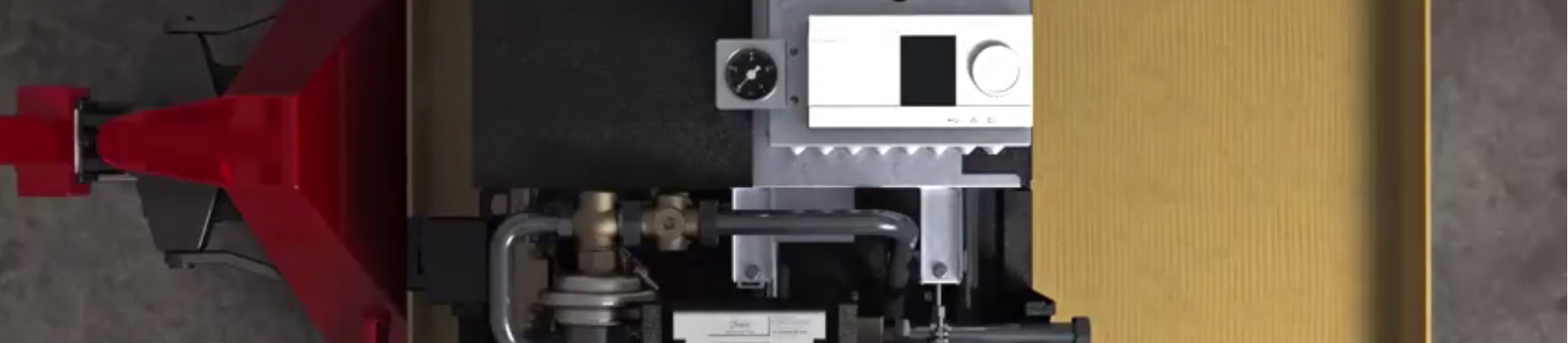
Smaller, lighter, more efficient: Danfoss' compact substation DSA1 Mini
Learn how the substation is installed, as well as tips and tricks for commissioning and maintenance.
Case stories
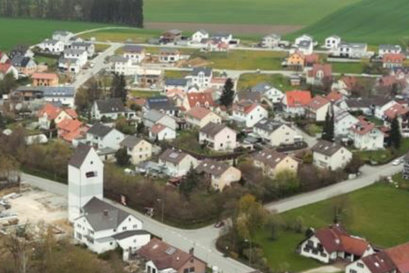
In the Wittelsbacher Land near Augsburg the local network in Eurasburg supplies heat to 80 buildings using a wood chip heating system. Danfoss’ substations ensure efficient heating in all building types, and its modern SCADA solution enables remote system monitoring and management.

In Europe, 30 percent of all energy consumption goes to heat or cool buildings. Danfoss has the solution to lower energy usage and improve indoor climate by adding a digital element: Leanheat software.

Viborg District Heating Utility supplies district heating to over 10,000 households and businesses in the cities of Viborg and Hald Ege in Denmark. The utility company has set a goal of being CO2 neutral by 2030 and is constantly looking for ways to improve the energy efficiency of its heating network and reduce heating costs for its end-users.
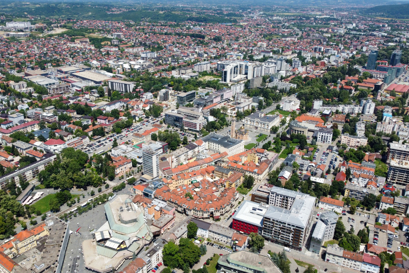
Banja Luka is the second largest city in Bosnia Herzegovina. The city’s district heating utility, Banja Luka Eko Toplane, is constantly looking for ways to make heat production, distribution, and consumption more energy efficient while improving comfort for its 20,000 end users. In 2017, as part of its decarbonization goals, the city of Banja Luka and Eko Toplane introduced a new renewable heat source for the district heating system, wood biomass, and set the stage for an ambitious renovation project.
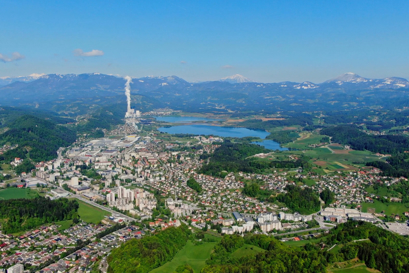
The Saleska Valley district heating network is the second largest network in Slovenia, dating back to 1959. Since then, the demands have changed significantly and have challenged the hydronic balancing of the system which was optimized with new intelligent controllers Virtus.
We can help utilities to optimize their supply of district heating to cities with a positive impact on decarbonization and reduced energy consumption. It's time to unlock the grid's full potential for ultimate cost-effectiveness, energy-efficiency and a resilient path to a greener future.
Read more