What is it?
The Energy Performance of Buildings Directive (EPBD) is a key legislative framework to enhance the energy efciency in buildings. It was originally introduced in 2010 and amended in 2018. The latest revision entered into force in 2024.
Why do we need it?
Requirements
What are the requirements?
The ultimate goal is to decarbonize all building stock by 2050. That’s an ambitious target, so the EPBD contains a wide range of incremental measures that will help member states move towards full decarbonization. Here are some highlights:
- Decarbonizing buildings through Minimum Energy Performance Standards and National Building Renovation Plans. This includes targets to renovate 16% of the worst-performing buildings and reduce average primary energy use in residential buildings by 2030.
- Decarbonizing heat sources and phasing out fossil fuels, including a phase-out of fossil fuel boilers by 2040.
- Improving technical building systems, including implementing building automation and control systems, mandatory hydronic balancing when heat sources are replaced and equipping buildings with self-regulating devices for adjusting room temperature.
What do the requirements mean for my building?
Modernization of technical building system (TBS) is one of the three key pillars of energy efficiency (other two being envelope (demand) and energy source efficiency). Part of TBS are Building Automation Control Systems (BACs), which will play a critical role in complying with EPBD’s requirements. For example, Article 13 in the revised EPBD from 2024 states that buildings need to have a demand-driven HVAC system. The BAC plays a critical role in this regard, as it enables a building to react to changes in heating and cooling demands. The EN15232 / ISO 52120 standard also provides insight into what functionalities a building’s BAC needs to include to improve the building’s energy classification. And the 2022 version of the ISO standard was updated to include hydronic balancing functionality, another key enabler for an efficient BAC.
Benefits
By optimizing our technical building systems, we could save EUR 67 billion on energy bills a year in 2030 and reduce emissions by 156 Mt. . That’s equal to 82 million cars! Then, there’s job creation. The construction industry in Europe accounts directly for 18 million jobs and generates about 9% of the continent’s GDP.
And the benefits go beyond the monetary. The EPBD also focuses on improving air quality and indoor climate. And since we spend most of our time indoors (some estimates place the figure at around 90%!), improving a building’s indoor climate will have a significant impact on the health and well-being of its occupants. As an example, the World Health Organization estimates that each euro spent on building renovation brings a €0.42 decrease in public health costs. And the energy savings has the potential to free countless households from the burden of energy poverty.
Where do I start?
Renovating your building can seem like an expensive and overwhelming task; but it doesn’t have to be. Small changes can have a big impact, and the technology is already widely available – with a payback time of under five years for many solutions.
Here are our three steps to a successful EPBD implementation:

For non-residential buildings, implement dynamic balancing to ensure that the just right amount of water is available in every terminal unit at any given time – no more, no less than required. Find out how our pressure independent control valves (PICVs) and actuators make this possible.

Help people and businesses to control indoor temperature and comfort in homes and offices. This step is easier than you think. See how our market-leading range of Radiator Valves and Thermostats can help.

Use smart energy monitoring and automated control systems to match actual needs with expected energy performance. Our range of AB-QMs (PICVs) with digital actuators can indicate energy levels directly at the terminal unit and, by adding energy meters on the branch, you can measure, collect and analyze energy consumption, as well as ensure accurate billing.
Contact us
Partner with Danfoss: Your comprehensive retrofit solutions expert for commercial buildings
Our innovative retrofit solutions are designed to minimize energy consumption and carbon footprints in commercial buildings. By upgrading existing systems, we ensure optimized performance, reduced energy costs, and enhanced environmental compliance.
Contact our experts to discover how our retrofit solutions can help you transform commercial buildings.
Expert papers

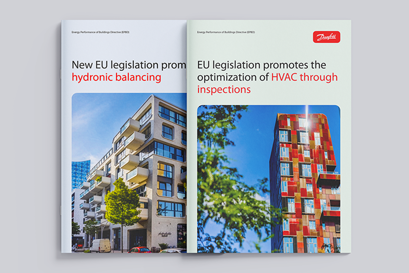
The EU's revised Energy Performance of Buildings Directive (EPBD) mandates hydronic balancing in new and renovated buildings to improve energy efficiency and comfort. This means new heating/cooling systems must be balanced from the start, and existing systems must be balanced when the heat or cooling generator is replaced. The legislation also requires buildings over a certain size to have Building Automation and Control Systems (BACS) to optimize performance, which is increasingly relevant for dynamic hydronic balancing solutions.

Heating and cooling account for 30-50% of energy consumption in the EU, primarily from fossil fuels. “Active control of energy usage”, provided through building automation and control solutions, is an essential pillar for efficient buildings. Our expertise in the EN ISO 52120 Standard, a key part of the Energy Performance of Buildings Directive, empowers to make a real impact on heating and cooling controls.
Efficiency upgrades in buildings are more crucial than ever. This expert paper explores cost-effective strategies using Building Automation and Control Systems (HVAC BACS) to enhance building performance, reduce costs, and meet new sustainability targets.