
As a society we are throwing away energy we have already paid for. Waste heat is one of the world’s biggest untapped energy sources, and reusing it is one of the fastest ways to strengthen Europe’s competitiveness, energy security and resilience. We cannot afford to keep letting it go to waste.

Waste heat reuse could cover more than 30% of Germany’s district heating demand
In Germany alone, the new Danfoss analysis of the German district heating networks shows that more than 30% of its district heating demand can be feasibly covered by existing industrial waste heat emitters. Critically, the analysis excludes combined heat and power plants and does not yet include data centers. Germany has more than 3,000 data centers, the highest number in Europe, and their inclusion would push the coverage figure considerably higher.
The data center opportunity
Data centers have huge potential to become reliable contributors of waste heat to energy systems. Typically operating continuously, data centers can serve as a constant source of waste heat.
Recovered heat from data centers or industrial production can power district heating networks or serve nearby facilities through microgrids and industrial clusters. When companies operate close together, they can rely on each other as both producers and consumers of waste heat, creating efficient, localized energy loops. Data centers often have the shortest payback periods due to their consistent availability of waste heat.
On-site reuse offers the fastest route to lower energy costs and emissions
By capturing waste heat from one process within a facility to heat water, space, and other industrial processes in that same facility, companies can save significantly on energy bills while reducing emissions.
One aluminum manufacturer in Denmark has eliminated all on-site gas usage through waste heat reuse, which is projected to cut 205,600 m3 of gas usage per year, equal to the annual heating and hot water gas use of 132 Danish homes.[1]
Leveraging waste heat requires action
The Danfoss report details that progressing on waste heat reuse requires several key actors to take action — namely industry, energy system operators, and governments.
Kristian Strand added: “The technology is here. The opportunity is here. Now we need the energy system to catch up. Industry must make heat recovery standard practice, energy operators must make connections easier, and governments must remove the barriers that make electricity more expensive than gas for these investments. Get those pieces in place and waste heat stops being waste. It becomes a source of cheaper energy, greater resilience and stronger competitiveness.
Key highlights:
- Two-thirds of global energy was wasted as heat in 2024 - and up to 55% is still expected to be wasted by 2030
- Reusing the waste heat produced globally in 2023 (3,100 TWh) could provide annual savings of EUR 140 billion
- Europe’s waste heat alone could power Paris for 48 years
- Germany could meet more than 30% of district heating demand with existing industrial waste heat, offering a blueprint for other industrial nations
- Capturing and reusing waste heat has the potential to replace natural gas as Europe’s primary heat source
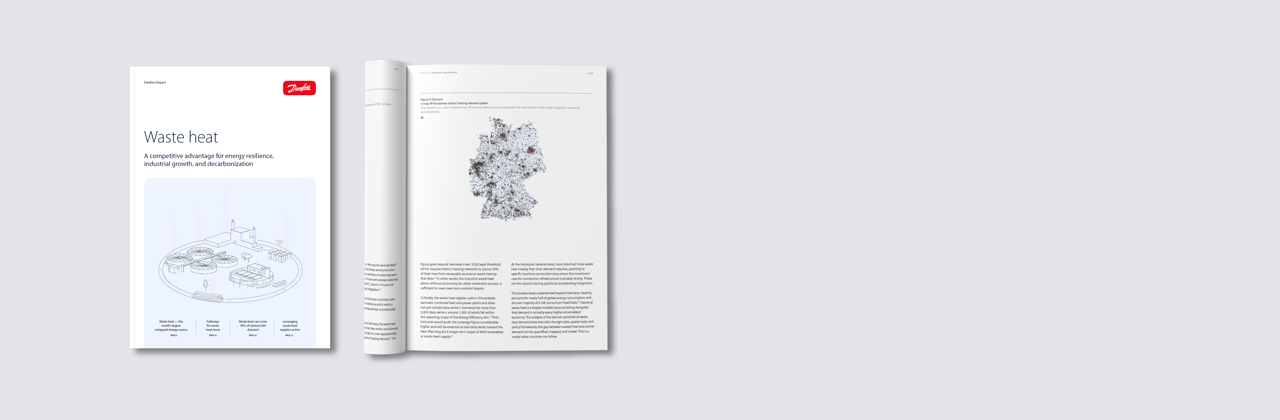
Waste heat: A competitive advantage for energy resilience, industrial growth, and decarbonization
Danfoss Impact
Download now