
For the Canadian Armed Forces (CAF), the Army’s Reverse Osmosis Water Purification Units (ROWPUs) are a core deployable capability, producing potable water for personnel use and, in some cases where infrastructure is unavailable, disaster-affected populations. These containerized systems are used across the Army and must perform reliably in remote, variable, and resource-constrained environments.
In this context, reliability, long service intervals, and ease of maintenance are not preferences, they are operational requirements.
BluMetric worked with the CAF to develop a new generation of ROWPU systems designed to address the limitations of earlier units. The objective was to reduce maintenance demands, extend service intervals, and ensure predictable operation in deployments where downtime and logistical complexity carry immediate consequences.
The challenge: Maintenance-intensive systems and unsustainable service cycles
The CAF’s legacy ROWPU systems, introduced in the mid-1990s, required frequent intervention driven in large part by the service intervals of the high-pressure pumps.
“The legacy positive displacement pumps needed rebuild kits at least every 1,500 hours, and in some cases as frequently as 500 hours,” says Bart Greer, equipment deployment expert at BluMetric.
Across more than 20 systems, this translated into a continuous cycle of maintenance. Frequent rebuilds increased demand for spare parts, required additional units be held in rotation, and added logistical complexity around transport, storage, and scheduling. Maintaining systems while they were in operation meant coordinating maintenance windows, parts availability, and personnel, often in environments where none of these could be guaranteed.
These challenges were amplified by the deployment context. ROWPUs are often operated in harsh environments with limited access to tools, parts, and specialist expertise. Maintenance is typically conducted by personnel who are not pump specialists, making simplicity and robustness critical.
“The Canadian Armed Forces said, ‘This is not sustainable,’” Greer explains.
BluMetric’s task was to redesign the system to reduce intervention frequency and simplify maintenance without compromising performance.
The solution: System-level redesign with Danfoss APP pumps
BluMetric addressed the challenge through a full system review and redesign, incorporating obsolescence management to ensure long-term maintainability and component availability. The ROWPU was engineered as an integrated, containerized unit, with components selected and configured to reduce intervention points, simplify field service, and ensure reliable operation over extended periods.
A key element of this approach was the adoption of Danfoss APP high-pressure pumps. The new ROWPU uses three Danfoss APP 5.1 pumps operating in parallel, delivering the required high pressure while providing built-in redundancy. This configuration allows continued operation without interrupting water production if a pump is taken offline.
The shift in service intervals was substantial.
“The first inspection is now at 8,000 hours,” says Greer. “Compared to the first-generation pumps, this difference was not just a multiple, it was orders of magnitude. We are now seeing rebuild intervals up to around 25,000 hours.”
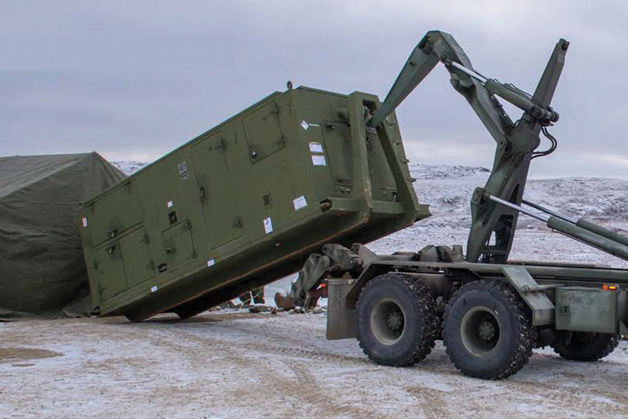
Each unit is in a customized 20-foot container and includes all major subsystems, including feed pumps, pre-filtration, high-pressure pumps, membranes, post-treatment, as well as the tools and consumables required for operation. The systems are designed not only for transportability, but for self-contained, predictable operation in the field.
A small team can deploy a unit and begin producing potable water within hours, supplying approximately 210 m³/day, enough to support 1,000 to 1,500 people. The units are built to operate reliably across a wide range of demanding environments, from arctic to tropical deployments.
The results: Reduced maintenance burden and improved operational continuity
BluMetric’s redesigned ROWPUs have significantly reduced maintenance frequency while improving overall system availability.
Extending service intervals from hundreds of hours to thousands has reduced the number of rebuilds, eased the logistical burden of spare parts and servicing, and enabled longer uninterrupted operation in the field.
“That’s not incremental,” explains Greer. “For the CAF, it fundamentally changes how the systems are managed.”
Fewer interventions mean less need to plan operations around maintenance windows and lower risk of disruption to water supply. Improvements in pre-filtration and overall system integration have also contributed to longer membrane life, with replacement intervals typically reaching five to seven years.
In practice, the systems deliver more stable performance with fewer disruptions and simpler maintenance when required, better aligning system behavior with the realities of deployed use.
More broadly, this shift reflects a change in how military water systems can be imagined and delivered. BluMetric’s approach treats water not as a support function, but as a dependable operational capability, engineered for continuity, resilience, and minimal intervention. This is the foundation of what the Canadian company defines as mission-critical water.
