
By building on their expertise in heat recovery and CO₂ hot gas systems, Dijksma Koudetechniek applied the Danfoss ICF Flexline™ valve station with the ICFD module in a new way - extending its use beyond traditional defrost into a combined heating and cooling application for flower bulb processing. The concept eliminates gas boilers, maintains compressor capacity during heating, and operates reliably at up to 50 °C with minimal flash gas, all within a fully mechanical setup providing precise climate control.
Read the full case story
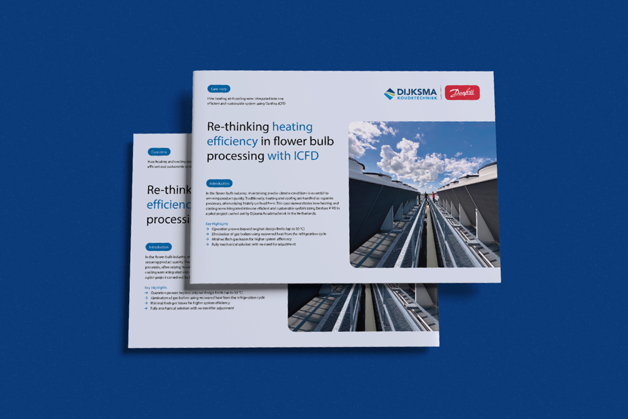
The challenge: Fossil-free heat recovery without compromising cooling
The facility needed fossil-free heat without disrupting cooling. Bulb drying demands tight control of temperature, humidity, air circulation, and ethylene, yet traditional plants separate heating and cooling and often rely on gas boilers. Dijksma aimed to integrate both, using recovered heat from the refrigeration cycle. The team had one key uncertainty: Would the floats function properly at higher condensation temperatures above 20 °C?
It was a pilot project because we did not know whether the floats would function properly at higher condensation temperatures.
The solution: Float-based ICFD that preserves compressor capacity
Based on experience with pressure-controlled concepts that reduce available compressor capacity during defrost, Dijksma selected a float-based ICFD approach to maintain capacity in a heating application that requires significantly higher throughput. Hot gas from the refrigeration cycle is injected into evaporators and condensed at 40 to 50 °C, providing usable heat while cooling continues. Originally developed for hot gas defrost, the ICFD ensures that only fully condensed liquid returns to the separator. This minimizes flash gas formation, improves energy efficiency, and reduces the load on ECO separator floats during heating. The system runs mechanically with no control adjustments and enables simultaneous heating and cooling.
The outcome: Integrated heating and cooling, gas boilers removed and higher efficiency
The system proved reliable at condensation temperatures up to 50 °C, enabling the elimination of gas boilers by using recovered heat from the refrigeration cycle. Minimal flash gas losses increased overall efficiency and reduced the load on ECO separator floats, improving condensate handling during heating. Crucially, the float-based ICFD approach preserved compressor capacity in a high-demand heating application, and the successful pilot was scaled with additional cells using the same concept.
Using the ICFD for this application creates a lot of possibilities for the future. The robustness of the ICFD, the extended operating envelope and the professional collaboration with Danfoss really give us new opportunities in this field.
Why choose ICFD for heat recovery
-
No system adjustments required, a fully mechanical and consistent operation
-
High efficiency with minimal flash gas
-
Reduced load on separator floats ensures better condensate handling during heating
-
Maintains compressor capacity during heating
-
Proven in operation up to 50 °C
FAQ
How does heat recovery integrate heating and cooling in this case?
Hot gas from the refrigeration cycle is injected into evaporators and condensed at 40 to 50 °C, providing heat while cooling continues. The ICFD ensures only fully condensed liquid returns to the separator, minimizing flash gas.
Can ICFD operate at higher condensation temperatures?
Yes. Operation was proven beyond the original design envelope, with reliable performance up to 50 °C.
Why choose a float-based ICFD solution over a pressure-controlled concept?
Pressure-controlled systems have reduced available compressor capacity in prior installations. The float-based ICFD approach preserved compressor performance during heating while minimizing flash gas.
Does the configuration require control tuning or special adjustments?
No. The setup is purely mechanical and requires no control adjustments, which simplifies commissioning and daily operation.
Can heating and cooling run at the same time?
Yes. The mechanical setup enables simultaneous heating and cooling, essential for stable climate control in bulb drying.
What is the impact on separator performance?
By returning fully condensed liquid and reducing flash gas, the solution eases the load on ECO separator floats, improving condensate handling during heating.
Where else can this approach be applied?
The concept fits agrofood and industrial refrigeration processes that need integrated, efficient thermal management and aim to reduce fossil fuel use.