
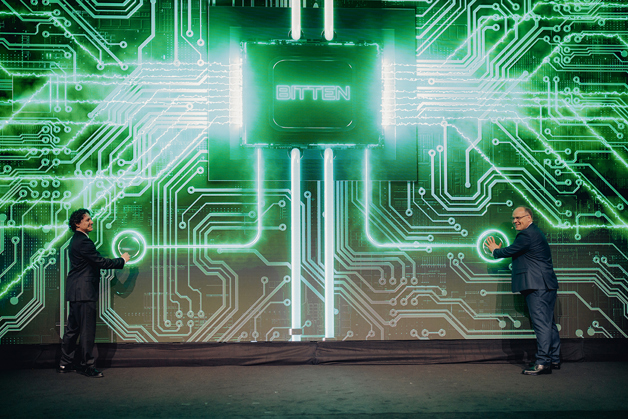
The University of Southern Denmark, in collaboration with Danfoss and HPE, brought a new national AI supercomputer online, enabling Danish universities to handle large data volumes and advanced AI models within a shared infrastructure. At the same time, the project demonstrated a scalable approach to building more energy-efficient AI infrastructure by integrating data centers with energy systems and enabling the reuse of waste heat.
The result
For Danfoss and HPE, the project stands as a replicable model for how AI infrastructure can be built more energy efficiently at a global scale. It proves that the right partnerships between industry leaders and technology providers can turn sustainability ambitions into operational reality.
The supercomputer is now part of Denmark's national research infrastructure. It is accessible to researchers and students at universities throughout Denmark via UCloud — a European, sovereign research cloud platform. UCloud has more than 23,000 users, making it one of the largest of its kind globally. Data, software, and computations remain under national and European control, addressing growing concerns around digital sovereignty.
Beyond academia, startups and spin-out companies will gain access to advanced AI and data analytics capabilities, accelerating their ability to develop and scale new products and services.
We have created a unique supercomputing solution that contributes positively across several areas. It delivers both high computational power and acts as an active part of the energy system — demonstrating that sustainability, technological development, and commercially attractive initiatives can go hand in hand.

Together, Danfoss and HPE have shown how AI infrastructure can be designed not only for performance, but also for long-term sustainability. The project demonstrates how closer integration between digital infrastructure and energy systems can help support the growing demands of AI while advancing decarbonization goals.