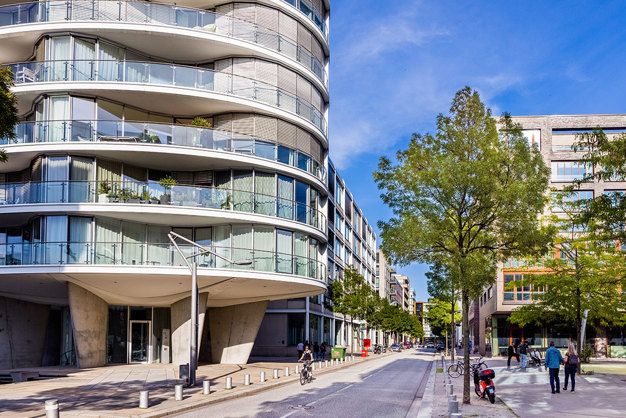
Danfoss House — the world's only multi-residential building of bricks and concrete to achieve the highest certification under the globally recognized DGNB-standard.
As buildings account for more than a third of the world’s energy consumption and 40% of all CO2 emissions, Danfoss has solutions that can change this.
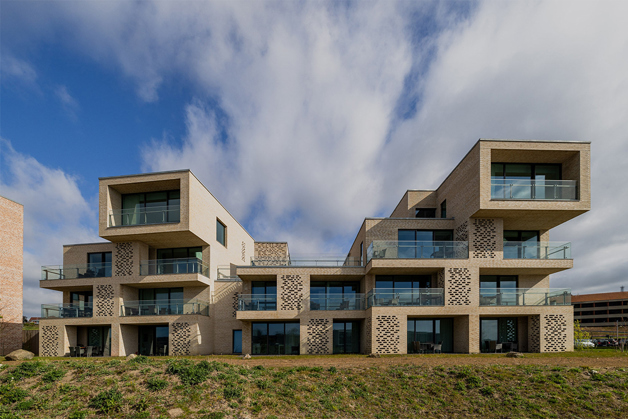
Danfoss House in Sønderborg, Denmark, is a combined residential building and living laboratory designed to continuously test, develop, and demonstrate technologies that improve comfort while lowering energy consumption. Today, Danfoss House is the world’s only multi-residential building made of bricks and concrete to achieve the highest certification under the globally recognized DGNB sustainability standard.
The challenge
For Danfoss, the challenge was not only to construct a highly energy-efficient residential building, but also to create a real-world environment where technologies and integrated energy systems could be validated under everyday conditions.
The building needed to function simultaneously as a home for employees, a testing and development center for residential building solutions, and a demonstration site capable of showing customers, partners, and policymakers what decarbonized multifamily housing can look like in practice.
The building also had to meet ambitious sustainability, architectural, and indoor climate requirements while remaining adaptable to future technologies and evolving building standards.
The solution
Built by the Bitten & Mads Clausen Foundation, Danfoss House was designed as a fully integrated smart residential building where energy-efficient technologies, comfort systems, and digital monitoring work together.
The building incorporates both centralized and decentralized heating systems, enabling Danfoss to test and compare the systems directly against each other. Ten 100-meter-deep geothermal boreholes provide groundwater-based cooling and heating, while floor cooling and diffuse ventilation help maintain indoor comfort throughout the year.
Danfoss House was also designed for long-term adaptability. Large technical shafts make the building upgradable as new technologies emerge, while smart home systems continuously simulate, monitor, and optimize indoor conditions to ensure the building never becomes too hot or too cold.
Key features of Danfoss House
-
Combines centralized and decentralized heating systems
-
Utilizes geothermal boreholes for efficient heating and cooling
-
Offers floor cooling and diffuse ventilation
-
Fully smart and upgradable home technology
It's actually pretty cool as an employee to see the Danfoss solutions in action. And it provides a lot of peace of mind for my family and me, having this place to stay in in the future.

The result
Danfoss House now serves as both a residential building and a full-scale demonstration platform for how multifamily housing can be decarbonized using technologies already available today. By combining energy-efficient heating and cooling systems, geothermal energy, digital controls, and smart building design, the project demonstrates how lower energy consumption and improved indoor comfort can go hand in hand.
The building has achieved DGNB Platinum certification — the highest level under one of the world’s leading sustainability standards — and is the only multi-residential building made of bricks and concrete to reach this certification level. Danfoss House has also received the DGNB Heart for indoor climate and well-being, the DGNB Diamond for architectural quality, and recognition as the most successful and beautiful new building in Sønderborg Municipality.
For Danfoss, the project reinforces the importance of demonstrating decarbonization solutions in real-world environments where people can experience the technologies directly.
Seeing is believing. It is really making the difference if you're able to show a real case as Danfoss House, you can touch it, you can look at it, you can go into it and you can see it's possible to build a super energy efficient house as we have here. In other words, the solutions are here, the components are here, and that is exactly what we are showing with Danfoss House.