Let’s level up liquid cooling
Optimize your data center’s thermal management with Danfoss comprehensive range of Coolant Distribution Unit (CDU) components and application expertise. Ensure reliability, efficiency, and sustainability in your liquid cooling solutions. Our team deeply understands the unique challenges faced by our customers and leverages extensive industry expertise to provide tailored support.
Want to learn more about CDUs?
As data centers evolve to handle increasing computational density, advanced cooling technologies such as direct-to-chip cooling and coolant distribution units (CDUs) are essential for maintaining optimal thermal conditions and improving energy efficiency.
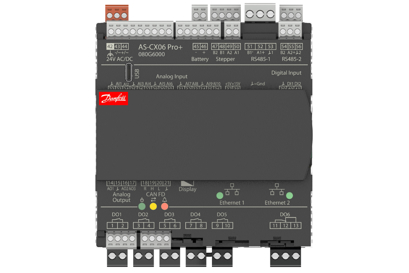
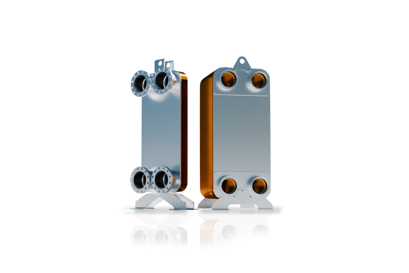
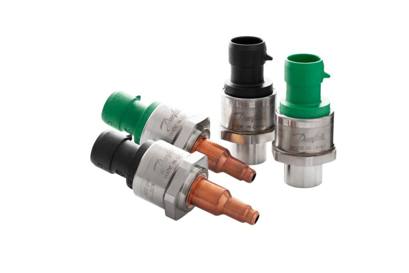
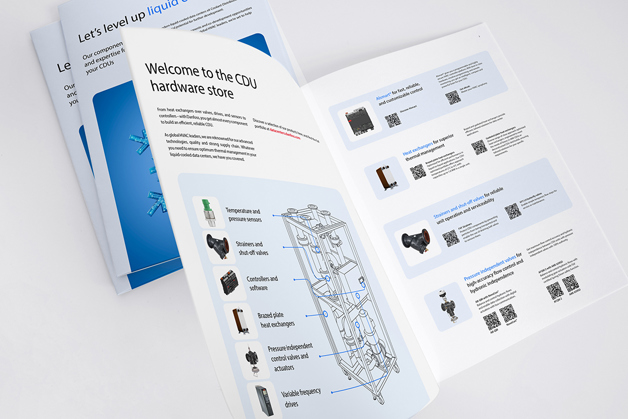
From heat exchangers over to valves, drives, and sensors to controllers – with Danfoss, you get almost every component to build an efficient, reliable CDU. Danfoss has developed its CDU components with next-generation cooling needs in mind, ensuring innovative solutions for advanced thermal management. Our flexible CDU components can be adapted to a wide range of project requirements and environments.
From heat exchangers to valves, drives, and sensors to controllers – with Danfoss, you get almost every component for almost the entire CDU ecosystem.
Download brochure
Why liquid cooling systems?
Liquid cooling is becoming the norm in high rack density applications like high-performance computing (HPC) and AI workloads. The technology involves bringing cold liquid closer to the IT equipment to remove heat, using either single-phase (only liquid) or two-phase (liquid evaporating to vapor) methods. Unlike traditional air-cooled systems that often struggle to manage higher thermal loads, liquid cooling—especially when integrated with Coolant Distribution Units (CDUs)—delivers superior thermal management, enhanced system reliability, and significant energy savings. CDUs efficiently regulate heat removal by optimizing heat dissipation and reducing energy consumption, ensuring precise cooling performance.
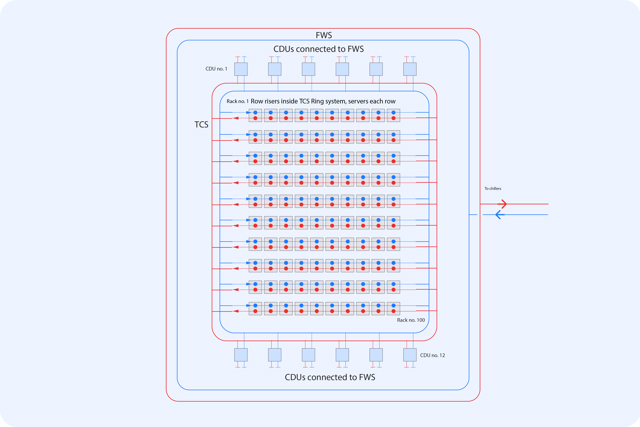
A Coolant Distribution Unit (CDU) is the heart of direct-to-chip (DTC) liquid cooling. Its primary objective is to deliver the required coolant flow at the required temperature to the racks. It is a critical component in the Technology Cooling System (TCS), which is a closed loop that delivers cold fluid to the racks and returns it to the CDU.
Air-cooling systems remain a central part of the data center cooling landscape not needing huge workloads (f.i. for banking). They offer a cost-effective, reliable, energy-efficient, and water-efficient cooling solution. While liquid cooling is gaining traction, air-cooling systems continues to play a significant role in data center cooling.
Product portfolio
Components for efficient coolant distribution units
By providing a comprehensive, reliable, and efficient cooling solution, CDUs empower data center operators to optimize their infrastructure for high density computing. Understanding the interplay of CDU components enables businesses to select the best fit solution, ensuring reliable performance, reduced energy consumption, and a future-ready data center that can evolve alongside emerging technologies.
Discover our product portfolio to design your CDU systems:


Superior thermal management.
Learn more:
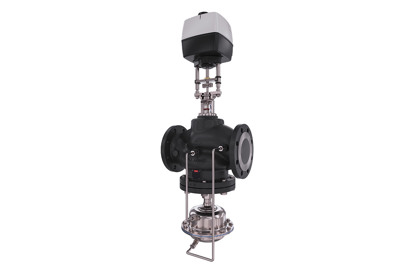

Accurate, dependable monitoring.
Learn more:
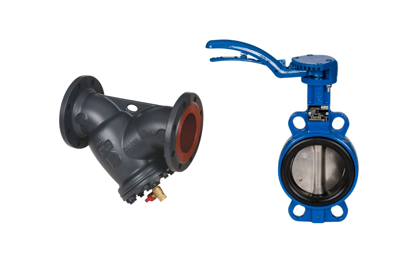
Reliable operation and serviceability.
Learn more:

Contact us
Simulations services and support
Application expertise and virtual tools to support you
With Danfoss, you get much more than components. Whatever the data center configuration, we have the application expertise to help design your CDUs. Team up with specialists within R&D, Application Development Centers, simulation, ADM & rapid prototyping, and application- and material-experts to level up your liquid cooling systems.
Virtual system solutions: our tools and virtual system solutions using Modeling & Simulation, Data Analytics, Digital Twins, and Software Development support our customers in making the right choices when it comes to system designs.
Applications
More solutions for efficient cooling, waste heat recovery, and valve trains.
Explore more

Insights
Additional insights on liquid cooling and CDUs
Liquid cooling technologies are evolving rapidly to meet the demands of high-density data centers and high output IT equipment. CDUs serve as a closed loop system that enables localized liquid cooling, which is critical for maintaining optimal temperatures and efficient heat transfer compared to traditional air-cooling methods. By absorbing heat directly from heat generating components, liquid coolant circulated by the CDU dissipates heat effectively, reducing thermal throttling and improving overall system efficiency.
The integration of CDUs with direct-to-chip cooling and rear door heat exchanger solutions allows data center operators to implement full liquid cooling systems or hybrid cooling strategies. These efficient cooling solutions not only lower power consumption but also support the increased thermal load from artificial intelligence and high-performance computing workloads.
Moreover, advanced CDUs provide precise control over flow rate and temperature, ensuring consistent cooling efficiency and system performance. This precise control is essential to prevent overheating and to maintain optimal operating temperatures, thereby extending the lifespan of IT equipment and reducing downtime.
As the data center industry moves towards greener and more sustainable cooling technology, CDUs are incorporating innovations such as improved filtration systems and compatibility with sustainable liquid coolants. These advancements contribute to effective thermal management while aligning with environmental goals.
In summary, CDUs are a cornerstone of modern data center cooling technology, enabling reliable, energy-efficient, and scalable cooling solutions tailored to the evolving needs of high-density data centers and advanced IT infrastructure.
FAQ
About liquid cooling and CDUs
Why is liquid cooling becoming increasingly important in modern data centers?
As data center power densities increase and processors demand more power, air cooling becomes less effective. Liquid cooling offers superior thermal conductivity, enabling efficient heat removal from high-density components. This allows for greater computing power in a smaller footprint, reduced energy consumption, and improved overall system performance.
What is a Coolant Distribution Unit (CDU)?
A Coolant Distribution Unit (CDU) is a critical component in liquid cooling systems for data centers, acting as a central hub for managing and distributing coolant to IT equipment. It effectively removes heat, maintaining optimal operating temperatures and ensuring system reliability. The CDU typically isolates the facility water system (FWS) from the technology cooling system (TCS), preventing contamination and maintaining coolant quality.
What are the key benefits of deploying CDUs in a data center environment?
Deploying CDUs provides numerous advantages in a data center environment:
- Enhanced heat removal: liquid cooling's superior thermal properties enable more efficient heat dissipation compared to air cooling
- Precise temperature control: CDUs offer precise temperature management, ensuring stable and reliable operation of sensitive IT equipment
- Energy efficiency: by optimizing cooling processes, CDUs minimize energy consumption and lower operational expenses
- Space optimization: liquid cooling solutions can significantly reduce the physical footprint of the data center, freeing up valuable space for additional IT infrastructure
- Improved reliability: consistent and controlled temperatures contribute to the extended lifespan and enhanced reliability of IT components
What are the essential components typically found within a CDU system?
A typical CDU comprises several key components:
- Pumps: circulate coolant throughout the technical cooling system
- Heat exchangers: transfer heat from the coolant to a primary cooling loop or external heat rejection system
- Expansion tanks: accommodate volume fluctuations in the coolant due to temperature variations
- Filters: remove particulate matter and contaminants from the coolant, ensuring its purity and optimal performance
- Control systems: regulate temperature, flow rates, and other critical parameters to maintain system stability
- Sensors: monitor temperature, pressure, flow, and other variables, providing real-time data for system monitoring and control
What types of heat exchangers are commonly employed in CDU applications?
Brazed plate heat exchangers (BPHEs) are widely favored in CDUs due to their exceptional efficiency, compact design, and ability to handle high pressures and temperatures.
How do Pressure Independent Control Valves (PICVs) enhance the performance and stability of CDU systems?
PICVs maintain precise flow control and hydronic balance within the CDU, irrespective of pressure variations in the system. This ensures consistent cooling performance across all connected IT equipment, optimizing temperature control and energy efficiency.
What is the role of Variable Frequency Drives (VFDs) in optimizing CDU energy consumption?
VFDs regulate the speed of the pumps within the CDU, enabling precise adjustment of coolant flow based on real-time cooling demands. This dynamic control optimizes energy consumption, reduces pump noise, and extends pump lifespan.
Can you explain the fundamental differences between direct-to-chip liquid cooling and immersion cooling techniques?
- Direct-to-Chip liquid cooling: involves attaching cold plates directly to heat-generating components, such as CPUs and GPUs, to facilitate efficient heat transfer to the coolant
- Immersion cooling: entails submerging entire servers or IT equipment in a dielectric fluid, providing full contact cooling for all components
What are some key considerations when selecting a CDU for a specific data center application?
Key factors to consider include:
- Cooling capacity requirements
- Redundancy and reliability needs
- Energy efficiency goals
- Space constraints
- Budgetary limitations
- Compatibility with existing infrastructure
What are some of the latest advancements and emerging trends in CDU technology?
Some notable trends include:
- Smart CDUs: incorporating advanced sensors, controls, and analytics for predictive maintenance and optimized performance
- AI-powered optimization: utilizing artificial intelligence to dynamically adjust cooling parameters based on real-time data and workload patterns
- Sustainable coolants: exploring the use of environmentally friendly coolants with low global warming potential
- Integration with Data Center Infrastructure Management (DCIM) systems: seamless integration with DCIM platforms for centralized monitoring and control of all data center resources
Configuration examples where CDUs can be applied
In-row CDU installation
In-row CDU installation is commonly deployed in data centers with a low degree of liquid cooling needed, i.e., in retrofit for legacy air-cooled data centers.
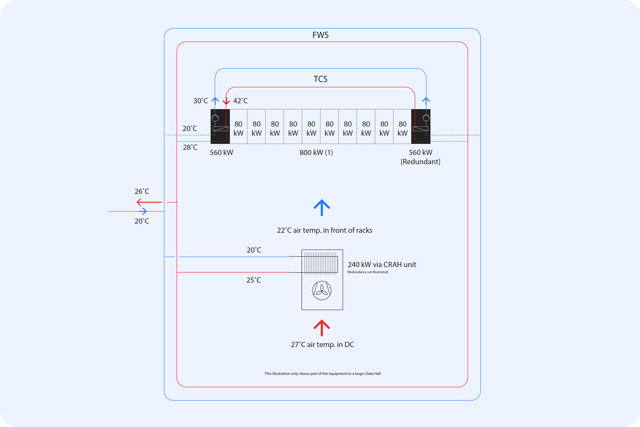
External CDU installation
External CDU installation for CDU installation outside the data hall. Feeds into a distributed ring system supplying the entire data center. Excellent for new-built data centers with dedicated TCS ring distribution systems, and for mixed deployments.