
Three years after opening, the Danfoss Smart Store in Nordborg is demonstrating what can be achieved when proven technologies for refrigeration, heating, heat recovery, electronic controls, sensors, cloud-based monitoring, and energy management are integrated under real operating conditions.
Latest figures show that the Smart Store delivers 60% lower net energy use than benchmark stores.
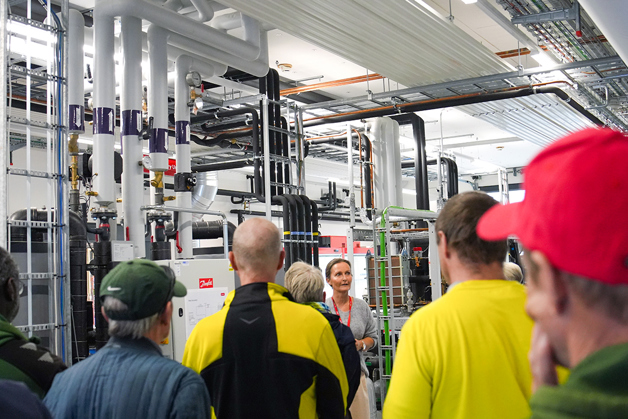
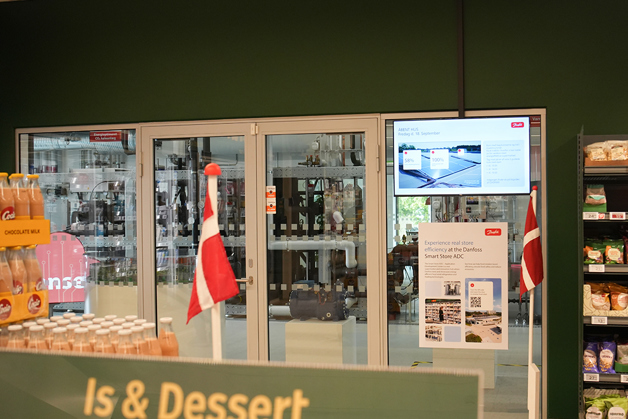
The site combines a fully operational Coop 365 supermarket, operated by BALS, with a Danfoss Application Development Center (ADC), where Danfoss engineers work with customers and partners to test, integrate and optimize technologies in real-life applications.
BALS is Denmark’s largest independent retail cooperative and operates 12 stores across Sønderborg Municipality. The company has a long track record of improving energy efficiency across its business.
For us, energy efficiency is very practical. If we can reduce energy consumption, we reduce costs and emissions at the same time. We have worked that way for years, and the Smart Store gives us a real supermarket where we can test new solutions, measure their impact and see how the learnings can be applied in our other stores.
What the Smart Store delivers
The Smart Store brings together CO₂ refrigeration, electronic controls and sensors, heat recovery, cloud-based monitoring, and solar energy.
Heat recovery is a central part of the concept. Heat from the CO₂ refrigeration system is reused for heating and hot water, while surplus heat is supplied to the local district heating network.
Since opening, 130,000 kWh of recovered heat has been used for heating the store, with an additional 50,000 kWh supplied to the local district heating network. The heat-recovery solution has an average payback time of three years.
Solar panels cover 38% of total electricity demand and produced 100,000 kWh of electricity in 2025, of which 25,000 kWh was supplied back to the grid.
An independently verified Danfoss case study found that, using projected Danish grid emission factors, found that over a 15-year system lifetime, the Smart Store can achieve 39% lower emissions than a modern CO₂-based reference store and 68% lower emissions than an HFC-based reference store.
The Smart Store demonstrates that the technologies needed to significantly reduce supermarket energy use and emissions already exist. By bringing refrigeration, heating, controls and energy management together in one system, retailers can improve efficiency, lower operating costs and strengthen competitiveness. The potential is even greater in larger stores and more carbon-intensive energy systems, where closer grid integration can further improve how energy is used.
Since opening in 2023, more than 4,500 customers, partners, policymakers and students have visited the Smart Store ADC.