
Danfoss Impact Issue No. 7
Our latest Impact paper emphasizes the critical importance of seeing water and energy as interdependent resources.
Download the Impact paper now
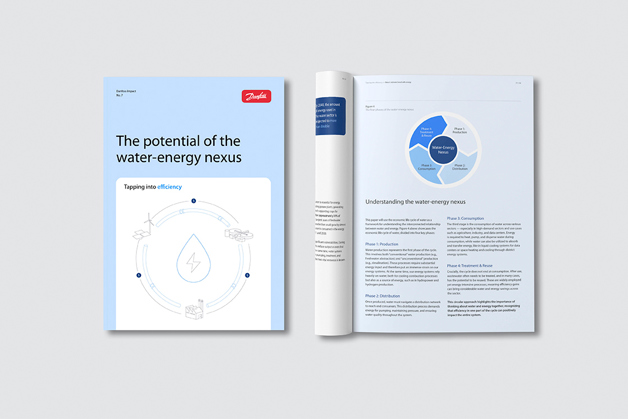
Water and Energy — how efficiency links them both
Water scarcity is one of the defining challenges of our time, affecting us all. Global water demand is projected to exceed supply by 40% as early as 2030, while more than two billion people already live without access to safe drinking water.
A major but often overlooked part of this challenge is water’s use of energy. The way we manage energy in the water sector is inefficient — and expensive. Water-related activities account for around 4% of global electricity use. This power is needed to produce, treat, and move water across homes, farms, and industries. Yet decades of underinvestment have left our systems strained and inefficient.
If we fail to act, inefficiencies across the water and energy nexus could cost high-income countries up to 8% of GDP by 2050. But the good news is that proven solutions already exist to strengthen efficiency, resilience, and competitiveness across the water sector.
Behind the global water crisis lie hidden inefficiencies: leaky pipes, aging infrastructure, and excessive energy use. Addressing these requires more than technology alone — it demands coordinated action among governments, companies, and civil society to modernize systems and reform policies.
This paper explores the critical interdependence between water and energy. It highlights where energy use is concentrated within the water cycle, which technologies can reduce waste, and how effective policy can close the gap between ambition and implementation. Above all, this paper calls for a shift in perspective: to see water and energy as interconnected systems, where efficiency in one drives efficiency and resilience in the other. By cutting waste, boosting efficiency, going digital, and making water count, we can scale existing solutions to secure human well-being, enhance climate resilience, and strengthen industrial competitiveness.
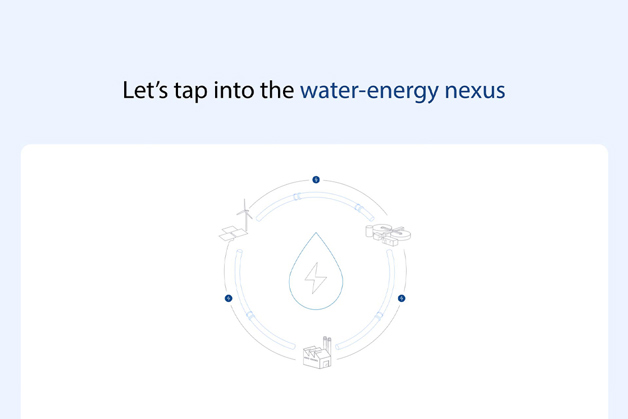
Only got two minutes?
These are the key takeaways

Current practices and infrastructure for water management are both inefficient and insufficient. By 2040, the water sector’s energy consumption is expected to more than double, while the energy sector’s water demand could rise by almost 60%.

Inefficient technologies and outdated processes mean that nearly all industries are consuming water at unsustainable rates. For example, growing demand for data processing has led to a corresponding growth in the energy and water consumption of data centers.

Water is crucial to competitiveness and security. As climate change worsens, reduced access to clean water, sanitation, and declining water storage could cause high-income countries to see an 8% reduction in their GDPs by 2050.10 For the US, 8% of GDP was equal to almost one-third of government spending in 2024. Lower-income countries could experience a more acute reduction of 10-15%.

By 2030, global water demand is set to outpace supply by 40%. To meet this demand, many regions will need to increase supply with energy-intensive methods of water production — namely, desalination and wastewater treatment.
The good news is that incredible potential exists today to increase the efficiency, resilience, and economic competitiveness of the water sector.

Policy recommendations
Danfoss Impact Series
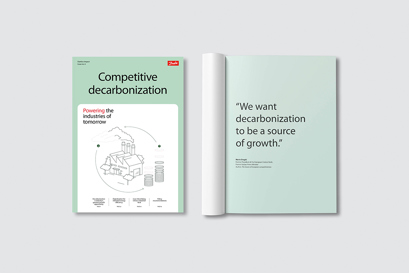
This Impact paper provides a clear guide on how companies can strengthen their competitive advantage through decarbonization, electrification, and energy efficiency.
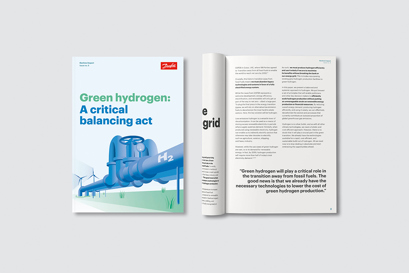
Green hydrogen will play a critical role in the transition away from fossil fuels and in decarbonizing hard-to-abate sectors, such as long-distance shipping and international aviation.
Energy efficiency, electrification, demand-side flexibility, conversion, storage, and sector integration are integral for a future energy system enabling an energy grid powered by renewables.