
Authors

Jan Eric joined Danfoss in 2000 and he has worked with dynamic simulation, laboratory tests, field tests, techno economic analysis, research and development. The focus is from component, subsystem to energy system level, related to Danfoss offerings within heating and cooling solutions. With the focus on conceptual development of district heating and cooling in the perspective of a smart and sector coupled energy system. A number of publications have been made, and lectures are given in relation to education and training activities. Jan Eric holds a Master degree in mechanical/energy engineering.

Oddgeir joined Danfoss in 2012 as a district energy expert at a global level. He has worked with a wide range of topics within the district energy sector, ranging from deep dives on components, to analyzing complex interactions and role of district energy systems in the perspective of the wider energy system, to hosting delegations seeking solutions for decarbonization and efficient utilization of energy sources. Oddgeir is actively engaged in international research projects and platforms aimed at sharing knowledge and positioning district energy systems. Additionally, he provides consultancy services to sector partners and institutions. Oddgeir holds a PhD. in Engineering from the University of Iceland.
Introduction
District heating systems have many desirable attributes addressing our modern-day challenges. In Northern Europe, they have proved to be exceptionally effective in decarbonizing building heating demands and becoming the enablers of a future smart and efficient energy system. In Ukraine, they have proven to be exceptionally resilient to bombings during the Russian war on Ukraine. The Ukrainian cities with district heating systems, even as outdated as they are, have proven to have safer, more reliable, more stable, and more predictable heat supply than cities with individual heating. In the United Kingdom, district heating is recognized as an important solution to fight energy poverty. The key reason for the multi-criteria success of district heating is the fact that aggregating the demands of all connecting users enables access to a pool of diverse heat generation technologies. By properly combining heat sources and generation technologies, the district heating utility can ensure low heat costs, long-term cost stability, resilience to disruptions in energy vectors, and in the end, a reliable and future-proof heat supply operating in synergy with the overall energy system.
Multi-source heat cost optimization principles
The basic steps for minimizing heat costs in district heating systems are:
A. Determine the annual heating demand
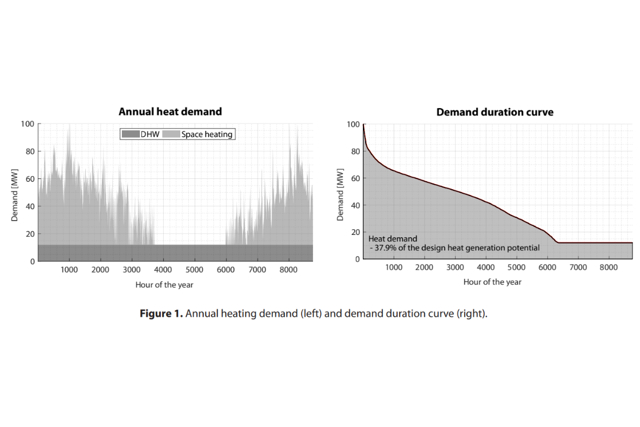
This article assumes we are designing a 100 MW district heating system to supply an annual demand of 333 GWh. Figure 1 shows the annual heat demand curve (left) and the same annual demand sorted in descending order, commonly called a duration curve (right). The load figures clearly show that the system will run on a part load for a large part of the year. The aim of the utility is to design the heat generation to allow cost-effective heat supply at any given heat demand or time.
D. Assess the capital expenditure (CAPEX) and operating expenditure (OPEX) of potential heat plants
Once the available energy sources have been identified, the next step is to access the key economic parameters influencing the cost of heat from using them. For an initial evaluation, financial data can be found in various technology cost catalogs, for example, from the Danish Energy Agency [1].
It is important to note that CAPEX is a one-time cost, the cost of establishing the heat plant, while OPEX is both fixed and variable. The fixed OPEX is the cost that falls irrespectively of the use of the heat plant; these can be due to general maintenance schedules of building and equipment. The variable OPEX is the cost directly related to the heat generation; this is the fuel and maintenance costs directly associated with the operation of the plant (wear and tear).
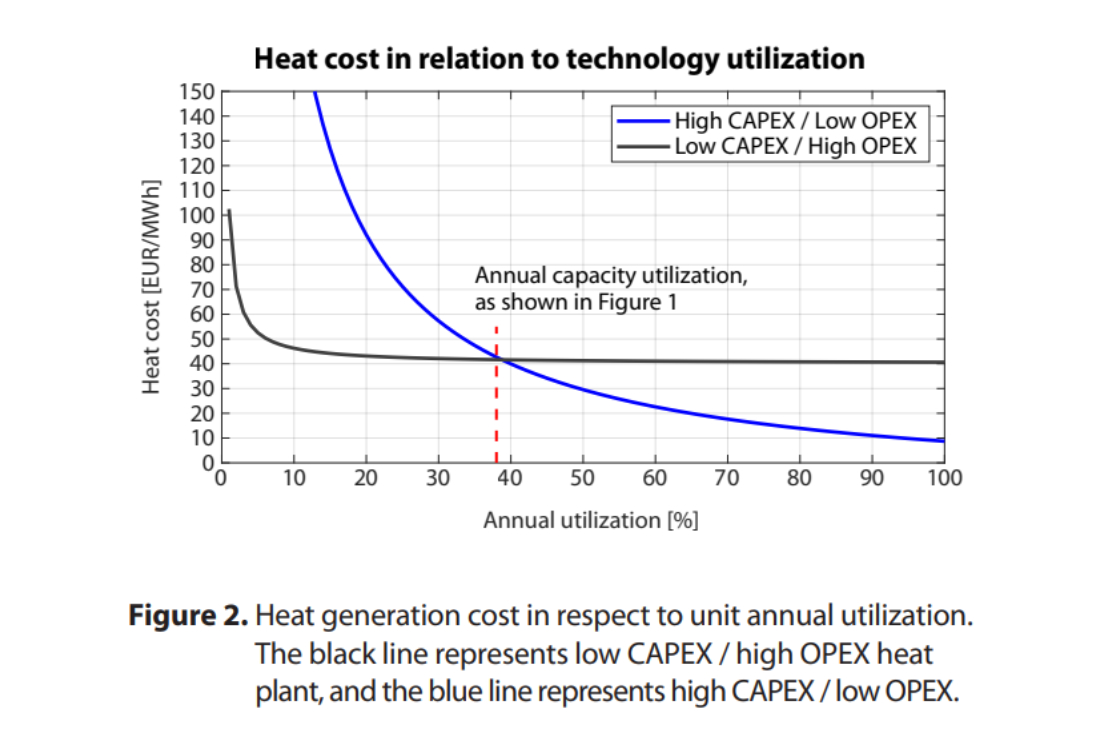
The rule of thumb is that heat plants with high CAPEX and low OPEX should be base load providers. In general, the cost of heat from these plants becomes lower the higher the plant utilization is, as shown by the blue line in Figure 2. At the other end of the spectrum are heat plants with low CAPEX and high OPEX. These plants are well suited as peak load plants, as the CAPEX per generated heat unit drops fast with increased utilization and the cost of the heat becomes dominated by the fuel cost, as is clear from the fact that the heat cost will reach a plateau around the variable OPEX, as shown by the black line in Figure 2.
E. Determine the most suitable mix of heat plants concerning CAPEX, OPEX, and heating demands being fulfilled
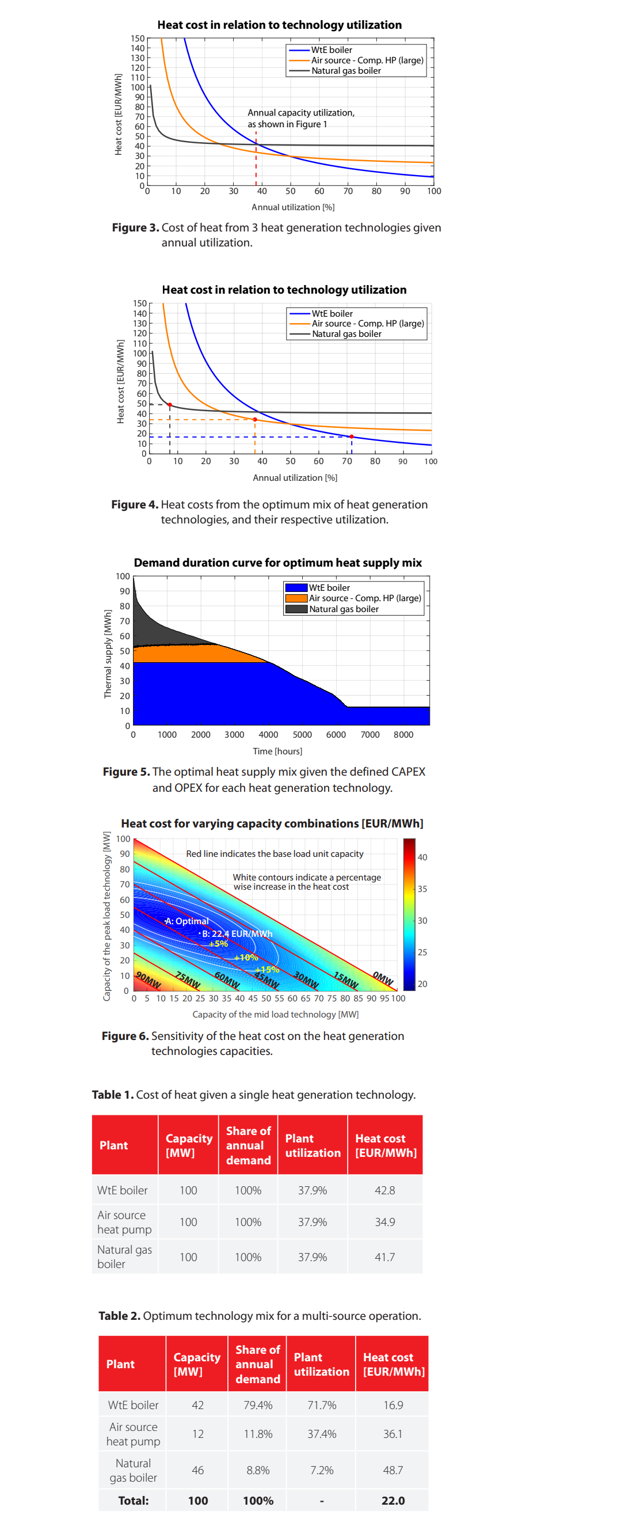
The following provides a simplified example of the heat cost optimization for the heat demand case shown in Figure 1. The case is based on three heat generation technologies, waste incineration (WtE), an air source heat pump, and a natural gas boiler, see Figure 3.
Table 1 shows the cost of heat from a single heat generation technology fulfilling the demand in Figure 1. As the table shows, the air source heat pump is the most cost-effective solution from a single technology perspective.
On the other hand, if one would designate the waste incinerator as a base load, e.g., ensuring high utilization of the investment, followed by an air source heat pump plant for mid load and at last, apply natural gas boilers for peak load, a better result can be achieved. In this case, the optimal solution would be as shown in Table 2 and visualized in
Figure 4.
Figure 5 visualizes the duration curve given the cost optimum heat generation mix.
By analyzing the sensitivity of the heat cost to the capacity distribution between the heat generation technologies, see Figure 6, interesting opportunities can be identified.
An alternative mix could be at point B, where the mix is a 38 MW WtE unit, a 25 MW heat pump unit, and a 37 MW natural gas boiler. The increase in the annual heat generation cost when moving from point A to B is only 2%. However, the flexibility impact of doubling the heat pump capacity from 12 MW to 25 MW could easily pay off, as the additional heat pump capacity will offer significantly increased sector coupling opportunities. For example, increased possibilities to take advantage of fluctuations in the power prices, provide balancing services to the power system and reduced reliance on natural gas, and consequently reduced dependency on imported fuels, as well as reduced CO2 emissions. A larger heat pump plant could also take greater advantage of higher efficiencies achieved during daytime temperatures, compared to night temperatures, and charge a thermal energy storage if available and limit or avoid operation at the coldest period of the night. Another opportunity could be to exploit synergies with other energy sectors, such as the cooling and industry sectors. Concerning the cooling sector, the heat pump could operate in synergy with district cooling systems or large building complexes, such as malls, hospitals, or other large complexes. In respect to the industry sector, the heat pumps could utilize waste heat from various industry processes and, by that, achieve high heat pump efficiencies for the district heating utility and either save the industry the cost of cooling off their waste heat or, in some cases provide a revenue stream to the industry. For additional information on the potential of excess heat, see [2].
Conclusions
By opting for multi-source operation and optimizing the heat generation capacities based on the relation between CAPEX and OPEX, district energy utilities can achieve multi-fold benefits, such as:
- Reduced thermal generation cost compared to a single energy vector strategy.
- Long-term stable and predictable thermal generation costs, as thermal generation cost from base load plants, will primarily be based on the initial investment cost and significantly less on operating the thermal plant.
- Significant opportunities to optimize which heat generation technologies to operate at any given time, for example, based on the cost of the input energy (electricity, fuel, surplus heat, renewables).
- Optimizing parameters other than cost, such as flexibility, can enable a heat generation mix that offers additional opportunities to take advantage of local conditions and energy spot markets, e.g., balancing services to the power system.
Another important conclusion from above is that in district heating, the heat cost sensitivity to the heat generation technology mix is low. With the low heat cost sensitivity district heating enables a wide range of technology combinations with stable and low heat costs. This is
important as new systems can be built with long-term planning, e.g., starting with a cheap peak load boiler and later when the system grows to build the CAPEX-intensive base load technology. This heat cost stability further enables district energy systems to take a leading role in the future integrated energy system, with enormous upside potential and limited risk.
For maximizing the benefits of multi-source operation, thermal energy storage options, and sector coupling potentials, district heating utilities can take advantage of digitalization options for optimizing the whole heat supply system, from the end-user to the heat generation, see [3].
By embracing the benefits and opportunities the infrastructure offers, district energy systems can ensure their relevance today and in the future.