

CO₂ Fundamentals & Applications
The move towards low GWP refrigerants marks a pivotal shift in the cooling and refrigeration industry. Discover the unique qualities of CO2 as a refrigerant in our expert paper.
Download the expert paper
The transition towards low GWP refrigerants represents a significant shift in the world of cooling and refrigeration systems. Historically, synthetic refrigerants have been widely used due to their non-flammable and non-toxic properties. However, the adverse environmental impacts of these synthetic substances, particularly their role in depleting the ozone layer (CFC and HCFC) and contributing to global warming, have led to a pressing need for more sustainable alternatives.
Natural refrigerants offer a promising solution to mitigate the environmental concerns associated with synthetic refrigerants. These substances occur naturally in the environment and have minimal impact on global warming. Examples of natural refrigerants include carbon dioxide (CO2), hydrocarbons (such as propane and isobutane), and ammonia.
The usage of natural refrigerants has gained momentum in recent years, driven by increasing
awareness of climate change and the need for sustainable solutions. A majority of research
and development efforts are directed to identify and optimize the use of natural refrigerants in various applications.
The application of natural refrigerants represents a pivotal moment in the refrigeration
industry’s journey toward sustainability. With their lower environmental impact and improved energy efficiency, natural refrigerants offer a viable and eco-friendly alternative. As the world continues to prioritize environmental-friendly solutions, the adoption of natural refrigerants is set to reshape the cooling and refrigeration landscape, contributing to a greener and more sustainable future.
CO2 as refrigerant
Carbon dioxide, CO2, also known as R744, has been used as a refrigerant in vapor compression refrigeration cycles since the 1880s. However, it lost market share to synthetic refrigerants in the 1930s due to energy efficiency, complexity, and technological limitation. In the 1980s, CO2 made a comeback as viable solution, thanks to improved system and component design as well as manufacturing processes.

More about CO₂


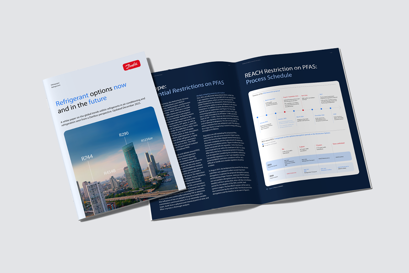

Want to know more about refrigerants?
Danfoss is a world leader in the supply of compressors and controls, and has one of the most extensive and complete product ranges in the HVAC/R industry. Our products are found in numerous business areas and applications. We are at the forefront in developing products using refrigerants and in evaluating the viability of new refrigerants as they are introduced.
Learn more about refrigerants