
As we transition toward a more environmentally friendly future, your refrigerant choice becomes an important factor for your business and the planet. CO2 is a natural cooling agent that delivers sustainable and energy-efficient refrigeration in everything from warehouses to ice machines. Allowing businesses to move forward naturally.
CO2 has several unique thermo-physical properties making it an ideal refrigerant:
In practical applications, CO2 systems deliver a very high-performance output. The main reasons are:
For all refrigerants, there is a decline in system efficiency with increasing condensing temperatures. High condensing temperatures are often seen as limiting factor for usage of CO2. However, the inherent thermo-physical properties of CO2 and the use of the expansion energy with ejectors can help to compensate for and offset this factor.
In addition, CO2 refrigeration systems possess heat recovery options that can help further future-proof your business. CO2 and its high energy content, which continues to scale at greater temperatures, can be reclaimed, increasing overall system efficiency.
From an environmental perspective, CO2 is a very attractive refrigerant with zero ODP and a GWP of 1. It is a naturally occurring substance and abundant in the atmosphere.
CO2 is a high-pressure refrigerant where high operating pressures are required for efficient operation. During standstill, the ambient temperature can reach and exceed the critical temperature and the pressure can exceed the critical pressure. Hence systems are typically designed to withstand pressures up to 90 bar, or sometimes even equipped with a small standstill condensing unit to keep pressures low.
At the same time, CO2 has a low compression pressure ratio (20 to 50% less than HFCs and ammonia), which improves volumetric efficiency. With evaporation temperatures in the range of -55 ºC to 0 ºC, the volumetric performance of CO2 is for example four to twelve times better than that of ammonia, which allows compressors with smaller swept volumes to be used.
The triple point and critical point of CO2 are very close to the working range. The critical point may be reached during normal system operation. During system service, the triple point may be reached, as indicated by the formation of dry ice when liquid containing parts of the systems are exposed to atmospheric pressure. Special procedures are necessary to prevent the formation of dry ice during service venting.
CO2 does not react with common metals or with Teflon®, PEEK, or neoprene components. However, it diffuses into elastomers and can cause swelling with butyl rubber (IIR), nitrile rubber (NBR), and ethylene-propylene materials (EPDM).
The density of liquid CO2 is about 1.5 times that of ammonia, resulting in higher mass charge in evaporators, such as large plate chillers in large industrial systems. Higher density means higher oil circulation as well, which in turn requires effective oil separators for industrial systems.
CO2 is a by-product in a number of industries, so the price of CO2 is low. However, CO2 systems tend to be more expensive than traditional systems due to higher pressures (in transcritical systems) or increased complexity (in both transcritical and subcritical systems). Complexity of systems seems to be decreasing with the entrance of Booster systems and as the number of CO2 installations has increased, history has shown that the cost approaches the cost of the reference systems using HFCs.
Secondary, large CO2 systems, especially in industrial refrigeration, may be less expensive to build than their glycol counterparts and thus offer lower initial and life-cycle costs.
Unlike most other refrigerants, CO2 is used in practice in three different refrigeration cycles:
The technology used depends on the application and the intended location of the system. There are a several applications where CO2 is attractive and already widely used today:
Danfoss believes that CO2 will be the main refrigerant in multipack commercial refrigeration systems. The F-gas regulation is a clear push in this direction.
CO2 systems can also be extended to cover heat recovery. In many cases the extra investment for gaining the waste heat is negligible and several cases have demonstrated that.
Read all about CO2 applications in our dedicated site for Food Retail and Industrial RefrigerationCO₂ applications in Food RetailCO₂ applications in Industrial Refrigeration
Read how Danfoss can help you save energy and protect the environment with our CO2 solutionsSave energy and protect the environment with our CO₂ solutions
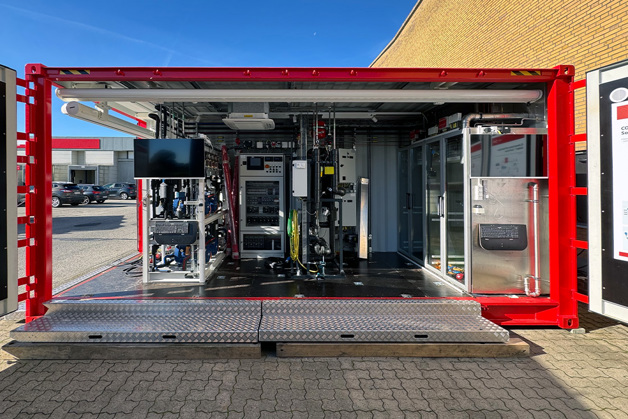
Danfoss presents the mobile training unit equipped with CO2 solutions and interactive learning modules for transport across the globe to support our worldwide community to address growing CO2 concerns.
Mobile CO2 training unit
A wide portfolio for lower GWP refrigerants
Select the best component for cooling applications [software]
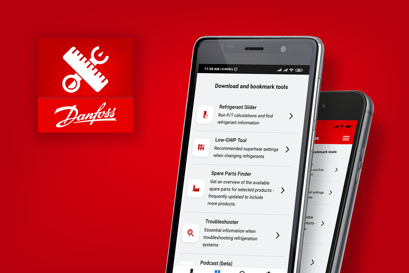
Download Ref Tools nowAccess Ref Tools via web browser