
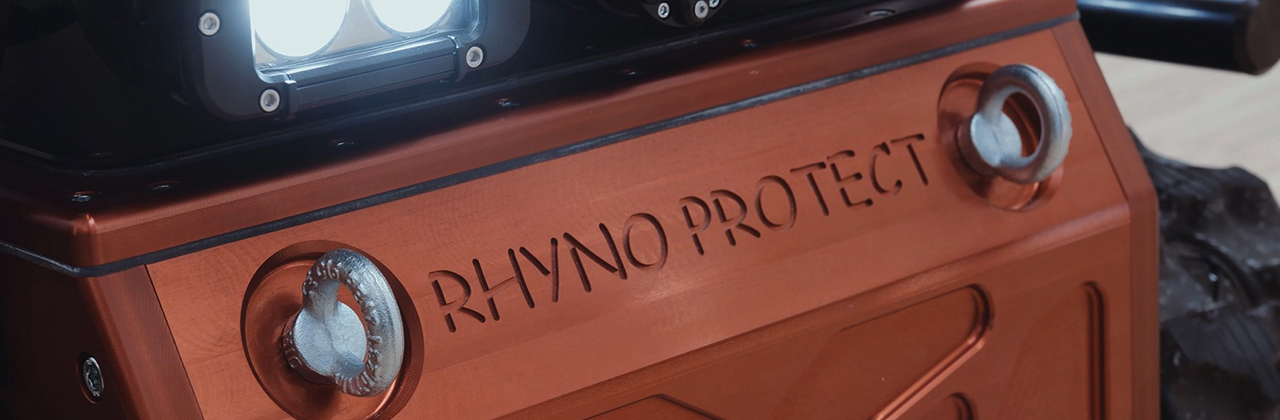
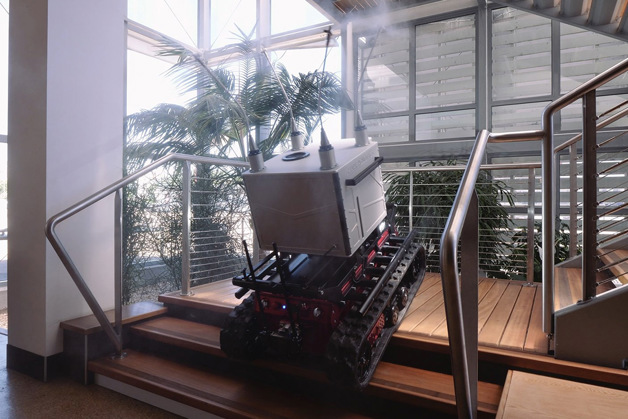
A robot developed by French company Shark Robotics, is now spraying COVID-19 virus to death inside public and private buildings in Europe. The robot sanitizes several thousand square meters in a few hours – and you control it with Danfoss technology.
Would you like to rest your hands on a restaurant table or grab the handrail walking up the stairs at your local library – without risk of catching COVID-19? You can, if the robot Sanitizing Rhyno Protect has just been around.
Equipped with 16 high-pressure nozzles and a 50-liter tank with decontaminant fluid, the robot leaves a spray in its path that eliminates the virus in a matter of seconds – a virus which, according to research, could otherwise stay alive from hours up to several days depending on the surface.
Faster than humans
French company Shark Robotics developed the Sanitizing Rhyno Protect as a direct response to the pandemic. And now, the robot is disinfecting shipping company warehouses, food processing plants, restaurant inventory, and public buildings in France and other European countries.
It can disinfect 20,000 square meters in less than three hours. This means that a food processing plant can have its premises disinfected over-night, so employees can go straight to work each morning.
“The Sanitizing Rhyno Protect disinfects faster than a team of human cleaners. Customers typically find this very surprising. The robot is also extremely easy to operate. You do it with a wireless remote control which most people can learn to operate in five minutes. A kid can do it,” says Cyril Kabbara, Shark Robotics Cofounder and COO.
Controlled by Danfoss
Shark Robotics works closely with ASLI – a French company specializing in radio control solutions. And ASLI has selected remote control systems from Danfoss as the best choice for all of Shark Robotic’s current robots, including the Sanitizing Rhyno Protect.
Laurent Blaise, owner and General Manager at ASLI, has been in the market for 30 years. He says:
“I have been unable to locate a supplier with more robust, well-functioning remote control systems than Danfoss. Their systems, consisting of transmitter and receiver, are easy to customize, so you can make them do exactly what you want them to. It is also key that Danfoss even allows us to do this customization in the first place. Very few, if any, other companies allow this.”
Engineers at Shark Robotics developed the Sanitizing Rhyno Protect in less than a month at the onset of the COVID-19 crisis. And, according to Cyril Kabbara, it was the right decision to put resources into the project:
“The robot has definitely been a success for us. Orders have been ticking in at a regular pace since launch and are now picking up speed. It’s an honor to bring a tool to market that can help fight this virus.”

Robots from Shark Robotics are used daily for complex operations in areas such as firefighting, security, and industry. The Paris Fire Brigade, for example, used a robot from Shark Robotics to help extinguish the Notre Dame Cathedral fire. Shark Robotics designs and produces all its robots in La Rochelle, France.
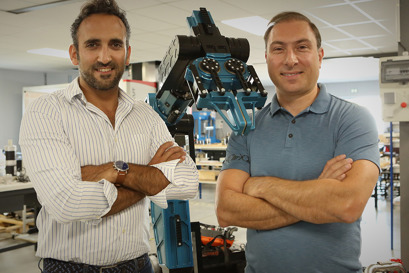
“Many of our robots are put to use in situations where operators are under stress. Take firefighting or mine clearing. Here, it is key that the remote control systems work very well and do not break if they are handled in a rough manner. They must also be easy to use. Danfoss’ wireless system lives up to all these criteria. It also allows us to control robots at a distance of up to 150 meters – and the signal never fails,” says Cyril Kabbara. Right: Cofounder Jean-Jacques Topalian.
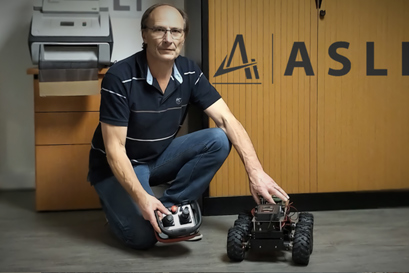
To be able to always respond quickly to requests from Shark Robotics, ASLI has built a mini-model of one of the robots including all software. Shark Robotics has a similar model and the two are connected to each other via the internet. “This means that we can discuss possible changes, implement them, and see the result on the mini-model before we make changes on the life-size robot. It’s effective and fun at the same time,” says Laurent Blaise.
The placement or function of buttons on Danfoss remote controls can be customized to fit operator preferences or specific work situations. They are lightweight and ergonomically designed, so operators can work without developing muscle pain. Danfoss is also working with the Valencia Institute of Biomechanics, Spain, during development of its newer ranges of remote control systems.
Danfoss remote control solutions