In Spain’s Canary Islands, where freshwater resources are scarce and desalination is essential, making seawater reverse osmosis (SWRO) as energy efficient as possible is critical – not just to reduce operating costs, but to lower the carbon footprint of securing a reliable water supply. That’s why the Canary Islands Institute of Technology (ITC), leader of DESAL+ LIVING LAB, designed the DESALRO® 2.0 solution – a cutting-edge research project supported by the European Union’s REACT-EU program.
The goal of DESALRO® 2.0 designs? To push the limits of SWRO energy efficiency by designing desalination plants, of several sizes, that consume less than 2.0 kWh of energy per cubic meter of freshwater produced – a specific energy consumption (SEC) benchmark never before achieved at such scale.
DESALRO® 2.0 solutions are designed not only to achieve a breakthrough in energy efficiency, but also to establish a replicable utility model: a fully functional, real-world system, optimized with best-in-class, commercially available technologies and conceived for use in a wide range of future desalination projects with minimal redesign.
The DESALRO® 2.0 designs are now a reality in a 2,500 m3/d SWRO plant located in Pozo Izquierdo (Gran Canaria), which was commissioned by Canaragua-Elmasa.
In line with its objective of conceiving a utility model, ITC designed the 2,500 m3/d DESALRO® 2.0 plant for mobility, fast deployment, and scalability. Fully containerized, its basic design comprises four plug-and-play units: three 40-foot containers (one each for pre-treatment, reverse osmosis, and post-treatment) plus a 20-foot unit for chemical cleaning.
To meet its ambitious SEC goal, ITC’s design for the reverse osmosis stage integrates several high-efficiency components: positive displacement (PD) pumps for high-pressure delivery, isobaric energy recovery devices, variable frequency drives, and advanced hybrid membranes – together with an optimized hydraulic design to minimize pressure losses – all optimized for maximum energy performance.
ITC specified PD pumps because they offer strong efficiency advantages. Unlike centrifugal pumps, which perform best near a fixed efficiency point, PD pumps maintain high efficiency across a wide range of flow rates and pressures. This flexibility results in consistently lower energy consumption despite seasonal variations in seawater salinity and freshwater demand.
“While every component in a project like this matters,” explains Juan Antonio de la Fuente Bencomo, water researcher at ITC’s Water Department, “the high-pressure pump is the single largest contributor to a SWRO plant’s SEC – and a key driver of long-term operating costs and carbon emissions. To break the 2.0 kWh/m³ barrier, we had to identify and implement the most energy-efficient high-pressure pumps available in the market, and we knew that these would be positive displacement pumps.”
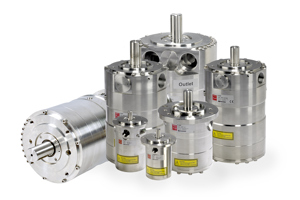
ITC selected two Danfoss APP 65 axial piston pumps running in parallel for testing in the plant’s high-pressure reverse osmosis stage.
“The choice of PD high-pressure pumps was obvious to achieve the objectives,” says de la Fuente Bencomo. Not only do APP pumps consistently achieve unrivaled energy efficiency in plants of this size, but their compact design also aligns with the plant’s modular, containerized setup. Just as important, their proven reliability in the field makes them well suited for a replicable system where long-term performance, minimal maintenance, and operational stability are essential.
After carefully laying the groundwork to meet the ambitious target of an SEC below 2.0 kWh/m³, ITC’s results were even better than projected. On 26 February 2025, the facility achieved a verified SEC of just 1.794 kWh/m³, earning a Guinness World Records title for the lowest energy consumption ever recorded by a seawater desalination plant. This groundbreaking result, achieved at the project facility in Pozo Izquierdo, Gran Canaria, significantly outperformed the project’s original targets – and easily surpassed the previous record of 2.27 kWh/m³ held by SWCC in Saudi Arabia.
“This is a significant milestone – not just for the Canary Islands, but for desalination technology worldwide,” says de la Fuente Bencomo. “It shows what’s possible when you combine robust design with innovation and proven technology.”
Thanks to its modular design and scalable components, the DESALRO® 2.0 utility model is already being adopted in a range of municipal projects across the Canary Islands and beyond. One example is the construction of eight new containerized plants for irrigation based on the same configuration. Another is a 5,000 m3/day future plant for domestic purposes.
“These new installations will bring clean water to more Canary Island sectors, with lower energy use and carbon emissions, than any comparable plant,” de la Fuente Bencomo concludes. “We’re proud to be setting a new standard for more sustainable desalination.”
Editor’s note (November 2025)
The range of high-pressure APP pumps is optimized for both landbased, off-shore and marine sea water reverse osmosis applications. Available with or without motor.
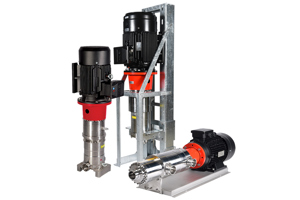
With a 3-in-1 design that integrates highly effective isobaric pressure exchangers with positive displacement booster pumps and electrical motors, active iSave® ERDs deliver big energy savings in small spaces. Covering train sizes from 200-3,000 m3/day