
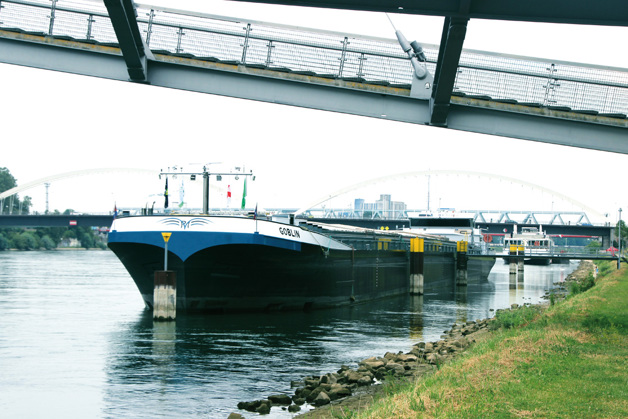
Venturing into hybrid propulsion was a bold step for the Vranken family’s dry cargo bulk carrier business, which serves the inland waterways of the Rhine. It has paid off fast, delivering rock-bottom operating costs, thanks to an innovative diesel-electric propulsion system.
The propulsion supplier, Hybrid Ship Propulsion BV, predicts even more potential in this exciting technology. They have achieved as much as 20 - 25 % reduction in fuel costs with the introduction of hybrid and electric propulsion to harbor tugs and ferries. The MS Goblin propulsion was the first of many hybrid projects, which have since established Hybrid Ship Propulsion BV as one of the leading suppliers of hybrid and electric propulsion systems in the Netherlands.
12.5 % less fuel consumption thanks to VACON® NXP Liquid Cooled Drive
The Vranken family ordered the new build of MS Goblin as sister ship to their first ship, the MS Lutin, which had operated since 2009. However, as they wanted to achieve the lowest possible operating costs, they chose an innovative diesel electric propulsion system instead of the traditional diesel propulsion system used on the MS Lutin.
Their decision has repaid itself many times over. The captain and co-owner of the MS Goblin, Danny Pols explains: “My brother in law and I measured and compared the fuel consumption of the 2 vessels on a round trip where the vessels were loaded with equal load and travelling one after the other. The ships had exactly the same performance but the MS Goblin used 12.5 % less fuel than the MS Lutin.”
Furthermore, the maintenance cost is 3000 € / year lower on the MS Goblin due to less running hours of the diesel engines. The maintenance cost includes spare parts and consumables such as lubrication oil, filters, fuel injection nozzles, and more.
A typical diesel engine also needs a complete overhaul after 20,000 hour in operation. The lower operating hours per engine will postpone the need for the overhaul.
Hybrid propulsion in 3 power modes
The hybrid propulsion system offers three power modes. Optimum performance is achieved by adjusting the mode to the conditions of the voyage.
- E-mode
In this mode, the Goblin runs without the main diesel engines and instead runs on the generator set. The main engine and the reverse clutch are out of operation and only the thrust bearing of the reverse clutch is used in the E-mode. The E-mode provides comfort while sailing. The generator can run at a variable speed to reduce fuel consumption and reduce the acoustic noise level. - Diesel-mode
In this mode the Goblin runs on the diesel engines only (conventional). The E-motor nevertheless also rotates while sailing in diesel mode because the E-motor is located around the propeller shaft, and connected to a flange on the propeller shaft. The E-motor therefore provides power to the on-board electrical system through an electronic grid generator, the VACON MicroGrid. While sailing, the VACON®MicroGrid system always supplies pure 50 Hz to the on-board electrical system. This means that the diesel generator set does not need to run whilst the ship operates in diesel mode. - Hybrid Diesel + E-mode
The Goblin has the advantage of offering both diesel and E-mode modes of operation. This flexibility means that it uses all the available power for propulsion. The main engines run at a slightly higher speed and that part of the rotational speed gives the e-motor an extra boost. While sailing, the Goblin can switch seamlessly between the three modes of operation.
Everything is programmed and approved by the ship classification society, to ensure that all operations function properly. Even from full speed ahead to full speed astern (in an emergency situation) it can switch from E-mode to Diesel-mode or hybrid mode.
Get more information
Read case story as a PDF
Read more about VACON® NXP Liquid Cooled
Read more about Marine and offshore
Read more about Hybridization