Control Subway Operating Costs
Subway operators not only pay attention to the temperature and humidity control of the subway air-conditioning system, but also highlight system energy conservation and stability. According to the subway operating data of a first-tier city in 2013, air-conditioning electricity consumption in subway stations and carriages took up 40-50% of the entire subway electricity consumption. The frequent maintenance of subway air-conditioning equipment also brought great pressure to the subway operating costs. Take summer, with the greatest reliance on air-conditioning, for example; the operating cost of subway central air-conditioning is 3 times more than during the rest of the year. Therefore, energy efficiency is no longer an option!
Guogongzhuang Subway Station Saves 3 “1 Million” Within One Year
The Beijing Subway Line 9, completed at the end of 2011, aims to be a demonstration line in terms of energy conservation and carbon emission reduction which is something to consider from the beginning. Beijing Urban Engineering Design Research Institute Co., Ltd., the design team of “Guogongzhuang Subway Station”, selected variable speed as core technology for subway air-conditioning. Danfoss joined McQuay Air Conditioning & Refrigeration (Wuhan) Co., Ltd. to develop the air-conditioning system of the station.
The operation time of the air-conditioning units is from May to October every year, and for the past two years, the units operation time has added up to 1year in total.
Due to interval subway classes and night off-stream, the passenger flow at the station hall changes dramatically. In addition, due to the great seasonal temperature difference in Beijing, the air-conditioning system frequently switches from peak to part-load and extra-low load.
The reality demonstrates annual efficiency and energy conservation of 3 * “1 million” and provides a satisfying answer under all circumstances. Compared to traditional constant frequency screw units, maglev water chiller units have saved about:
- 1 million kW of energy consumption,
- More than RMB 1 million of electricity charges
- 1 million kilograms of CO²
Unit IPLV as high as 11
The integrated converter-driven control technology of Danfoss Turbocor® compressors allows 4 units in Guogongzhuang Subway Station to realize over 11 IPLV and seasonal efficiency could reach 13. When condensing temperature and/or thermal load changes, compressors regulate cooling capacity to meet actual demand by controlling and adjusting the rotating speed of motors and vanes through frequency converting control. In the meanwhile, compressors can avoid surges to achieve the best efficiency. Compared with ordinary cooling units, chillers equipped with Danfoss Turbocor® compressors are still be able to operate smoothly even in 10% under-load operating conditions.
Unit Design Brought More Benefits
- Enhanced lifetime: the unit is designed with two compressors and both can run independently. Before one of them reaches full-load capacity, the other one starts to operate based on the left load, adjusts to the required capacity and avoids the full-load operation of the first compressor. This unit design enhances the lifetime of the compressors and improves overall system safety.
- Compactness: the compressor model is only half the size of the screw machine and the entire unit width is less than 1.2 meters. It is very convenient for installation and frees up space in the machine room area.
- Quiet operation: the extra-low noise vibration-free functioning of 72 dB doesn’t impact surrounding facilities, eliminates the need for insulation equipment and facilitates the unit construction.
- Reduced maintenance costs: the Maglev unit oil-free system even could save after-sales maintenance costs. It’s predicted that RMB 600,000 – 700,000 could be saved during the entire life cycle.
These added values have won the operators’ recognition and praise.
* ASHRAE research report shows that the energy efficiency of a water chiller with 3.5% oil content can be reduced by as much as 8%
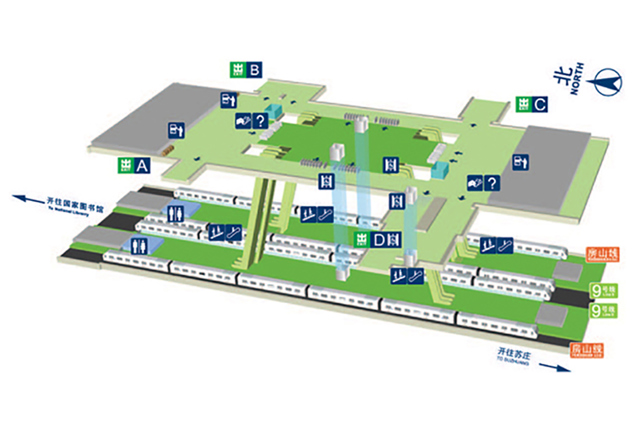
Guogongzhuang Subway Station in Brief
- Hall of 15,000 square meters
- Terminal station for both Line 9 and Fangshan Line
- 1st cross-platform interchange in Beijing
- Direct connection on the same floor