
Industrial Refrigeration Application Handbook
The Danfoss application guide is designed to be used as a reference document. The guide aims to provide answers to the various questions relating to industrial refrigeration system control and in answering these questions, the principles of the different control methods are introduced followed by some control examples, comprising Danfoss Industrial Refrigeration products.
It is non capacity and performance related and operating parameters of each application should be considered accordingly before adopting any particular layout. Not all valves are shown, and the application drawings are not to be used for construction purposes. For the final design of the installation it is necessary to use other tools, such as the manufacturer’s catalogues and calculation software (e.g. Danfoss Industrial Refrigeration catalogue and coolselector tool). Coolselector is the software for calculation and selection of Danfoss Industrial Refrigeration valves. Coolselector is delivered free of charge. Please contact your local Danfoss sales company. Please do not hesitate to contact Danfoss, if you have questions about control methods, application and controls described in this application guide.
This chapter provides an introduction to various vapor compression refrigeration systems and their applications.

The compressor is the “heart” of the refrigeration system and it has two basic functions: 1. Maintain the pressure in the evaporator so that the liquid refrigerant can evaporate at the required temperature; 2. Compress the refrigerant so that it can be condensed at a higher temperature.

In areas where there are large variations in ambient air temperatures and/or load conditions, it is necessary to control the condensing pressure to maintain a high degree of system efficiency. Read about the different solutions in this chapter.
Condensers disperse the heat from the refrigeration system to the ambient air or water. Controlling the condenser is essential for the efficient operation of the refrigeration system.
Liquid level regulation is an important element in the design of industrial refrigeration systems. It controls the liquid injection to maintain a constant liquid level. Read about the main principles; High pressure liquid level regulation system (HP LLRS) & Low pressure liquid level regulation system (LP LLRS)

The evaporator is the part of the refrigeration system where the effective heat is transferred from the media you want to cool down (e.g. air, brine, or the product directly) to the refrigerant. Therefore, the primary function of evaporator control system is to achieve the desired media temperature. Furthermore, the control system should also keep the evaporator in efficient and trouble-free operation at all times.
Generally, industrial refrigeration compressors are lubricated with oil, which is forced by the oil pump or by the pressure difference between the high and the low-pressure sides to the moving parts of the compressors (bearings, rotors, cylinder walls etc.). In this chapter you can read about control of oil temperature and oil pressure which are the two main oil parameters which needs to be controlled to guarantee reliable and efficient operation of the compressor.

All industrial refrigeration systems are designed with different safety systems to protect them against unsafe conditions, like excessive pressure. Any foreseeable excessive internal pressure should be prevented or relieved with minimum risk for people, property and the environment. Requirements on the safety systems are heavily controlled by authorities, and it is therefore always necessary to verify the requirements in the local legislation in various countries. Generally the illustrations in this chapter reflect the EN 13136 standard, but some should be considered to be ‘best practice’.
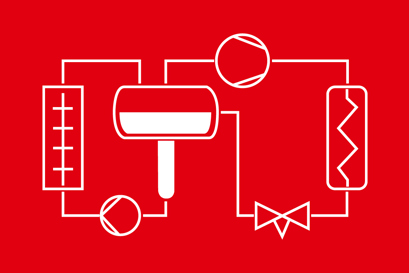
Typically, industrial refrigeration systems have pump circulation of liquid refrigerant. There are some advantages of pump circulation compared with DX type systems. The pumps provide efficient distribution of liquid refrigerant to evaporators and return of vapor-liquid mixture back to the pump separator. By supplying more refrigerant than the evaporators can evaporate, called overfeed, it is possible to avoid superheating the refrigerant in the evaporator, thereby increase efficiency of the evaporators, without risk of liquid hammer in the compressor. In this chapter you get “best practice” within designing pump systems including capacity control and safety issues.

This chapter covers industrial refrigeration applications for removal of water and air in the system as well as heat recovery systems. These applications aim at optimizing operation of the refrigeration systems, reducing the energy consumption and harvesting excess heat for other purposes, e.g. space heating or hot water production.
This chapter covers the use of C02 in industrial refrigeration applications. The use of carbon dioxide (CO2) in refrigeration systems is not new. Carbon dioxide was first proposed as a refrigerant by Alexander Twining (ref. [1]), who mentioned it in his British patent in 1850. Thaddeus S.C. Lowe experimented with CO2 for military balloons, but he also designed an ice machine with CO2 in 1867. Lowe also developed a machine onboard a ship for transportation of frozen meat.
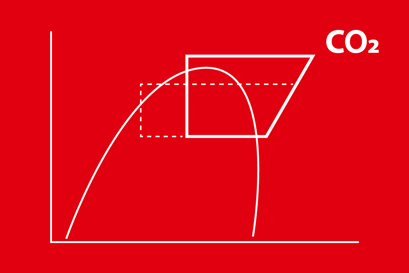
The chapter will cover an introduction of transcritical C02 systems and the typical layouts including booster system, parallel compression and using low pressure ejectors, high-pressure ejectors and liquid ejectors. It also covers the most commonly used products in the high-pressure side and the by-pass line.
Heat exchangers perform the primary duties of the refrigeration/heat pump systems – heating and cooling - as well as several internal functions. For efficient operation of heat exchangers, it is necessary that the system is both designed, constructed and controlled appropriately. The chapter will cover the usage of heat exchanger in a selection of refrigeration applications.