
“This is the second step – and an important one - for us on our decarbonization journey in Burner Components,” says Stefan Spornberger, Head of Application, Development & Project Management, and elaborates: “We acquired the first TÜV certification for our Bio30 pump and the first UL approval for Bio20 back in 2021, and now we have two new upgrades for up to 100% biodiesel. The approvals will be very valuable especially for our efforts to market the pumps in Europe and the US. Obtaining these approvals for our new biofuel pumps demonstrates our commitment to be first movers and set the industry standards for quality, safety, and not least sustainability. We already supply our Bio100 pump to one of the major burner manufacturers in North America, who also announced the launch of their first Bio100 compliant burner at the beginning of this year".
No brass components in new biofuel pumps: no corrosion
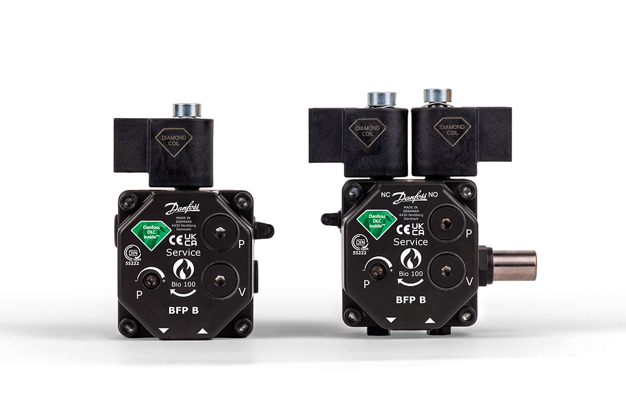
Ina Corneliussen, Product Manager, Burner Components, explains how the new biofuel-ready pumps address the known challenge of biofuel versus brass components: “Safety is and always has been a main priority for us. That is why we have changed the brass components in our Bio100 pumps. We make sure that all product components are biofuel compatible.”
BC introduced the new line of biofuel pumps at the ISH exhibition in Frankfurt back in March 2023 (watch the video). “And shortly afterwards, we started the process of acquiring the certificates,” says Stefan, who handled the project together with his team of engineers.
The future is yesterday
A few years ago, BC started to develop a future-ready portfolio of nozzles for water spray applications and pumps for liquid low-carbon fuels as part of their decarbonization journey. Today, the portfolio includes preheaters, boiler thermostats, fuel pumps, nozzles, and ignition units. “In the future, which actually started yesterday, our new nozzle program will be used increasingly in water spray systems, and the pumps in installations that use new types of synthetic oils and biofuels,” confirms Stefan and Ina.
“Some of the largest OEMs are already using our Bio30 pumps and have approved them for their applications, and we can see that more of our existing customers are interested in switching to Bio30 pumps or even higher content of biofuels. France changed its regulations to only install Bio30 ready products in their boilers since July 1, 2022, but they are already planning to increase to much higher content and now we are ready for that with UL and TÜV certificates / DIN CERTCO approved Bio100 pumps”, comments Stefan Spornberger. “We are pleased to support our customers’ decarbonization efforts by providing them with best-in-class solutions for transitioning to carbon-neutral energy sources.”
Learn more about the new Biofuel pumps
See the certificate: TÜV/DIN CERTCO 5S222

The future of biofuels: Evolution, challenges and opportunities at ISH 2025
Danfoss burner components sees biofuels as a critical bridge to a Net Zero heating future, anticipating wider adoption and more integrated biofuel plant solutions in the years ahead. Despite ongoing market adjustments and concerns about performance and supply, biofuels are gaining momentum through early adopters and growing policy support.

Danfoss Bio100 Pumps
Danfoss expands its line of high-quality burner components by introducing the 100% biofuel ready pumps. The Bio100 pumps support any fuel mix, enhancing the overall efficiency of the heating burners.
FACT BOX :
Facts - Biofuel versus brass components in fuel pumps:
Traditional fuel pumps contain copper or copper-containing metals, for example brass. Independent research has shown that contact between parts made of brass and biofuels should be avoided. When biofuel comes in contact with this type of nonferrous metal, it oxidizes and polymerizes. The fuel’s acid content increases and it becomes more corrosive. The fuel will then react with these metal parts in the pump, which can adversely impact pump performance, cause leakage, or lead to the safety function (e.g., solenoid valve) failing.
Additionally, the combination of copper-containing parts and higher temperatures harms the biofuels because of the internal circulation process. The fluid passes these parts several times, thereby reducing the biofuel’s stability and causing the fuel to degrade.
Case stories
Committed to sustainable heating solutions and helping its customers progress towards CO₂ neutrality, the company wanted to transition its residential burners from standard pumps to Bio100 pumps. However, there is significant uncertainty in the market surrounding Bio100 pump adoption. While these pumps are undoubtedly the future, there are risks associated with being amongst the first movers. Despite these concerns, this OEM’s commitment to CO₂ neutrality and innovation drove its decision. After a thorough market investigation, the company chose Danfoss' Bio100 pumps for their proven reliability, paving the way for a greener future in Germany and Europe.