
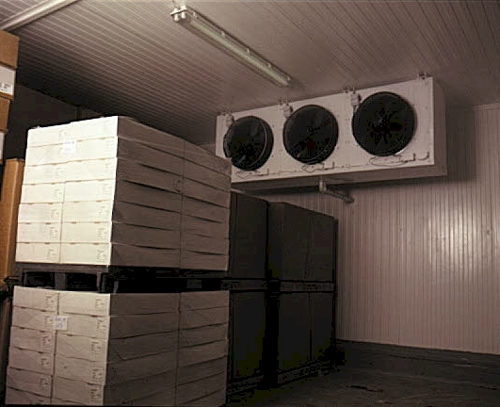
Virtually all cold storage facilities use air-coil evaporators for space refrigeration. Each evaporator has one or more fans of either centrifugal or axial type. Most modern applications utilize axial fan evaporators.
The number of fans can vary from one to six per evaporator. These fans typically range in size from 1/3 hp to 10 hp or larger. Since the motors of these fans operate in a cold environment, they are often sized to operate well inside their service factor. These motors not only use electricity but also the heat generated by these motors must be removed from the space as a refrigeration load. In some facilities, evaporator fans are not only a large energy user, but also a primary contributor to refrigeration load.
Evaporator coils may employ any of a variety of capacity control methods, including:
- Solenoid for liquid refrigerant interruption
- Fan cycling or manual fan shedding
- Back-pressure regulators to change refrigerant pressure in the coil
- Two-speed fan motors
- Mechanical (variable sheave) or electro-magnetic (eddy-current clutch)
- Engine room suction pressure
- No control – room temperature and refrigeration system reach equilibrium
The most common methods of control in cold storage are solenoids, fan cycling (manual or automatic) or back-pressure regulators (BPRs). Unfortunately, of these methods, only fan cycling provides energy savings.
Save energy – VFD control
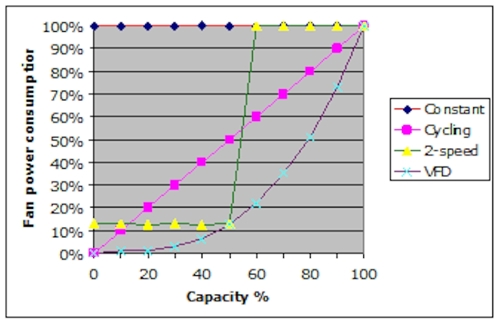
As we know, fan power benefits from a cubic reduction as speed is reduced. A comparison of power requirements for the most common control methods is shown in this graph.
2-speed motors can provide excellent savings but flexibility is limited to two operating speeds only. Fan cycling can provide savings as well, although some applications will not allow fully reduced airflow. However, as the graph shows, the maximum energy savings and flexibility result from full-range speed control of the fan.
When using VFD technology for evaporator coil capacity control, there are some issues that need to be taken into consideration:
- Minimum speed acceptable to be determined by the room configuration and the need for high air movement. In general, most cold storages can be operated at substantially reduced fan speed with no increase in temperature stratification or the appearance of ‘hot spots’.
- Maximum speed – a maximum speed set point provides a number of advantages. First, due to coil effectiveness, a coil operating at 80% fan speed still provides 90% of the rated capacity. At the same time, this reduces the fan power to nearly 50%. In addition, a maximum fan speed helps reduce utility peak demand charges.
- Control system & sensors – fan speed control is best implemented with a reasonably sophisticated control system and a sufficient distribution of temperature sensors throughout each cold storage zone. It is important to control the VFD in such a way that all zones in cold storage are maintained at an acceptable temperature.
Article by: Deepinder Singh Chani