This is the first post is a series about the advantages of using variable frequency drives (VFDs) in refrigeration and cold storage applications. Using VFDs to control compressors, evaporator and condensor fans, and pumps in these applications provides maximum flexibility, full control and maximum energy efficiency.
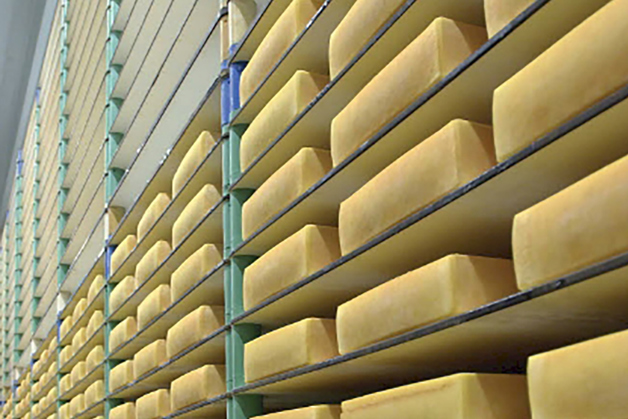
The initial cooling, processing and cold storage of fresh fruit and vegetables is among the most energy intensive segments of the food industry. Significant levels of refrigerants and heating are needed to slow down spoilage and maintain preharvest freshness and flavor of ripe fruit and vegetables.
Variable frequency drives make it possible to quickly provide the necessary cooling or heating to maintain a uniform temperature, humidity, air-circulation or fresh air requirements in cold storage while at the same time the energy consumption is reduced to a minimum.
VFD Control Background
In standard system design electric motors are intended to operate at a fixed speed. This speed is determined by the frequency of the power supply and the motor design (number of poles). The shaft load on the motor is determined by the product of shaft speed and torque. With a fixed speed, motor power is determined by the torque of the load. With a change in speed the motor load will not only benefit from the speed reduction, but also any reduction in torque with speed. Two types of motor load exist; constant torque and variable torque.
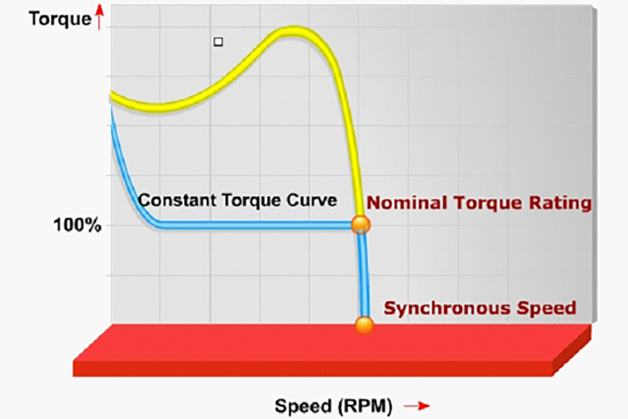
Positive displacement compressors (i.e. screw, reciprocating or rotary vane compressors) are constant torque devices. That means that the force required to turn the shaft is constant, regardless of the speed. Therefore the shaft power is determined by the operating conditions (pressure) and the method of capacity control, which both effect the torque. In general a reduction in speed of for example 50% will provide a proportional reduction in shaft power of 50%.
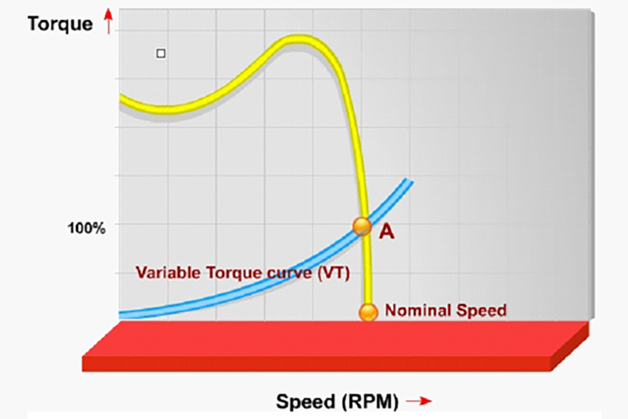
Fans are variable torque devices. The force required to turn the shaft is not constant but rather a squared function of the shaft speed. This means that the shaft power, which is the product of speed and torque, will vary as the cube of speed. This is quite important because in this case a reduction in speed of 50% will result in a dramatic cubic reduction in power of up to 80%.
General VFD Application
Why should you use a VFD for cold storage capacity control when a variety of alternative control methods exist? The general answer is that a VFD gives better control and more efficiency. For compressors, fans and pumps.
There are several incentives for using for example the VDF speed control on screw compressors:
- VFD speed control will reduce the power penalty associated with the slide valve, poppet valve or throttling capacity control. On compressors with no capacity control speed control will eliminate other poor control strategies.
- VFD speed control will reduce wear and tear associated with slide valve action.
- VFD speed control allows a precise suction pressure to be maintained. With a slide valve a broad dead band is often maintained to avoid excessive wear.
- VFD speed control makes it possible to reduce compressor size with the same system capacity demand.
For evaporator fans several incentives exist for speed control:
- VFD speed control provides dramatic fan power reductions at reduced speed. This also translates into reduced motor heat loads in refrigerated spaces.
- VFD speed control provides outstanding space temperature control relative to cycling.
- VFD speed control provides outstanding humidity control.
- VFD speed control will reduce the fan noise dramatically at lower speeds. This creates a more pleasant working environment in distribution centers and the like.
- For cold storage, reduced fan speed may improve the storage of perishables such as apples in a controlled atmosphere. The mass loss from fruit is reduced.
Similar to evaporator fans several incentives favor speed control on condenser fans:
- VFD speed control provides dramatic fan power saving relative to fan cycling.
- All condenser fans can be ramped together in speed and ensure that all condenser fans can operate to minimize condensing pressure when possible.
- A wet-bulb approach feature can be used to match the delivered condenser capacity to actual heat rejection requirements, regardless of ambient conditions.