
Refrigeration systems using CO₂ as refrigerant provide a number of benefits
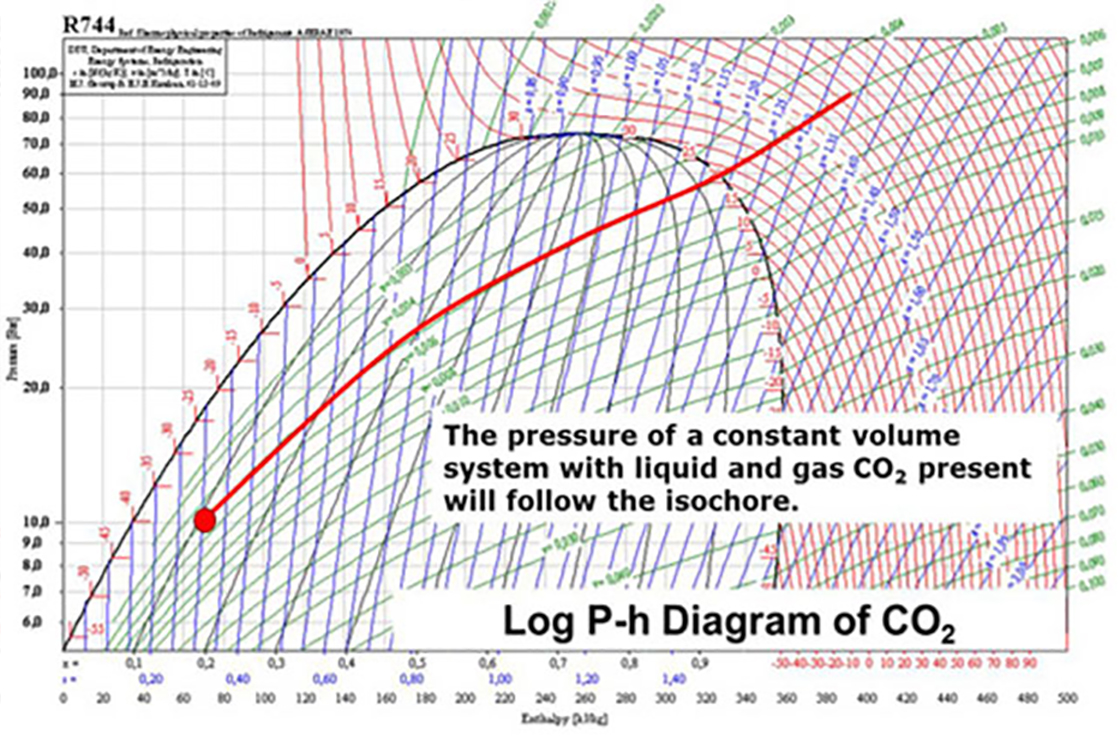
Graphic of rising pressure with temperature during system downtime
Refrigeration systems using CO₂ as refrigerant provide a number of benefits such as superior efficiency, integrated heat reclaim and a reduced carbon footprint. Both subcritical and transcritical type systems have gained in popularity in recent years, especially in food retail refrigeration, but also in other segments. The share of new store installs and retrofits with CO₂ is significant and growing. It is fair to say that within few years, there will be urban areas with several hundreds of stores. Large grid power failures do not happen often, but over time, they do occur. Heavy weather taking out a transformer substation on a hot August day could lead to a handful of service technicians trying to recharge these systems before food at great expense needs to be discarded; an unforgiving task.

Hypothetical distribution of stores with CO₂ systems in greater London
Whether it is a grid power failure or system shut down during servicing, peace of mind comes with knowing that the system is able to cope with the temperature and the pressure. With Danfoss' new line of components designed for intrinsic standstill security, distributed CO₂ refrigeration systems can be built with peace of mind. Expensive backup systems that never work when you need them and cost a fortune to service can be avoided. Danfoss has determined that the optimal pressure level for standstill capable systems is 90 bar (1300 psi).
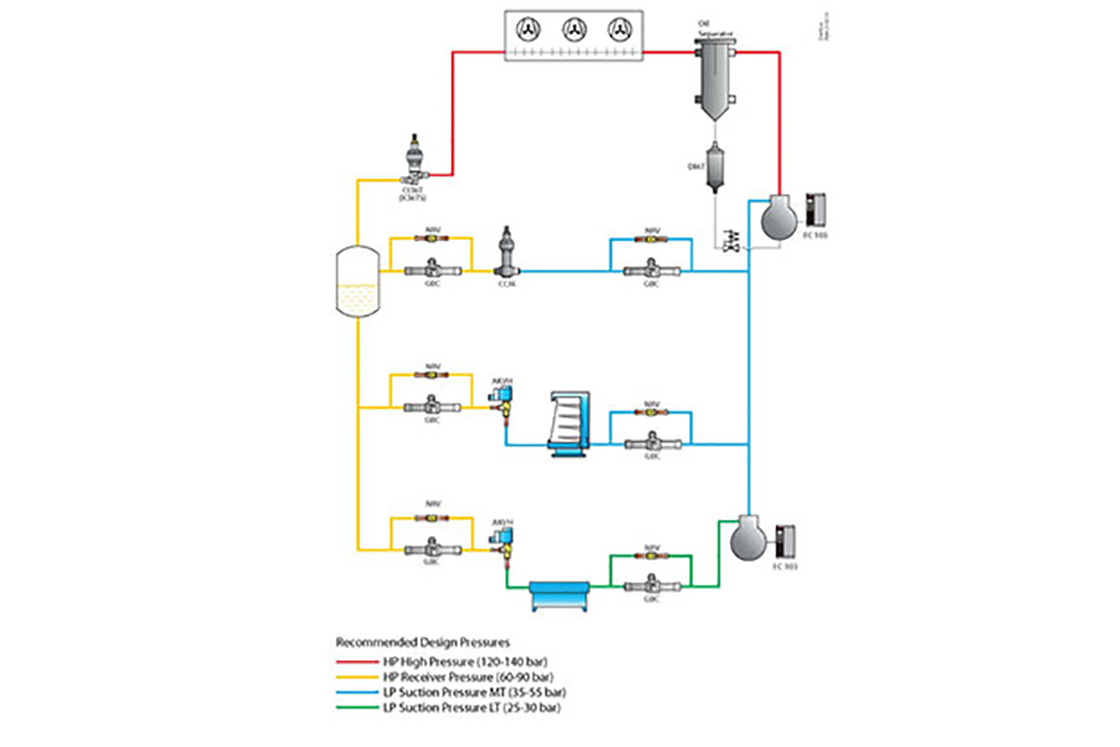
System graphic showing the typical transcritical CO₂ booster system
Standstill capable GBC ball valves and NRV check valves
Extensive laboratory and field testing has been done to ensure these seemingly simple components can live up to the needs of the industry. The new series of valves have now been tested in the field for over 2 years to ensure good material compatibility and robust function. The standstill capable valves with 90 bar (1300 psi) Maximum Working Pressure, allow for simple to service systems and complete system shutdown without blowing the charge. The NRV can be used either in hot gas lines or for internal (upstream or downstream) pressure relief of the components isolated with the GBC ball valves. Both the NRV and GBC are tested to withstand up to 90 bar differential across the closed valves. As with all Danfoss valves for CO₂, they are tested to the standards of the Pressure Equipment Directive and live up to the requirements of the EN12284, PED harmonized standard.
- 90 bar (1300 psi) Maximum Working Pressure
- Up to 90 bar (1300 psi) differential when closed
- Sealing materials developed specifically for CO₂
- Sizes up to DN22 (7/8") available with copper connections
Complete line of Standstill Capable and Transcritical controls
The ball and check valves are only the newest addition to the Danfoss series of standstill capable and transcritical components, compatible with the award winning line of Danfoss ADAP-KOOL® controls. The AKVH, CCM, CCMT, and ICMTS expansion valves are all either capable of at least 90 bar maximum working pressure. AKVH expansion valves for case control are a further development of the AKV expansion valves which for over 25 years has ensured high food quality and exceptional energy savings. Used together with the newest generation of Danfoss case and pack/rack controllers, the benefits are many:
For the AKVH electronic expansion valve:
- Minimum stable superheat (MSS) optimization maximizing evaporator utilization
- Floating condensing pressure for optimal COP
- P0 optimization for optimal COP and reduced defrost cycles
- Long lifetime proven in the field
- Serviceability with built in strainer and exchangeable orifice for precise control after lid retrofits
- Food quality and reduced wastage by ensuring a constant air temperature
- Fewer defrost cycles reducing operating costs and avoiding dehydration of frozen foods
- Normally closed and solenoid tight valve during power failure avoiding compressor failure
- Silent and energy saving actuation with the soft open EEC coil
- 90 Bar MWP and 35 Bar MOPD for versatile use and standstill capability
- Remote monitoring and case fault detection through ADAP- KOOL® controls
For the ICMTS transcritical control valve:
- Optimal control for highest system COP with the patented high pressure algorithm
- Proven in the field with over 3000 installations since 2006
- Designed for transcritical operation with 140 bar (2030 psig) MWP and 90 bar (1300 psig) MOPD
- Magnet coupling for real hermetic sealing of the actuator
- Manual operation possible via ICAD 600TS or the Multi-function tool
- Wide range of control with 4 different sizes available
For the CCMT transcritical control valve:
- Optimal control for highest system COP with the patented high pressure algorithm
- Designed for transcritical operation with 140 bar (2030 psig) MWP and 90 bar (1300psig) MOPD
- Optimized for small to medium sized applications, available in 3 sizes
- Patented cone and balance design with built in strainer for trouble free operation
- Combo connections for engineering freedom (Solder/Braze or Weld)
For the CCM gas bypass and liquid expansion valve:
- Precise positioning for optimal control of intermediate pressures in transcritical CO₂ systems or for liquid injection in heat exchangers
- Proven in the field with over 1500 installations since 2009
- Combo connections for engineering freedom (Solder/Braze or Weld)
- Low temperature stainless steel valve housing
You can find more information and material about GBC ball valve and NRV check valve on below links.