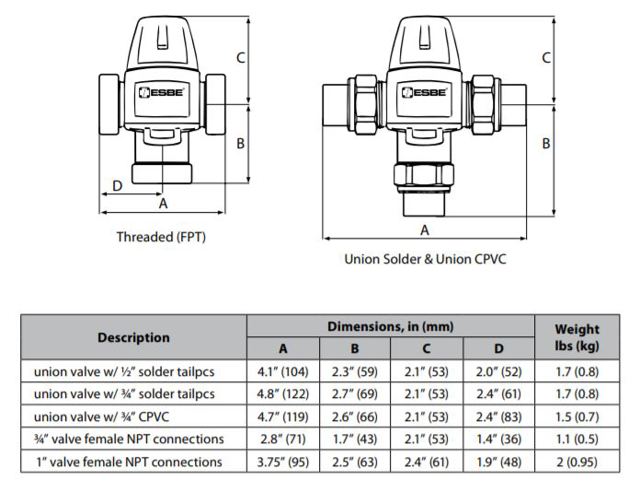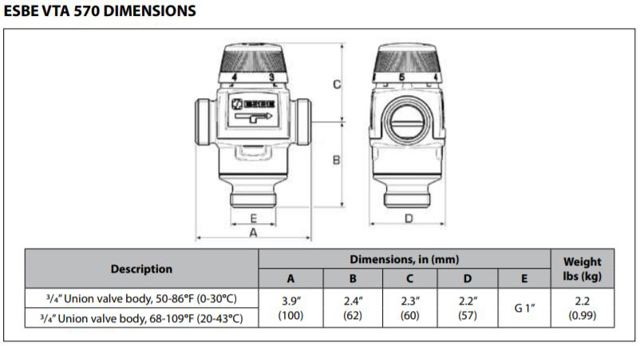
The three way mixing valves feature anti-scalding technology and are available in a VTA Series Lead Free style or a VTA 570 mixing and diverting style for closed loop applications.
Snap-on cover prevents debris as well as unauthorized adjustment or tampering
Compact lightweight design used in domestic & radiant heating applications
Suitable for hot water recirculation
Quiet operation with long lifespan & easy maintenance
Anti-scald & anti-legionella protection
A variety of connections available:• Threaded body (FNPT)• Solder Union• CPVC Union
The 3-way ESBE VTA Series thermostatic mixing valves replace Series 20 & 30MR styles of valves and are designed for point of source in domestic hot water distribution systems and/or regulation of supply in hydronic heating systems.
They are available in a range of connection sizes, types, and temperature ranges. See below.
Solder & CPVC Valve Body
Required Tailpiece Kit
The 3-way ESBE VTA570 can be utilized in a mixing or diverting application for hydronic closed looped systems (not for potable water). Typically, this thermostatic control is used as a non-electric alternative for a 2-pipe changeover diverting application.
VTA570 Valve Body
Low maintenance, easy-to-install thermostatic mixing valves (TMVs) are designed to protect against accidental scalding, & increase amounts of available hot water.
View

View case study
KOVM mixing valve bodies are designed to maintain room temperature by controlling hot (or chilled) water flow through radiators, fans, convectors, etc. Due to the KOVM’s unique bypass design, a constant system flow is achieved regardless of the room’s heating (or cooling) requirements. Therefore system pressures and flow rates are automatically kept constant without the need for pressure controlled bypass valves.
Motorized rotary actuators specific to ESBE rotary valves that operate on a variety of input signals.
ESBE Rotary valves are designed for regulation of flow temperatures in hydronic heating or chilled systems.
Find information on hydronic heating troubleshooting, including our top frequently asked questions, our video library, links to hydronic heating literature, a link to our newsletter, and more.
Go to Technical Support page