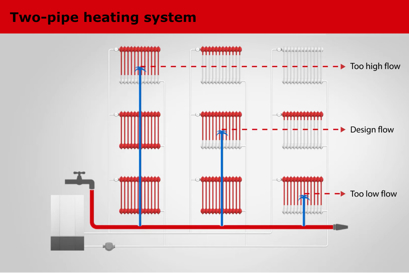
With static hydronic balancing, the mass flows are regulated manually, via pressure-dependent valves. Here, the mass flows are calculated and set exclusively for full load cases – efficiency-optimized heating water distribution is therefore only aimed at for the maximum utilization of the heating system. This means that the partial load case or varying load ratios cannot be mapped with this solution – which is why it is known as static balancing.
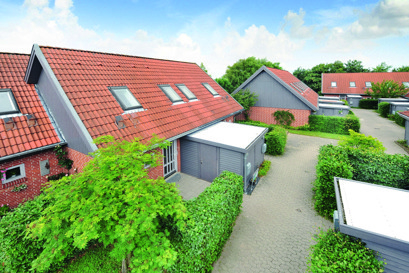
If the room-by-room heating load is included in the calculation, static balancing offers the best cost-benefit ratio among balancing solutions for detached and semi-detached houses or multi-family houses with small residential units. This is because the pressure-dependent thermostatic or balancing valves required for its implementation are already present in most existing systems or can be retrofitted at low cost if necessary. Even with underfloor heating systems, static balancing is completely sufficient for smaller residential units, as dynamic balancing only offers insignificant advantages due to the inertia of the system. Static pre-balancing in combination with adaptive heating optimization based on room temperature achieves the best results here.
Since the mass flows are only optimally balanced in full load cases, flow noises often occur in partial load cases, which are caused by increased flow speeds in the thermostatic valves. It is also important to remember that the full load case only occurs a few days a year and the heating system is therefore not optimally balanced for the rest of the year. Nevertheless, carrying out simple static balancing is more beneficial in terms of energy than completely omitting hydronic balancing. Our tip: The combination of "static balancing" with a high-efficiency pump with the lowest possible and constant delivery head provides a solid basis for almost any smaller residential unit.
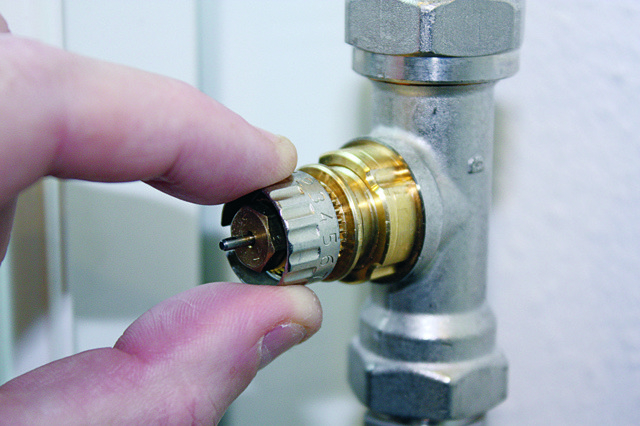
Suitable components for static hydronic balancing are thermostatic valves type RA-N or RA-UN or built-in valves; combined with mechanical radiator thermostats RA2000. And manifolds and controls for hydronic floor heating IconTM, and balancing valves Danfoss series of LenoTM or MSV-F2.
Danfoss Heizkörperthermostate halten die Raumtemperatur für jeden Raum auf dem gewünschten Niveau und tragen zur Senkung des Energieverbrauchs bei. Mechanische Thermostate, Design-Thermostate oder elektronische Thermostate – hier finden Sie sie alle.
Robust gebaut und auf die Anforderungen des gewerblichen und industriellen Bereichs ausgelegt, steht ein umfassendes Programm an Danfoss Ventilgehäusen für nahezu alle Systeme und Einbaubedingungen zur Verfügung.
Hahnblöcke für Ventilheizkörper mit und ohne Differenzdruckregelung
Manuelle Strangventile bieten einen statischen hydraulischen Abgleich für viele HLK-Anwendungen. Die Ventile begrenzen den Durchfluss in die verschiedenen Stränge von Heizungssystemen. Da manuelle Strangventile nicht auf schwankende Bedingungen reagieren können, empfehlen wir den Einsatz solcher Ventile in Systemen mit konstantem Durchfluss.
Klicken Sie hier, um Dokumentation, Softwareinformationen, Installationsvideos und Anleitungen zu finden.
Dynamic hydronic balancing keeps the water flows and differential pressure of the heating system constant throughout the building under all load conditions and offers high energy saving potential, especially in large buildings.
Auto-balancing can be used in addition to or as an alternative to static or dynamic balancing. Auto-balancing solutions use intelligent digital system control to ideally implement complete hydronic balancing without complex pre-calculations.
Hydronic balancing is one of the most important measures for optimizing heating systems. Although all experts are aware of this measure, it is still difficult to draw clear distinctions between its variants – static, dynamic and auto-balancing.