Enhance your projects and secure long-term reliability and energy efficiency with the industry’s most comprehensive CO₂ product range and expertise. Benefit from solutions designed to help you scope, build, and maintain CO₂ refrigeration systems proven to perform across different applications and climates.
Contact us
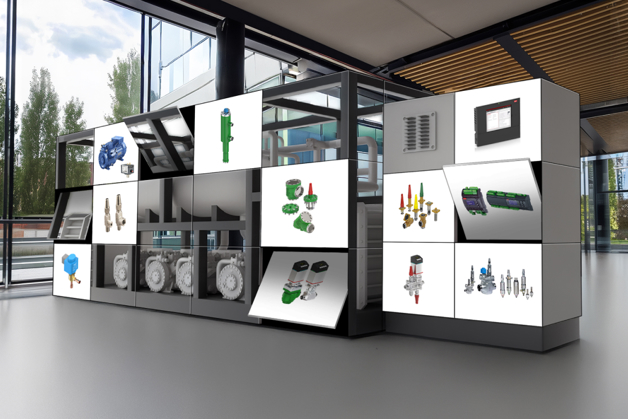
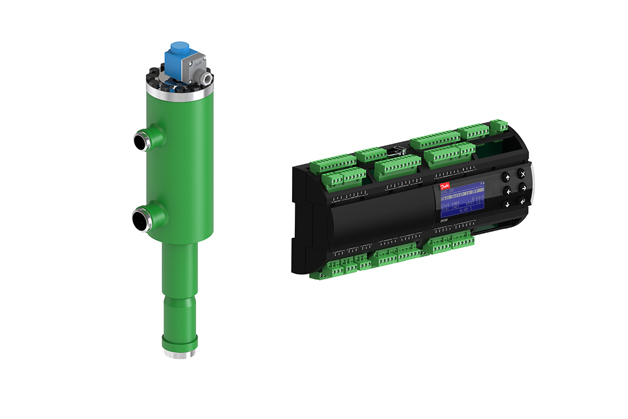
The new large ejector solution is the largest scalable ejector
available on the market, designed to deliver immediate
efficiency gains while simplifying system design, installation,
and maintenance. The solution delivers higher overall system
efficiency and lower energy consumption by improving cooling
system efficiency.
Learn more
Product range
- For CO₂ systems with parallel compression
- Lifts part of the gas from MT suction and mixes it with gas from gas cooler at medium pressure level
- Designed for large capacity transcritical CO₂ systems
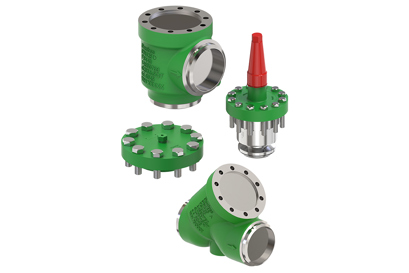
- Balances large differential pressures
- Long-lasting seat design and replaceable valve seat
- Designed for favorable flow conditions

- Simplified installation and design
- Precise regulation at partial load conditions
- Specifically built for heavy commercial and industrial applications
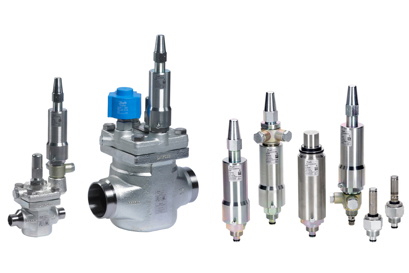
- 65 bar upgrade makes subcritical CO₂ and NH3 heat pump applications easy
- Operational safety and efficiency
- High design flexibility
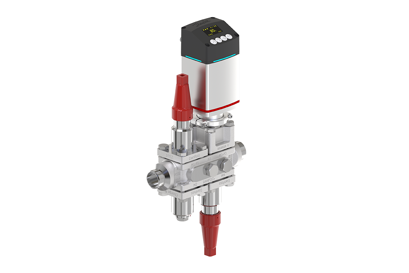
- Transformative multi-ported design 943 psig (65 bar)
- Trusted efficiency and productivity
- Time-saving, plug-and-play solution
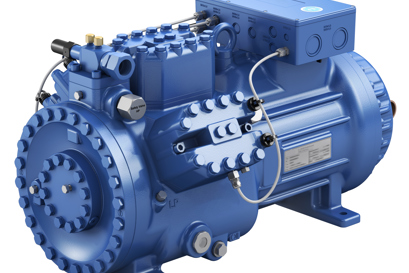
- Broad operating limits and wide frequency range
- Optimized efficiency for the highest EER/COP values
- Unrivaled reliability and durability
Brochure
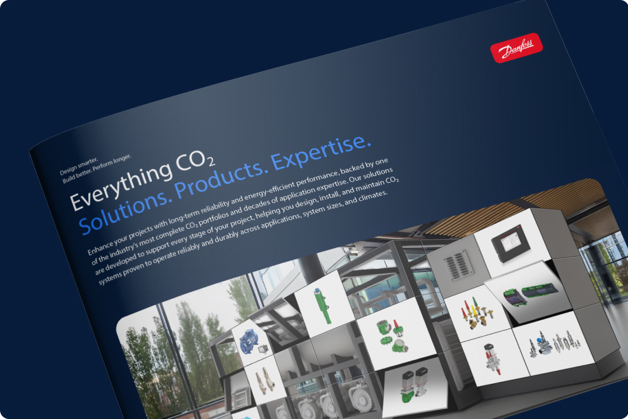
Building and maintaining flexible, reliable CO₂ transcritical systems is easier than ever. Discover the industry's most extensive CO₂ product range and know-how – and learn how you can enhance your projects.
Get the brochure

CO₂ is a sustainable, natural refrigerant that, compared to F-gasses, delivers strong benefits in industrial applications. With zero ozone depletion and a GWP of only 1, CO₂ refrigeration has a low environmental impact and works in any climate at a large scale.
The choice of refrigerant and system design can directly benefit your business and your bottom line. Not only can CO₂ systems provide great energy efficiency and options for heat recovery, but they are a future-proof application and a sustainable platform for an evolving business.
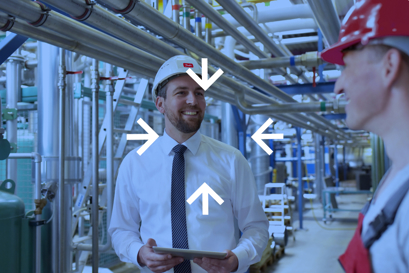
Get access to expert know-how and support from people on the frontline of industrial refrigeration. From design to implementation and maintenance of complete CO₂ cooling systems, we’re here to share knowledge and support your interest and investment.
Videos
Welcome to our 'Expert Talks' video series, where we break down the essentials of industrial refrigeration. In 'Embracing CO₂ in Industrial Refrigeration,' we discuss the shift to natural refrigerants. 'Building Industrial CO₂ Transcritical Systems: Key Considerations' walks you through the critical point for constructing top-notch CO₂ systems. Curious about efficiency? Tune into 'CO₂ Transcritical vs. Other natural refrigerants' for a straightforward comparison. Join us for practical insights that matter in the world of industrial refrigeration – no-nonsense, just expertise.