What is a cold room refrigeration system?
Build reliable walk-in coolers and freezers with Danfoss solutions for selection, control, refrigerant transition, and energy efficiency.
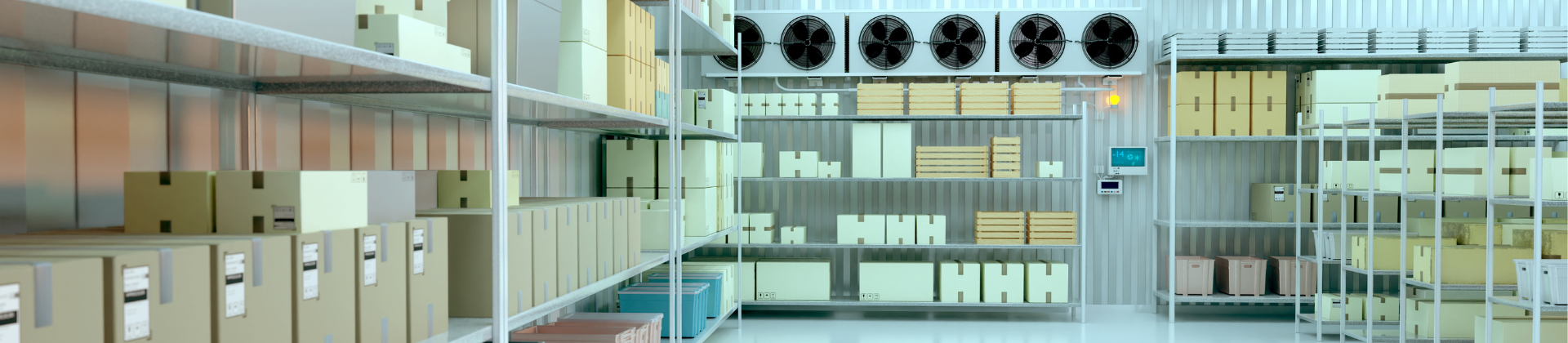
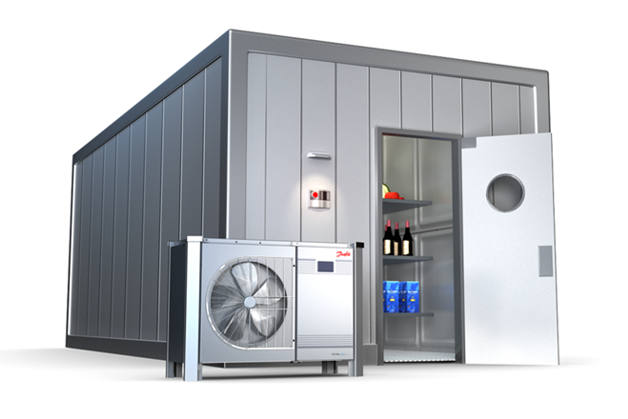
Cold room refrigeration systems are used to keep food, beverages, medical products, and other temperature-sensitive goods at stable conditions. A typical cold room system includes a condensing unit, cold room controller, expansion valve, solenoid valve, filter drier, and evaporator.
Cold room refrigeration systems are used in applications such as food service, food retail, processing, logistics, and pharmaceutical storage, where uptime, efficiency, and compliance with refrigerant and energy regulations are critical.
Danfoss supports cold room installations with refrigeration components, refrigerant‑ready solutions, and digital selection tools that help installers choose compatible products, simplify installation, and plan for low‑GWP and natural refrigerants.
On this page you can:
- Understand the main components of a cold room system
- Compare refrigerant-ready solution paths
- See where Danfoss products fit in a typical installation
- Use tools to size and select the right components
- Get answers to common installer questions
Quick answers for cold room installers
Installers need a cold room solution that is easy to select and install, ensures reliable temperature control, complies with refrigerant regulations, and supports long‑term operation with compatible components.
What components are needed for a cold room refrigeration system?
Most cold room refrigeration systems include:
- A condensing unit to compress and circulate refrigerant
- A cold room controller to manage temperature, alarms, and defrost
- An expansion valve to regulate refrigerant flow into the evaporator
- A solenoid valve for control in liquid, suction, or hot gas lines
- A filter drier to protect the system from moisture, acid, and particles
Which refrigerant should I choose for a cold room?
The best refrigerant for a cold room depends on the application and regulatory requirements, with installers typically choosing A2L refrigerants for lower‑GWP transition projects or non-flammable and non-toxic CO₂ refrigerant (R744), both supported by Danfoss cold room components.
Which condensing unit is commonly used for walk‑in coolers and freezers?
For small to mid‑size walk‑in coolers and freezers, installers commonly use the Danfoss Optyma™ condensing unit because it is designed for easy installation, reliable operation, and compatibility with low‑GWP refrigerants.
Which cold room controller is used for cold room temperature control?
For cold room temperature control, installers commonly use Danfoss Optyma™ cold room Controller, which manages temperature, defrost, alarms, and system protection in walk‑in coolers and freezers.
Why choose Danfoss for cold room systems?
Danfoss offers a broad cold room portfolio, including Optyma™ condensing units, Optyma™ cold room Controller, thermostatic expansion valves, solenoid valves and filter driers, together with digital selection tools e.g. CoolSelector that support system design and product choice.
How a cold room refrigeration system works?
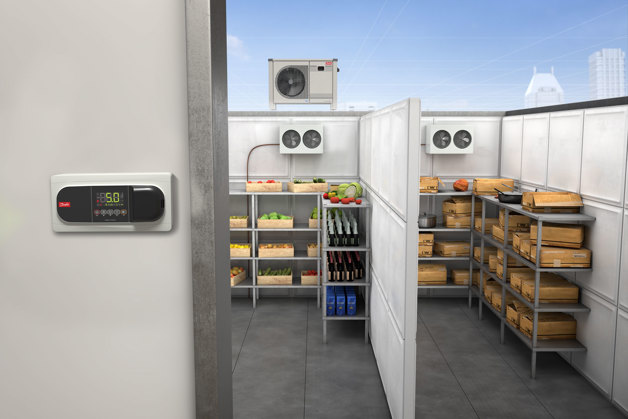
A cold room refrigeration system removes heat from an enclosed space to keep products at a stable, controlled temperature. It works by circulating refrigerant through a closed loop of components that compress, condense, expand, and evaporate the refrigerant, while controllers continuously monitor and regulate operating conditions.
Cold room systems are designed to run continuously, which makes component compatibility, control logic, and refrigerant choice critical for system performance, energy efficiency, and lifetime.
Core components in a typical cold room refrigeration system
A typical cold room refrigeration system includes these main component groups, each with a specific role in reliable operation:
- Condensing unit – provides the refrigeration capacity and rejects heat
- Compressor – compresses and circulates the refrigerant and is an integrated part of the condensing unit
- Cold room controller – regulates temperature, defrost, alarms, and protection
- Thermostatic expansion valve (TXV) – controls refrigerant flow into the evaporator
- Solenoid valve – enables refrigerant control and shut‑off functions (e.g. so-called pump down operation)
- Filter drier – removes moisture and contaminants to protect the system
- Evaporator – transfers heat from the room air to the refrigerant
What matters most when selecting cold room components?
| Installer priority | Why it matters | Danfoss answer |
|---|---|---|
| Fast installation | Saves labor time and reduces commissioning errors | Optyma™ cold room Controller is designed for easy installation and setup, and Danfoss tools support quicker selection |
| Reliability | Reduces downtime and food-loss risk | Danfoss components are designed for long service life and cold room duty |
| Refrigerant readiness | Helps future-proof projects | Danfoss offers options across low-GWP and hydrocarbons (e.g. R290, propane) and CO₂ (R744) refrigerant pathways |
| Energy efficiency | Lowers operating cost | Danfoss solutions focus on control, superheat stability, and efficient system operation |
| Serviceability | Makes maintenance easier | Product ranges such as TXVs and valves are built for application flexibility and service access |
Cold room refrigeration system components: function and examples
| Component | Function in the system | Example Danfoss solution |
|---|---|---|
| Condensing unit | Provides refrigeration capacity and rejects heat from the system | Optyma™ condensing units commonly used for walk‑in coolers and freezers |
| Compressor | Compresses and circulates the refrigerant through the system | Danfoss refrigeration compressors matched to cold room applications as an integrated part of the condensing unit |
| Cold room controller | Regulates room temperature, defrost cycles, alarms, and system safety | Optyma™ cold room Controller for cold room temperature management |
| Thermostatic expansion valve (TXV) | Meters refrigerant flow into the evaporator and stabilizes superheat | Danfoss TXVs for refrigeration applications |
| Solenoid valve | Controls refrigerant flow and enables shut‑off function | Danfoss EVR solenoid valves |
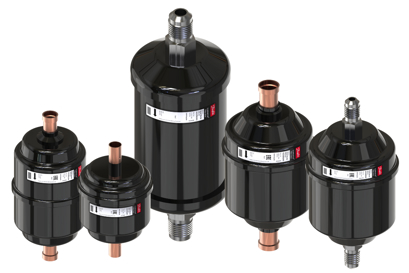
| Filter drier | Removes moisture, acids, and contaminants to protect the system | Danfoss DML / DCL filter driers |
| Evaporator | Absorbs heat from the cold room air | Evaporator selected to match load and refrigerant |
Cold room refrigeration system diagram
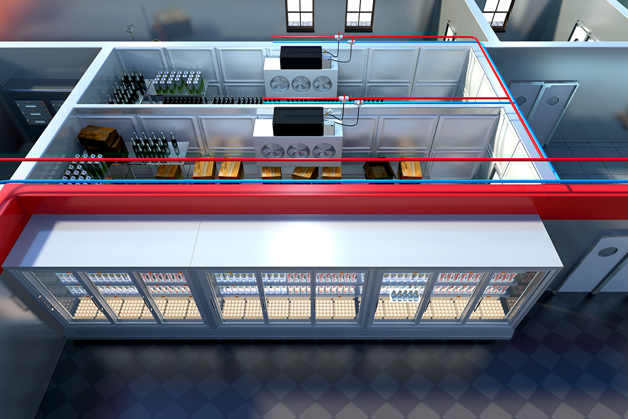
Cold room refrigeration system diagram showing the main components and the refrigeration cycle
A typical cold room refrigeration system consists of a condensing unit, cold room controller, thermostatic expansion valve (TXV), solenoid valve, filter drier, and evaporator, working together to remove heat from the room and maintain stable temperature conditions in walk‑in coolers and freezers. Danfoss supports this system architecture with compatible refrigeration components and controls.
Why system integration matters
In cold room applications, reliability depends on how well components work together as a system, not only on individual product performance. Correct matching of compressors, valves, cold room controllers, and refrigerants helps ensure:
- Stable room temperatures
- Efficient operation and lower energy consumption
- Compliance with refrigerant regulations
- Longer system lifetime and easier servicing
Danfoss supports this system‑level approach by offering compatible component portfolios, refrigerant‑ready solutions, and digital selection tools that help installers design and build cold room systems with confidence.
Which cold room solution should you choose?
Choosing the right cold room solution starts with understanding the application goal, the refrigerant strategy, and the level of control and efficiency required. The guide below helps installers decide what to start with and what to check next before final selection.
Decision guide: installer goals vs solution path
| If you need to… | Start with… | Then check… |
|---|---|---|
| Build a small or mid-size walk‑in cooler | Optyma™ condensing unit | Cold room controller, TXV, solenoid valve, and filter drier compatibility |
| Build a walk‑in freezer | Low‑temperature condensing unit and compressor setup | Defrost strategy, controller logic, and valve selection |
| Plan for lower‑GWP refrigerants | Refrigerant choice (A2L or CO₂) | Component compatibility, safety requirements, and standards |
| Design a future‑proof installation | System architecture and refrigerant path | Availability of compatible components across the system |
| Improve temperature accuracy and food safety | Dedicated cold room controller | Sensor placement, alarms, and monitoring needs |
| Reduce energy consumption | Efficient system control and stable superheat | Expansion valve selection and control strategy |
| Simplify installation and commissioning | Integrated component portfolio | Selection tools and pre‑configured solutions |
When selecting a cold room solution, installers typically start with the application type and refrigerant strategy, then confirm component compatibility, control requirements, and efficiency targets before finalizing selection.
Highlighted products
Which Danfoss products are used in cold room systems?
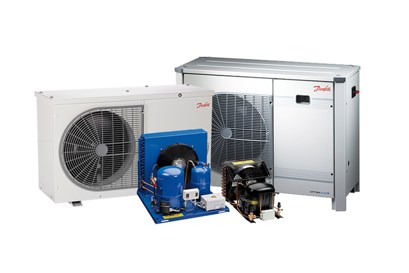
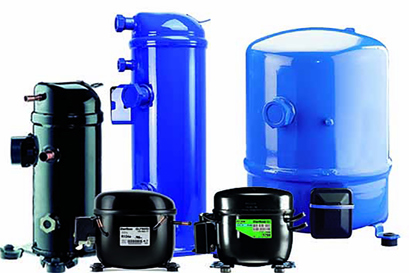
Danfoss Optyma™ condensing units are used as the core refrigeration unit in many small to mid-size cold room applications. They are positioned for versatility, simpler installation, and support for low-GWP, HFC, and hydrocarbons like R290, propane and CO₂.
Use when: you need a compact, practical condensing solution for a cooler or freezer
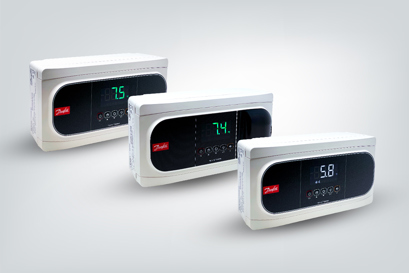
Danfoss Optyma™ cold room controller is designed for cold room control, safety, protection, and ease of installation. Danfoss also offers broader room/evaporator control options in the AK controller product range.
Use when: you need control of temperature, defrost, fans, alarms, and system operation.
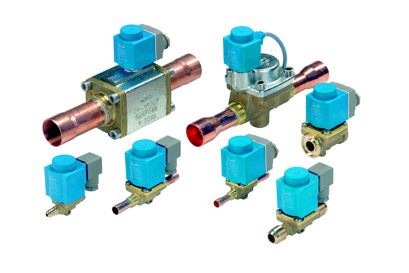
Danfoss EVR and related solenoid valves are used for controlling refrigeration circuits and support applications across liquid, suction, and hot gas lines.
Use when: you need shut-off or control functions in the refrigeration circuit.
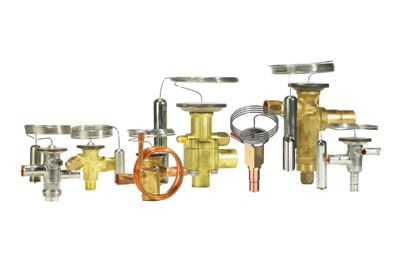
Danfoss TXVs, including T2/TE2 and broader thermostatic expansion valves product range, regulate refrigerant injection into the evaporator and help protect the compressor.
Use when: you need stable refrigerant feed and superheat control in a dry expansion system.
Refrigerant options for cold room applications
Cold room projects typically choose between A1 retrofit, A2L transition, CO₂, hydrocarbons like propane (R290) where applicable. A2L is used when lower GWP is required with a practical transition path, while CO₂ is chosen for its very low GWP and non-flammability. Hydrocarbons like propane (R290) are another very low GWP potential option when relevant safety aspects and requirements due to their high flammability are taken into consideration.
Refrigerant choice affects efficiency, regulatory compliance, safety requirements, and long‑term system viability. This overview helps identify which refrigerant path best fits your cold room application before you explore detailed solution pages.
Which refrigerant path is right for my cold room?
Most projects follow one of four paths: A1 (legacy/retrofit), A2L (transition), CO₂ (non-flammable and very-low GWP), or R290 propane (where applicable for self-contained/compact systems). Your best fit depends on whether you are retrofitting or planning for planning for new, very low GWP refrigeration system installations.
When should I choose CO₂ (R744) for a cold room?
Choose CO₂ when the project prioritizes a non-flammable pathway and very low GWP. CO₂ systems operate at higher pressures, so component selection and system design differ from many legacy systems.
Best fit for: Commercial cold rooms prioritizing non-flammablility and long‑term sustainability targets.
Use CO₂ when you need:
- Very low GWP
- A non-flammablility pathway
- Solutions aligned with future regulatory and sustainability strategies
If you choose CO₂ refrigerant
The resources below help you answer questions such as:
- Is CO₂ suitable for this cold room size and temperature?
- Which control and valve strategy is required?
- How do I select components for high‑pressure operation?
Additional CO₂ refrigerant resources:
When should I choose A2L refrigerants for a cold room?
Choose an A2L refrigerant type when you need lower GWP than legacy HFC solutions and want a practical transition option for selected commercial cold room systems. A2L projects typically require planning around component compatibility, charge limits, and safety requirements.
Best fit for: New systems or selected retrofits that require lower GWP with a practical transition approach.
Use A2L when you need:
- Lower GWP than legacy HFC solutions
- A transition path aligned with evolving regulations
- Compatibility planning across components, charge limits, and safety requirements
If you choose A2L refrigerant
The resources below help you answer questions such as:
- Which components require A2L compatibility?
- What safety requirements and charge limits apply?
- How do I plan system architecture for A2L refrigerants?
Additional A2L resources:
When should I choose A1 (legacy / non‑flammable retrofit path)?
Choose an A1 retrofit path when the priority is continuity of an existing system and a refrigerant change is not feasible in the short term. Plan for future transition if regulations or supply constraints tighten.
Best fit for: Installed-base continuity and short‑term retrofit practicality.
Next step: confirm compatibility and plan a staged transition
When is propane (R290) relevant for cold rooms?
Choose a propane refrigerant type when the project uses compact or self-contained concepts where propane is applicable and safety requirements can be met. Propane is a hydrocarbon refrigerant with very low GWP, but system design must follow relevant safety requirements and charge considerations.
Best fit for: Smaller/self-contained solutions where applicable.

Danfoss support for refrigerant transition
Danfoss supports refrigerant transition through compatible products, application know‑how, and selection tools for A2L, CO₂, and broader low‑GWP portfolios.
Find a cold room solution that matches your refrigeration needs.
Refrigerant portfolio for cold room A2L, CO₂ and propane
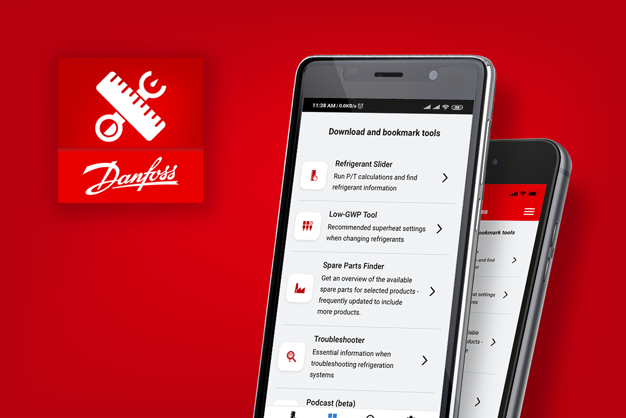
Tools and apps
Documents
Documents for cold room selection and refrigerant planning
Use these documents when you need a deeper reference during system selection, design review, or installation.
Cold room and refrigerant type FAQ
Explore how Danfoss supports the selection and design of future‑proof cold room solutions—based on refrigerant choice, regulations, and real application needs, here.
Low-GWP product overview
See which Danfoss product categories support lower-GWP and natural refrigerant strategies:
Video resouces
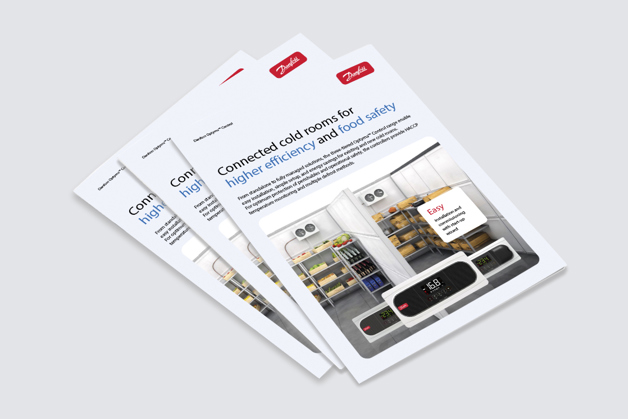
Cold room product selection guide
Use these resources to understand the main component groups used in cold room systems.
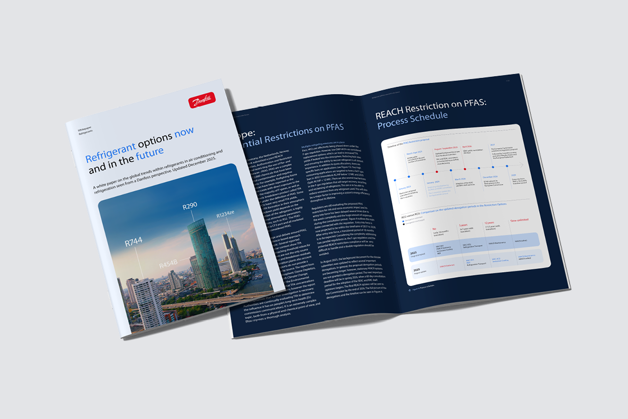
• Cold room brochure for installers and contractors
• Walk-in cooler and freezer solution brochure
• Infographic: Product selection guide
• Animated product portfolio of A2L- ready solutions
Food safety in cold rooms
Explore the relationship between food safety and refrigeration, and the importance of system reliability.
• Food safety focus on system performance, reliability and connectivity
Learning
Learn more about cold room design and operation
Use Danfoss training resources to learn:
- how cold room systems work
- how refrigerant choice affects design
- how controls and components interact
- how to improve performance and food protection
Start the cold room training program
Case studies
Proof in the field: Danfoss cold room solutions in real installations

ITALY: At Rivoira Group, VLT® drives with built-in condition-based monitoring help preserve fruit perfectly by ensuring utterly reliable refrigeration.

Fast food restaurant chain’s new restaurant needed refrigeration to be quiet, energy efficient and reliable – with easy installation and servicing. Optyma™ Plus condensing units were the obvious choice.

The growing store added new refrigeration capacity – and still saw energy bills fall – after replacing two condensing units with a single adaptive package.

A high-performing cold room delivered in a matter of days, so Hurren’s Butchers could maximize seasonal business.

As authorities and customers focus on energy efficiency standards and ratings to understand not just what a commercial refrigeration unit costs to buy, but what it costs to operate, the refrigeration design engineer needs to look again at the fundamentals and consider new approaches.
News
What’s new in the world of cold room solutions?
Stay updated on Danfoss product news relevant to:
- superheat control
- valve developments
- controller updates
- refrigerant-ready component ranges

Engineered for air driers, water chillers, ice cream machines, and frozen beverage dispensers, it provides stable operation and enhanced durability—all at a lower applied cost. Importantly, AXV is a pressure regulator — not a superheat regulator.


Built on the top-performing ETS 5M valve, the new ETS 5T offers a reliable, robust valve in a compact size. The company is also introducing an enhanced version of its successful ETS 5M valve, covering an even wider range of applications.
Contact us
Need help with a cold room project?
Talk to Danfoss if you need support with:
- component selection
- refrigerant transition planning
- control strategy
- technical documentation
- product compatibility
FAQ
Cold room installer questions
What components are needed for a cold room refrigeration system?
A typical system includes a condensing unit, compressor, controller, expansion valve, solenoid valve, filter drier, and evaporator. Danfoss supports this system architecture with products such as Optyma™ condensing units, Optyma™ cold room controller, thermostatic expansion valves, solenoid valves, filter driers, and refrigeration compressors.
Which controller is used for cold room temperature management?
For many cold room applications, installers use a dedicated cold room controller that manages temperature, defrost, alarms, and connected components. Danfoss positions Optyma™ Control as a cold room controller designed for safety, protection, and ease of installation.
Which valve is used to control refrigerant flow into the evaporator?
A thermostatic expansion valve controls refrigerant injection into the evaporator and helps maintain stable superheat. Danfoss thermostatic expansion valve product ranges are designed for refrigeration applications and long service life.
Why is a filter drier important in a cold room system?
A filter drier helps protect the refrigeration system from moisture, acids, and solid particles that can reduce reliability and compressor life. Danfoss DML/DCL filter driers are designed for this protection function.
Which refrigerant should I choose for a cold room?
That depends on the application, regulatory context, safety requirements, and long-term refrigerant strategy. Danfoss provides content and products across low-GWP, A2L, and CO₂ pathways.
What is the best condensing unit for a cold room or freezer room?
The best condensing unit for a cold room or freezer room is one that has the correct refrigeration duty for the application and is reliable and energy efficient in operation.
Should I use a remote or self-contained condensing unit for a cold room — and how does the choice affect noise, maintenance, and which refrigerants I can use?
The choice between a remote condensing unit or self contained unit depends on the application, refrigeration duty required, location of the installation, availability of outdoor space for the remote condensing unit and distance between the indoor and outdoor unit. Other key considerations are noise, installation cost, maintenance and ambient temperature of the condensing unit location.
Which controller is best for cold room temperature management?
The best cold room controller for temperature management is one that has accurate temperature measurement, including high and low temperature alarms which are programable.
Which expansion valves work with CO₂?
Only expansion valves designed for CO₂ can be used with CO₂ due to the higher working pressures of a CO₂ system.
What extra components do I need if I'm building a cold room with A2L refrigerant instead of R404A?
The main components for a cold room refrigeration system are the condensing unit which pumps the refrigerant around the system and expels heat to the ambient air and the evaporator or 'blower' inside the cold room which absorbs heat from its surroundings using the refrigerant all contained within the closed loop system and a range of mechanical and electronic controls to ensure reliable and safe operation.
Can you give me a full bill of materials for building a cold room with a low-GWP refrigerant — including controls and any safety components I might not think of?
A typical bill of materials would be:
- Cold room structure made from insulated panels complete with an access door.
- Complete refrigeration system comprising of a condensing unit, evaporator, interconnecting pipework and insulation, mechanical and electronic controls.
- Cold room control panel
- Water drainage pipework from the evaporator
- Cold room lights
- Racking
How do I design a refrigeration system when I need both a chilled room and a freezer room in the same facility?
To design a refrigeration system for a cold room you need to calculate the following:
- Required room size and storage temperature
- Product type and quantity
- Refrigeration heat load
- Select refrigeration system type & refrigerant
How do I calculate the cooling load for a walk-in cooler that gets opened a lot throughout the day?
To calculate the cooling load for a cold room you must work out all the sources of heat entering the cold room such as:
- The product load
- Heat entering through the insulation
- Electrical loads such as lights, defrost heaters, evaporator fans
- Personnel loads
- Air infiltration entering through the door
How do I pick the right size condensing unit for a freezer room — and does it matter if it's installed somewhere hot?
The correct size of the condensing unit will be based on the total refrigeration duty for the cold rooms heat load.
How do I choose the right TXV for a cold room, and does the choice change if I'm switching from R404A to an A2L refrigerant?
The correct thermostatic expansion valve for a cold room will be based on the refrigerant being used and the refrigeration duty of the system.
What cold room controller is used for commercial cold rooms?
The cold room controller for a commercial cold room manages temperature control, temperature alarms and operation of the refrigeration system.
Where should I put the condensing unit for a cold room — rooftop, outside on the ground, or in a machine room? What are the trade-offs?
Ideally the condensing unit for a cold room should be located outside in a well ventilated location where heat from the condenser can be rejected.
How do I tell if the TXV in my cold room is faulty — what symptoms should I look for, and when should I replace it vs just adjust it?
To diagnose a faulty TXV in a cold room refrigeration system, you need to understand the operation of the TXV, pressures and temperatures of the system. Most faults will be diagnosed with poor superheat control and or refrigeration system performance.
What components do I need for an A2L cold room?
The main components for an A2L cold room refrigeration system are the condensing unit which pumps the refrigerant around the system and expels heat to the ambient air and the evaporator or 'blower' inside the cold room which absorbs heat from its surroundings using the refrigerant all contained within the closed loop system and a range of mechanical and electronic controls to ensure reliable and safe operation. Specifically for an A2L refrigeration system all the components must be approved for use with the A2L refrigerant be used.
What components do I need for a CO₂ cold room?
A CO₂ refrigeration system for a cold room is different to a standard HFC system. It requires components designed for much higher working pressures and control and regulating valves that ensure the system operates efficiently across a wide range of ambient conditions.
What cold room controller do I need for a CO₂ refrigeration system?
A cold room controller for a CO₂ refrigeration system needs to be compatible with the specific control function of the CO₂ system.
Which A2L-ready condensing unit supports R454C or R455A for a small cold room?
Danfoss Optyma Slim and Optyma Plus are A2L ready condensing units and can operate with either R454C or R455A.
Which condensing unit is easiest to install for a small to mid-size cold room using low-GWP refrigerants?
Danfoss Optyma Slim and Optyma Plus condensing units are easy to install and can operate with a range of Low GWP refrigerants such as R454C or R455A.
Which cold room controller supports direct control or pump-down and multiple defrost methods?
The Danfoss AK-RC 205 range of cold room controllers supports direct control or pump down mode with multiple defrost methods.
Which cold room controller is best if I need adaptive defrost and easy commissioning?
The Danfoss AK-RC 305w-SD cold room controllers supports adaptive defrost and is easy to commission.
What's the real difference between a TXV controller and an electronic expansion valve controller for a cold room — is the extra cost worth it?
The choice between a basic TXV cold room controller or one that uses an electronic-expansion-valve comes down to cost verses performance and the type of application.
Which TXV is better for small-capacity cold rooms: TD1 or T2/TE2?
The choice between TD1 or T2/TE2 for a small capacity cold room comes down to duty fit flexibility and if there is a requirement for service.
Which thermostatic expansion valve works for CO₂ cold rooms?
Danfoss has a specially designed TE2 thermostatic expansion valve to work with CO₂.
Which low-GWP components can I use to build a cold room without changing the whole system design?
Using low GWP refrigerants such as A2L's means you can keep the same basic system design as a HFC system, however all the components must be certified A2L compatible.
Which condensing unit is better for a natural refrigerant cold room: A2L-ready HFO blend or CO₂?
The choice between using A2L, HFO blend or a CO2 condensing units depends on the priorities:
- A2L/HFO - Traditional system, low GWP
- CO₂ - Higher working pressures, ultra low GWP and future proof refrigerant
Which CO₂ condensing unit is suitable for small stores or HORECA with cold rooms?
Danfoss has a range of iCO₂ condensing units suitable for small stores or HORECA cold rooms.
Which CO₂ condensing unit is suitable for medium-size to larger cold rooms?
Danfoss has a range of iCO₂ condensing units suitable for medium to larger cold rooms.
Which cold room components are easiest to commission and monitor remotely?
For easy commissioning and remote monitoring cold room components such as the cold room controller and electronic expansion valve controller would need to communicate on a network and have remote access.
Which cold room solution gives me temperature control, alarms, and food-safety monitoring in one package?
The Danfoss AK-RC range of cold room controllers gives temperature control, alarms and food safety monitoring.
Which cold room solution is best if I want energy savings from adaptive defrost?
The Danfoss AK-RC 305w-SD cold room controllers supports energy savings from adaptive defrost.
Which cold room setup is most future-proof for low-GWP refrigerants and simple installation?
Using low GWP refrigerants such as A2L's for a cold room set up means you can keep the same basic system design as a HFC system for a simple installation and future proof refrigerant choice.
What components do I need to retrofit a walk-in cold room to an A2L refrigerant?
You can only retrofit a cold room to an A2L refrigerant if the original installation was installed to the correct A2L standard with A2L approved components.
What controls and alarms do I need for a pharma cold room that has to pass GDP audits — and what kind of temperature documentation is required?
The type of control and alarms for pharmaceutical cold room depend of the product specification being stored and the required level of documentation.
For a small food producer adding a new chilled room, how do I choose between A2L, CO₂, and conventional refrigerants?
The choice between using existing A1 refrigerants, A2L or CO₂ for a cold room is a technical, regulatory and long term strategic decision.
If I'm switching my cold room from R404A to A2L, can I keep the existing evaporator and piping or do I need to replace everything?
When retrofitting a cold room refrigeration system the choice between using the existing evaporator or replacing it, is decided if it is approved for use with the refrigerant you will use in the new system.
I just commissioned a new cold room and the temperature keeps swinging. What settings should I check on the controller and expansion valve?
If the temperature in a newly commissioned cold room is unstable check the following:
- Thermostat setting / sensing location
- Check operation of refrigeration system
- Check that the door is closed to the cold room
I replaced the TXV in a cold room but now suction pressure is too low. Is it the wrong valve size, a charge issue, or something else?
If the suction pressure is too low after replacing an expansion valve it points towards a restriction in flow of refrigerant through the expansion valve or part of the system. Check installation of the valve and sensing bulb to ensure the valve is getting the correct signals.
How do I size a condensing unit for a meat processing cold room that gets loaded with warm product frequently and needs to pull down temperature quickly?
Sizing a condensing unit for a meat processing cold room with frequent door openings requires a detailed heat load calculation specifically accounting for the high infiltration heat load from the door openings.
Which safety components do I need for an A2L cold room installation?
Safety components for an A2L cold room installation should be decided after consultation with the relevant norms and standards.
What is the running cost difference between CO₂ and HFC cold room systems?
Running cost differences between CO₂ and HFC are highly dependent on system design, ambient conditions.
We have several cold rooms at different temperatures in our store. Is it worth standardizing on one controller brand, and what do we gain from that?
Control strategy should be based on the application requirements of each cold room.
How do I work out what refrigeration capacity I need for a cold room, and are there any tools that can help me pick the right condensing unit?
To calculate the refrigeration capacity for a cold room you must work out all the sources of heat entering the cold room such as:
- The product load
- Heat entering through the insulation
- Electrical loads such as lights, defrost heaters, evaporator fans
- Personel loads
- Air infiltration entering through the door
How do I choose between different TXV families for a walk-in cooler — what matters most in the decision?
To choose a thermostatic expansion valve for a cold room evaporator you need to know the refrigerant and the refrigeration capacity of the system.