
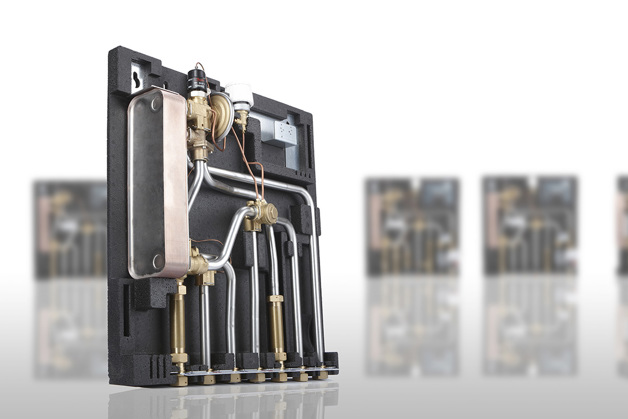
Flat stations are decentralized heating systems installed in flats and apartments in order to provide heating and hot water on demand to end-users.
Direct heating and domestic hot water substations have no heat exchanger separating the primary flow from the secondary flow. Therefore, the supply from the network or the central oil/gas boiler will flow directly into the network in each flat.
Direct heating substations are recommended for maximum PN10 or PN6 networks.
Flat stations for direct heating with mixing loop and domestic hot water
The supply from the network will flow directly into the network in the building. A mixing loop on the heating side gives the possibility to control the supply temperature for the housing installation in the substation. Direct substations are recommended for maximum PN10 or PN6 networks.
Distribution systems - floor heating for flat stations
Prefabricated systems for floor heating as well as for warm and cold water. The systems can be installed separately or directly connected to the Danfoss flat station range, in connection with a boiler or as an extension of an existing heating system. The distribution units are available as built-in variants with a recess box as an option or as wall-mounted variants with a cover as an option.
Features and benefits
-
Cost-effective solution for new installations, refurbishment and renovation projects with low service and maintenance costs when in use.
-
Quick and easy installation.
-
Less space used and can be built into walls, stairwells or shafts.
-
Energy metering and consumption monitoring with energy meter.
The modern replacement for traditional centralized heating and domestic hot water solutions
EvoFlat
Product range
Documents
| Type | Name | Language | Valid for | Updated | Download | File type |
|---|
Tools and apps

Heat Selector
Danfoss Heat Selector is the best-in-class online selection tool that optimizes the planning process for heating application experts.
Open Heat Selector
FAQ
General functionality
What is the Danfoss flat station concept for decentralized heating systems (EvoFlat)?
The Danfoss flat station concept "EvoFlat" comprises an installation, for which flat stations that are supplied from a central energy source, are built into each flat. These units normally incorporate a compact plate heat exchanger, which delivers instantaneous hot water on demand and a differential pressure control valve to control the heating flow to the tenants’ radiators.
What is the difference between traditional heating systems and decentralized systems with flat stations?
The main difference between traditional heating systems and decentralized ones with flat station is that in decentralized systems the process of domestic hot water preparation is moved from central heat source (traditional systems) to flat station units in each apartment. In traditional systems 5 main ascending pipes are using instead of 3 in decentralized heating systems.
What are the typical heating applications with flat stations?
There are two typical applications which depend on the type of heating installation in the apartment – Radiator heating and Floor heating.
What can be used as a heat source for EvoFlat concept?
The heat source to the decentralized system can be oil, gas or wood-fired boiler, district heating, heat pumps or a combination of these. Furthermore, the system can also be supported by solar energy. It is important that the energy source(s) is/are capable of generating a sufficient minimum supply temperature with the object of producing acceptable domestic hot water temperatures in the heat exchanger, placed in each apartment. Furthermore, the installation includes a buffer tank.
What is the buffer tank's role?
The buffer tank avoids frequent starts and stops of the burner in a boiler installation and is thereby contributing to increasing the service life of the boiler and reducing its harmful emissions. The buffer tank also stores an adequate volume of energy that allows an instant supply of sufficient flow to the water heaters in each flat during peak load intervals. The buffer tank is then loaded to the desired supply temperature for the distribution system. In principle, the buffer tank is not required for a large number of flats as the entire piping system and the larger boilers will provide a sufficient buffer volume to accommodate the large load changes in domestic hot water use. The actual limit will depend on the volume in pipes and boiler as stated previously, but it does also relate to the boiler load.
What is instantaneous domestic hot water preparation?
In the EvoFlat concept for decentralized system the heat exchangers are used mainly for producing domestic hot water. The operating principle of instantaneous water heating/the flow principle can be described as follows:
- Heating water circulates on one side of the plate heat exchanger transferring heat to cold water passing through on the other side. The heated water is then fed straight to local hot water taps
- To control the domestic hot water capacity of the unit a self-acting control valve, especially developed for this purpose, is used to regulate the flow across both sides of the plate heat exchanger
- For instantaneous water heaters various DHW control valves with control principles, which each incorporate advantages and disadvantages, can be implemented
These are typically grouped accordingly: temperature-controlled, pressure-controlled, temperature and pressure controlled.
Danfoss offers a comprehensive product range, which includes flat station variants with ALL control principles.
What are the advantages of instantaneous domestic hot water preparation?
The advantages of the instantaneous DHW preparation are:
- Minimized risk of legionella bacteria
- Added comfort due to a continuously high output
- Very little space required for installation
- Low return temperatures, which increase the overall efficiency in systems including condensing boilers, solar energy etc.
- Operates at as low supply temperatures as e.g. 50 - 55 °C
What is alternative of instantaneous domestic hot water preparation?
Alternatively, a domestic hot water cylinder, placed in each flat, could be implemented. This solution, however, does not offer the same advantages as the flow system. The cylinder solution can not be excluded on account of not being operational and can be incorporated in the concept at the request of the client.
How is the heating circuit configured in flat stations?
In the EvoFlat concept for the decentralized system the heating circuit of a flat station can be configured in 3 ways:
- Directly – controlled only by a differential pressure controller and optionally by a zone valve controlled by a programmable room thermostat. This principle is applicable mainly for radiator heating in supply systems with maximum PN10.
- Directly with mixing circuit – controlled by a differential pressure controller and a mixing circuit. This principle is applicable mainly for floor heating and systems with maximum PN10.
- Indirectly - a plate heat exchanger is controlled by a 2-way thermostatic valve and optionally by a zone valve, controlled by a programmable room thermostat. This principle is applicable mainly for floor heating and systems with maximum PN16.
Designing
What is the simultaneous/coincidence factor?
An estimation of the domestic hot water requirement is part of the total evaluation, which is the reason why the term coincidence factor is relevant in this context. Briefly stated, only a part of all tap points is used in actual practice, based on a 99.9 % confidence interval in a statistic probability distribution.
In the Danish standard for domestic hot water installations DS439 and the specifications from TU-Dresden the consumption pattern of a “standard flat”, which by definition includes 3.5 persons, constitutes the basis for the factors. Deviations may occur if the dwelling for example is inhabited by residents for which an atypical consumption pattern can be expected. Therefore, the application of these factors must be supported by an estimation of the composition of the residents of the building. In the EvoFlat dimensioning tool the following factors can be selected: Danish Norm DS439, Danfoss-Redan, Swedish and German factor.
How to calculate total flow rate in decentralized heating systems?
The total flow is formed by the heating loop flow rate and the primary supply flow rate for the water heaters, reduced by the relevant coincidence factor and a flow rate to compensate for other heat losses.
What are recommendations for pipe sizing?
The size of pipes is determined by maximum flow rates in each partials section. Criteria are normally a certain velocity and a certain pressure loss per running meter. For visible pipes typically v≤1m/s and <100 Pa/m has been recommended, but for other sections and pipes covered in shafts other criteria can be used for dimensioning.
Is there any software for decentralized heating system dimensioning?
Yes, Danfoss offers a software for dimensioning flat stations. It is called "EvoFlat dimensioning tool". Contact your local Danfoss sales office for more information.
What do I enter as size fort he heat source?
This dimensioning has to be viewed in a context, as the buffer tank and the boiler/HEX size can be adapted according to each other to cover the energy requirement for domestic hot water and heating. A major quality of the buffer tank is to cover domestic hot water peak loads and to reduce the number of boiler starts and stops and thereby ensure a more economical operation. Finally, a buffer tank is the automatic choice, if solar heating supports the other heat sources. In such situations the size of the solar collector area will often be dimensioning, and it is recommended that separate calculations are made.
What are system advantages of EvoFlat concept?
Following advantages compared to traditional system installation designs can be listed:
- The flat station concept can be implemented in both new buildings as well as by refurbishments.
- The system is independent of the energy supply – gas, oil, district heating, heat pump, biomass or solar.
- Individual, fair energy bills for each flat or tenancy are possible.
- The system enables remote monitoring of the energy consumption of each flat with the proper energy meter.
- Only three ascending pipes are required in the building – cold water, supply and return heating.
- Minimum space requirements for fitting the unit in the flat - comprising possible integration in wall construction.
- Individual adjustment of room temperature over time and independent domestic water production is possible.
- Bacteria-free domestic water production with the flow principle – minimized risk of the legionella bacteria.
- Added hot domestic water comfort compared with traditional gas-fired water heaters (35 – 80 kW against 22 kW).
- Increased energy efficiency through improved boiler or district heating installation operation and through possibly low operational temperatures.
- Reduced heat loss in the distribution network compared to the classic solution as the hot water and domestic water circulation line is not required.
- A minimum of maintenance in each flat thanks to the simple technique.
- Relatively safe system as electrical short circuits and gas leakages are not possible.
- Suitable for operation with condensing boilers and solar energy owing to the low return temperatures of the system.
Do we have a DHW priority in flat stations?
If the DHW control valve turns off mechanically the supply of heat for the radiators/floor heating, the existence of 100% DHW priority may be assumed. In case control valves for DHW without mechanical changeover function are used, it must be calculated, whether DHW priority may be assumed (Hydraulic priority).
when ΔpDHW < Δp Heating DHW priority in the unit can be assumed.
when ΔpDHW ≥ ΔpHeating DHW priority cannot be assumed.
Installation
When is summer bypass needed?
Summer bypass is applicable with NC DHW controllers – PM2+P, PTC2+P and TPC+M. When the units are mounted more than 2-3 meters away from the main risers, a thermostatic bypass (FJVR) is recommended. During the summer the bypass keeps supply pipes warm and enables tapping of hot water without any delay – ensuring the best possible efficiency and economy during summer when the heating system is in reduced operation. The bypass can be mounted before or after a heat meter.
When is DHW re-circulation needed?
When the unit is mounted far from hot water taps, a DHW re-circulation is recommended to increase customer comfort by shortening the waiting period during hot water tapping. DHW re-circulation sets are available as accessories for flat stations.
Why are flow limiters recommended?
To guarantee customer comfort according to design parameters, mounting a flow limiter on the DHW outlet pipe is recommended.
How can the flat station be installed?
There are 2 ways to install Danfoss flat stations:
The unit is mounted directly on the wall (on-wall mounting concept).
The unit is mounted in the wall, using recess boxes (in-wall mounting concept).
Stations can be mounted in shafts, but one of above-mentioned concepts is always used. Please ask your local Danfoss sales office for more information.
Is it possible to install a flat station in all positions?
No, it is not always possible. Follow the mounting instructions exactly - or ask your local Danfoss sales office for support.
Is it possible to install a flat station and a distribution unit in one cabinet?
Yes, it is possible. Ask your local Danfoss sales office for more information and support.
Products
What does EvoFlat FSS or EvoFlat MSS mean?
Product naming of the EvoFlat series is as follows:
EvoFlat FSS 1/2/3 – a compact and simple to operate flat station for direct radiator heating and instantaneous domestic hot water with an innovative self-acting TPC – M controller for control of heating and DHW temperature. Digit behind the name shows the type of HEX:
•type 1 for XB06H-1 26 (up to 35kW) •type 2 for XB06H-1 40 (up to 35kW) •type 3 for XB06H+ 60 (up to 55kW)
EvoFlat MSS 1/2/3 – a compact and simple to operate flat station for direct heating with mixing loop and instantaneous domestic hot water with an innovative self-acting TPC – M controller for control of heating and DHW temperature. Digit behind the name shows the type of HEX:
•type 1 for XB06H-1 26 (up to 35kW) •type 2 for XB06H-1 40 (up to 35kW) •type 3 for XB06H+ 60 (up to 55kW)
Both product types cover up to 15 kW for heating.
What are the main parts of the multi-functional TPC-M controller?
The main parts are:
- Flow actuator
- Differential pressure controller (HE + DHW)
- Zone valve
- Control valve with thermostat and temperature sensor
- Air vent
What kind of accessories can be used with EvoFlat units?
The following accessories for EvoFlat units are available:
- Room thermostat
- Safety valves
- Ball valves (60mm)
- Ball valves with connection for pressure gauge ¾”(120mm)
- Mounting rail for mount-on-wall variant
- Recess box for build-in variant incl. mounting rail
- Insulated front cover
What are the main benefits of the newest EvoFlat units?
The main benefits of EvoFlat stations are:
- Reduced heat loss due to insulation cover, insulated back-plate and less radiating surfaces inside the station.
- No need of re-tightening after transportation or other vibrations due to the new Click-fit connections.
- No risk of leakage and reliable during pressure shock due to the Click-fit connections.
- Higher energy efficiency, lower return temperature and lower heat and pressure loss due to the MicroPlate heat exchanger usage.
- Prepared for low supply temperature.
- Innovative, energy-saving multifunctional controller TPC(-M) in combination with high performance heat exchanger for on-demand domestic water heating, thereby eliminating no-load losses.
- Pipes and heat exchanger made of stainless steel AISI 316.
Minimum space required for installation. - Build-in or wall-mounted variant.
- Minimized risk of lime scale and bacteria formation.
What is the purpose of the sensor accelerator in Termix units?
The patented sensor accelerator accelerates the closing of the Danfoss AVTB valve and protects the heat exchanger against overheating and lime scale formation. The heat exchanger cools the DH water very efficiently, thereby creating a very good operating economy.
The sensor accelerator and AVTB valve also works as a bypass keeping the house supply line warm. This shortens the waiting periods during summer when the heating system is in reduced operation.
The sensor accelerator helps to ensure a stable hot water temperature regardless of varying loads, flow temperatures and differential pressure without the need for readjusting the valve.