
To achieve the best possible space comfort for users, every building is equipped with a suitable Heating and/or Cooling system. There are various options to increase or decrease the room temperatures and how this is controlled:
- Terminal units
- Radiator heating
- Floor heating
Terminal units
Among others, cover fan coil units, cooling panels and climate ceilings. These are mostly installed in the ceiling and provide a room with heating and/or cooling via a 2-, 3- or 4-pipe system. To control the room temperature, the most accurate results, in both full- and partial load conditions, can be achieved by using Pressure-Independent Balancing and Control Valves (PIBCV). They are simply set to the required flow under full load conditions and function as automatic flow limiters. In partial load conditions, the actuator accurately reduces the flow according to needs. No overflow situation will occur, increasing the energy efficiency of the heat or cooling source.
The actuators can be controlled via a Building Management System (BMS) or stand-alone electronic room controllers. In case the terminal units contain a fan, the room controller can also be used to change the fan speed.
Radiator heating
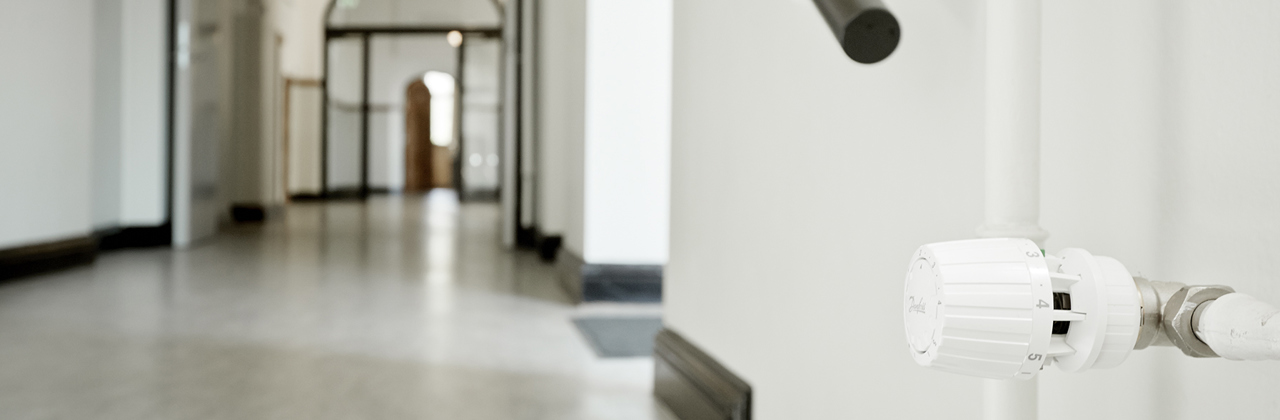
In most cases, designed as a 2-pipe system with one or more radiators in every room. To control the room temperature, Danfoss radiator thermostats are used. They consist of a thermostatic radiator valve, mostly with a pre-setting of the design flow, and a temperature sensor. A wide variety of sensors ensure accurate control of the room temperature. For example, if curtains prevent proper measurement of room temperature, a version with remote sensor or remote sensor and control provide a better solution.
For optimal space comfort, it is recommended to equip the radiator system with an automatic hydronic balancing solution. This eliminates pressure fluctuations, thereby ensuring that the radiator thermostats function optimally.
Floor heating
Offers a high level of comfort by heating rooms from the floor up. The heat is spread evenly and, because it is situated in the floor, it doesn't take up any precious room space. Danfoss offers both water-based (hydronic) floor heating as well as electrical floor heating solutions. It can be used to heat all spaces in the building or to heat dedicated spaces, such as hotel bathrooms, where the comfort requirements are highest.
With both hydronic floor heating and electrical floor heating systems, room and/or floor temperature can be controlled via room thermostats. These ensure a superb level of space comfort while avoiding rooms being heated when this is not needed.
Danfoss Dynamic Valve™
2-in1 thermostatic radiator valves with built-in differential pressure controller
Go to product page
How we can help you
-
Accurate room temperature control
-
High user comfort experience
-
Complaint-free indoor comfort
-
Wide variety of systems and control solutions

Danfoss HVAC applications in commercial buildings
Danfoss helps you create better indoor environments with HVAC solutions based on application knowhow and a comprehensive portfolio of products for heating, ventilation and air conditioning in public and commercial buildings.
View animation

Related products

AB-QM Pressure Independent balancing and Control Valves (PICV) provide both a control functionality and dynamic balancing solution for HVAC heating and cooling systems. PICVs are designed for various types of terminal units, Air Handling Units (AHU), chillers and provide high indoor comfort and energy efficiency in public and commercial buildings.

To take advantage of the combined balancing and control features of Danfoss AB-QM it has to be equipped with actuators controlled by room thermostats or a Building Management System. Danfoss offers a broad range of actuators varying from Thermal on-off to Geared digital actuators with bus communication.

Robustly built and designed to meet the rigors of the commercial and industrial sectors, a comprehensive range of Danfoss radiator valves is available for practically all systems and installation conditions.

Danfoss floor heating manifolds are characterized by their flexibility to establish the best suited manifold solution based on requirements. Select from all the components to construct a manifold with or without pre-setting, flow-meters, shut-off valves and air-vents that best fits your project.

Danfoss floor heating mixing shunts establish a water temperature low enough to safely be distributed through the floor heating system. It’s designed to fit the FH manifolds and mixes the warm supply temperature with colder floor heating return flow to the required floor heating supply temperature.

To ensure hydronic (water based) underfloor heating or cooling systems achieve the expected high level of comfort and low energy consumption, good room temperature controls are essential. They control the room or floor temperature to avoid overheating. For optimal comfort each room has it's own room thermostat.
Case studies

Katowice Business Centre is a modern office building where Danfoss hydronic balancing solutions are used; AB-QM balancing and control valves in combination with revolutionary NovoCon® actuators.

The Prime Tower in Zurich is a building of many records. With its 126 meters it is the tallest building in Switzerland with 36 floors and 40,000 square meters accommodating mostly offices. And with its more than 6,000 AB-QM valves it is also one of the biggest heating and cooling installations ever designed and installed by Danfoss.

At the heart of the new King Abdullah Financial District in Riyadh stands the impressive SAMBA head office. The 40-storey building represents a landmark in sustainable architecture and engineering and forms an attractive work space for the 800 people working in the SAMBA Financial Group head office.

The 20-storey Consplant Tower in Kuala Lumpur, Malaysia, is used very differently during the day and night. Office space is primarily used during the daytime, shopping malls into the early evenings and restaurants into the night. This mixed use of the building, however, challenges the energy efficiency of the cooling system.

