

Heat Recovery Tool

Heat Recovery Tool
Try out our new Heat Recovery Tool that analyzes your heat source and consumption. The tool links data with current energy prices to provide tailored recommendations for your operation.
Heat recovery tool
Benefits
Legislation
Legislation creating a burning platform for waste heat recovery implementation
Legislation plays a crucial role in advancing waste heat recovery by setting standards, providing incentives and creating opportunities for businesses and municipalities. The urgency to act is clear: stakeholders who fail to embrace these legislative drivers risk falling behind in a rapidly evolving energy landscape.
Here are some key legislative drivers based on the new framework of the Clean Industrial Deal and the much-needed implementation of existing policies, particularly the Energy Efficiency Directive (EED) and the Renewable Energy Directive (RED III). With the Clean Industrial Deal, more opportunities are expected to arise and further improvement of the conditions to accelerate the uptake of waste heat recovery.

The framework conditions for waste heat recovery have never been better, thanks to the Clean Industrial Deal's Affordable Energy Action Plan and the upcoming Heating and Cooling Strategy. The Clean Industrial Deal is a comprehensive plan by the European Commission aimed at supporting the competitiveness and resilience of European industries while accelerating decarbonization. It addresses high energy costs and fierce global competition by promoting the transition to a low-carbon economy, creating quality jobs, and ensuring the right conditions for companies to thrive. This includes measures to lower energy bills for industries, businesses and households by speeding up the roll-out of clean energy, enhancing electrification, and reducing dependence on imported fossil fuels. This aligns perfectly with the goals of waste heat recovery.

Imagine a world where every municipality with over 45,000 residents is equipped with a detailed heat map, pinpointing exactly where waste heat can be harnessed and utilized. This is the vision of the Energy Efficiency Directive (EED), which mandates such heat mapping to ensure no thermal energy goes to waste. The EED also calls for a significant increase in the share of renewables in district energy networks.
And for certain facilities that are undergoing renovations – such as data centers and industrial installations – to conduct thorough cost-benefit analyses to increase energy efficiency. Speaking of data centers, the EED requires those with capacities over 1MW to reuse waste heat, turning what was once a byproduct into a valuable resource.
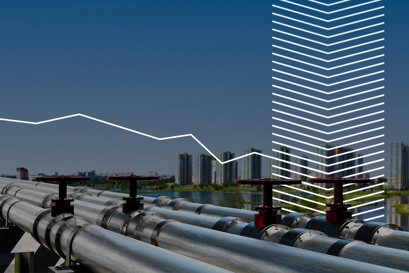
All of this is further supported by the Renewable Energy Directive (RED III), which recognizes waste heat as a renewable energy source under certain criteria. This recognition allows waste heat to be counted towards overall renewable energy targets and specific targets in heating, cooling and district energy. Such an approach enables member states to achieve their renewable energy goals without the need for heavy investments in new renewable infrastructure.
Solutions
Our solutions for waste heat recovery and reuse
Leanheat® Network
Plan, visualize and optimize a sustainable network operation
Leanheat® Network is a thermo-hydraulic modeling tool, developed specifically for use in district energy systems to support planning, design and operational processes.
- Network design to build and maintain models
- Simulate hydraulic and thermal conditions in your district heating network
- Optimize network supply temperatures and pressure conditions
- Predict and interpret future network consumption using AI
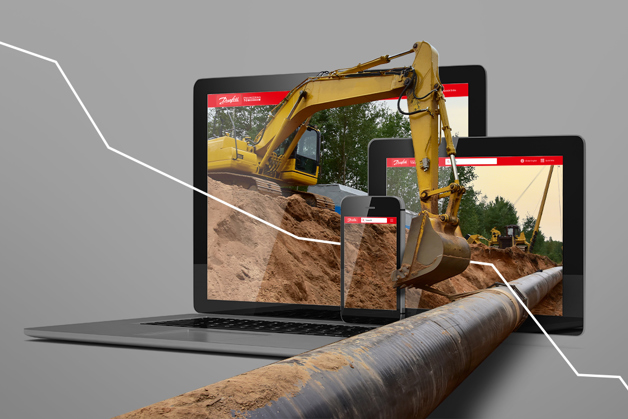
Leanheat® Production
Leverage data to maximize energy efficiency
Leanheat® Production is an advanced software tool for forecasting, planning and optimizing district energy production and distribution. The future-proof software helps adjust, reduce and optimize energy consumption.
- Load forecasting predicts exact in-network heat consumption '
- Reduce heat loss by 5-10 % by optimizing temperatures
- Save between 1-3% on fuel costs by optimizing production
- Low ROI between 6 months to 2 years

Heat Recovery Module for reducing data centers’ CO₂ footprint and overall operational cost
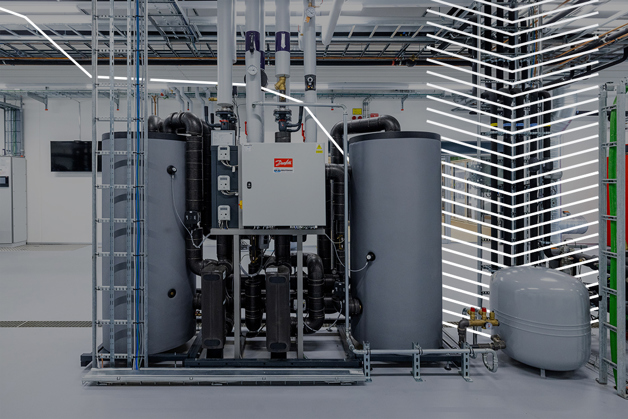
The Danfoss Heat Recovery Module (HRM) helps eliminate the technical challenges of managing heat recovery in data centers. The HRM is an integrated modular solution for data center waste heat recovery. Recovered heat can be sold to district heating grids or nearby office complexes and neighborhoods.
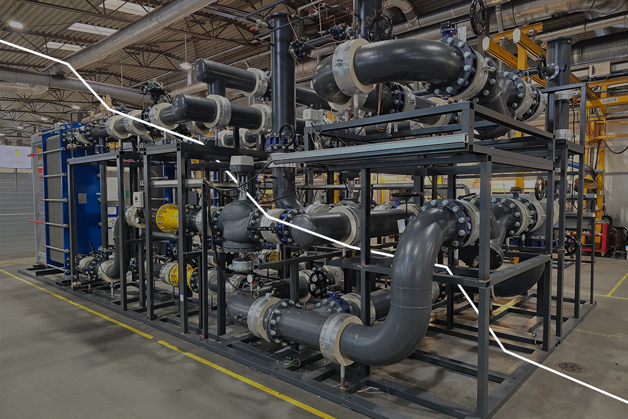
Heat Recovery Unit for reducing supermarket heating costs and CO₂ footprint
The Danfoss Heat Recovery Unit (HRU) helps to eliminate the technical challenges of managing heat recovery. The HRU is an integrated solution that manages and buffers the heat from the CO2 refrigeration pack, enabling it to be reused for space heating, hot tap water, or sold to district heating grids.
See the possibilities of waste heat recovery
Find out more about how our waste heat recovery technologies can help you capture and reuse waste heat from your industrial processes, so you can reduce your carbon footprint and operational cots while boosting energy efficiency.

Explore how EU policies and advanced technology drive waste heat recovery. This white paper covers legislative frameworks, innovative tools, and real-world success stories for sustainable energy solutions.
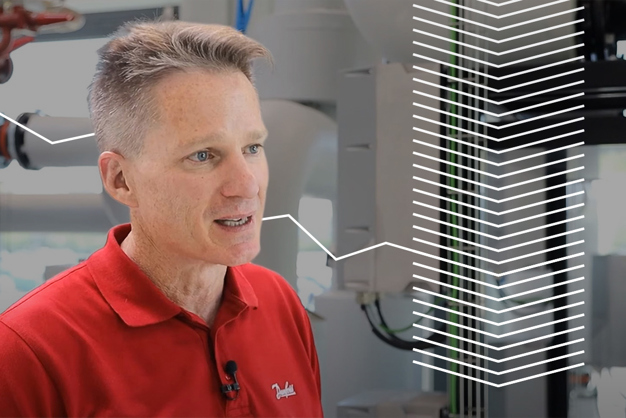
In this video, Danfoss' Drew Turner explains how recovering and reusing waste heat – the world's largest untapped energy source – can dramatically reduce your carbon footprint and lower operational costs.

Find out how you can use sector coupling – combining two or more heating & cooling systems – can help you repurpose waste heat and lower your operating costs & emissions.

In this article, Danfoss’ Saška Rihtaršič explores how the combination of district heating, digital optimization, and hydronic balancing can help us recover and reuse waste heat. Find out how we can drive decarbonization, energy savings and resilience by using excess heat smarter.
Case studies
Waste heat recovery in action
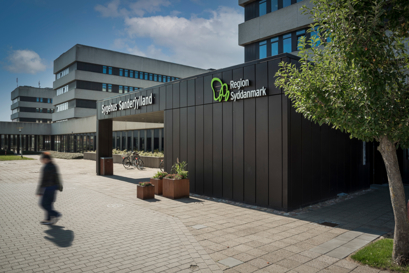
Sygehus Sønderjylland, a hospital located in Sønderborg, Denmark, has partnered with Danfoss Sector Coupling Solutions and the district heating utility company, Sønderborg Varme, to reduce its CO2 emissions.
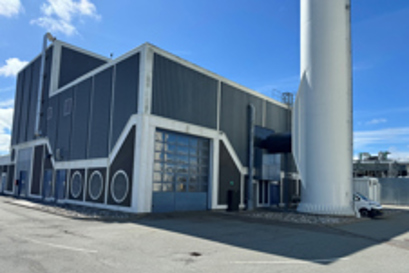
Frederikshavn DHU operates a 14-megawatt gas boiler to provide essential heating services during colder periods. To improve energy efficiency and reduce environmental impact, a project was initiated to recover more energy from the flue gas emitted by the existing biomass boiler system.
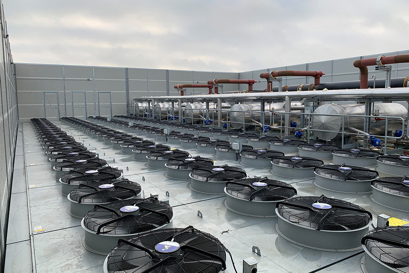
Ringsted District Heating Company (DHC)—a large district heating utility in Denmark—has reduced its reliance on fossil fuels by 97% after Unicool installed an innovative heat recovery system using Geoclima heat pumps built with Danfoss Turbocor® oil-free compressor technology.
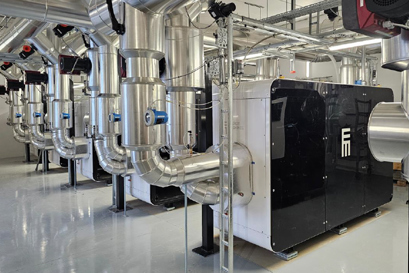
A global leader in freight forwarding and logistics was searching for an energy efficient heating and cooling solution for its approx. 300,000 m2 logistics center in northern Denmark. The company teamed up with longtime Danfoss OEM partner, Energy Machines and Danfoss to implement a sustainable heating and cooling system using 100% renewable energy.
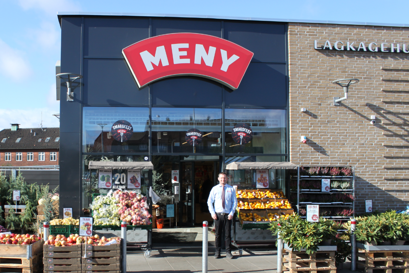
Danish supermarket cuts heating bill and CO₂ footprint with Danfoss Heat Recovery Unit (HRU)
A busy Danish supermarket reduced its annual heating bill by 89.7% and its CO₂ footprint by 6.7 tons a year by making use of the waste heat from its refrigeration system.

Discover how Warsaw is pioneering the capture of excess heat from its Metro System to transform district heating. This innovative project promises to reduce energy demand, stimulate the economy, and accelerate the city's green transition. Explore the future of sustainable energy in Poland.

A Danish supermarket fulfills 95 percent of its heating demand from its own cooling display cases. The chain has installed Danfoss heat recovery units and managed to halve its CO2 footprint in five years. Imagine if this was done in all supermarkets in the world.