
Proving the advantages of adaptive solutions
Tough competition and a constant push to cut down on operational costs are the main drivers of the convenience market in Ukraine as in many other countries. In order to explore smart ways to bring down the energy consumption, two retailers – both leading players in the convenience sector – commissioned Danfoss to carry out in-store tests to analyze and document the energy saving potential of adaptive control solutions.
"The field tests in the Ukrainian c-stores clearly demonstrated the power of adaptive technologies for food retail refrigeration. By enabling the system to perform with the highest possible COP and the highest possible capacity of the evaporators according to varying load conditions, we recorded potential energy savings of up to 34 % in the stores. When you compare the potential savings with the relatively low investment costs required to enable adaptive refrigeration, you get pay-back times of only 2-3 years in a typical convenience store in Ukraine", says Sergiy Kolinchuk (FR Sales Engineer).
The test cases also revealed other low-hanging fruits for improving COP and for prolonging service-life of refrigeration equipment in the stores.
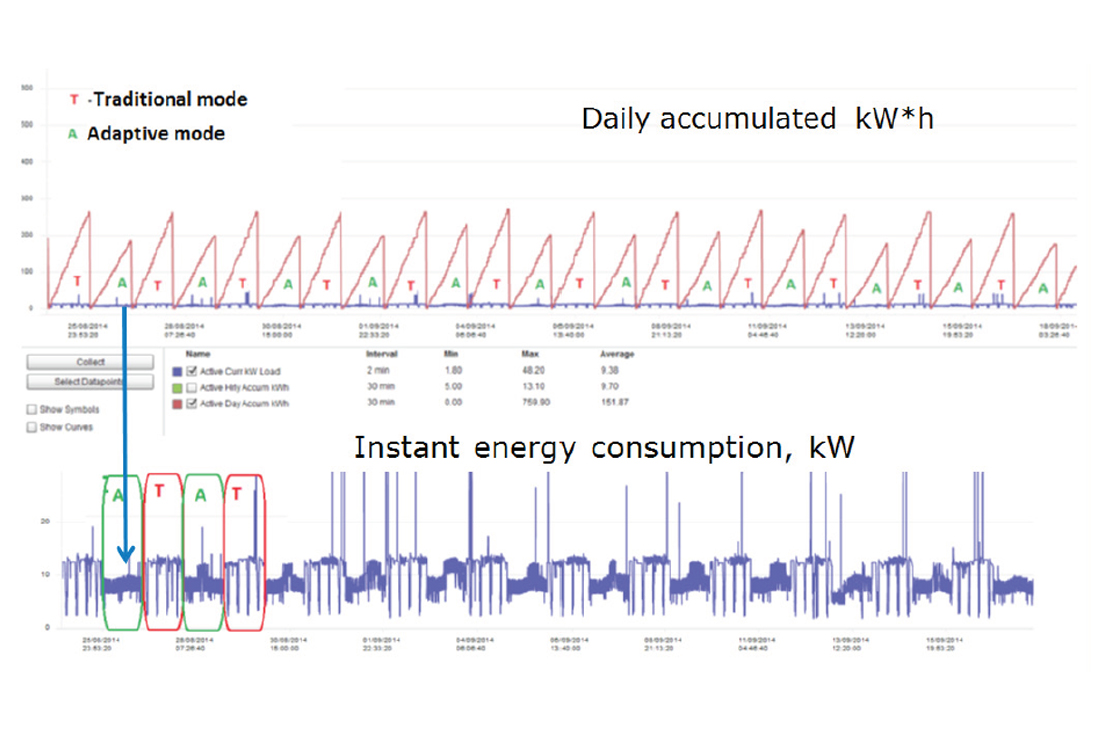
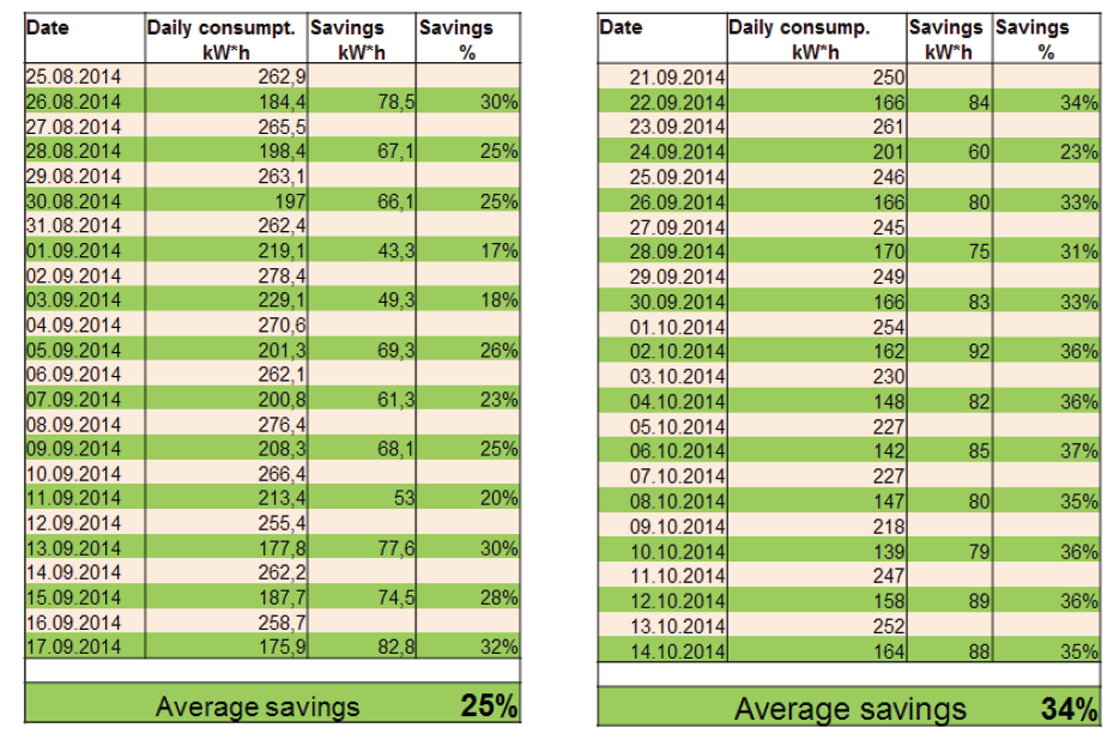
Test Site 1 – Adaptive Solution Returns Energy Savings up to 34%
- Convenience store in Ukraine operated by one of the leading retailers in the country looking for cost-effective solutions in the daily operation of the c-stores.
- The purpose of the test was to provide reliable data about potential energy savings when replacing conventional thermostatic control with adaptive, self-learning technology to cold cases and powerpack.
- The test was performed on 6 MT cases and 2 semi-hermetic compressors with unloaders. Each case was fitted with conventional thermostatic expansion valves to measure the energy consumption of the non-adaptive solution; and with AKV valves and controllers to benchmark the energy savings with adaptive technology. The power pack was fitted with fixed and floating Pc control respectively.
- The energy consumption benchmark was performed during 12 days by switching between conventional mode and adaptive mode every 24 hours.
- The test ran for two periods, one during summer with average temperatures during the day above 30º C and the other during early fall with average day temperatures around 15-20ºC.
- The tests returned average energy savings of up to 25% during summer and up to 34% during fall with adaptive control technology.
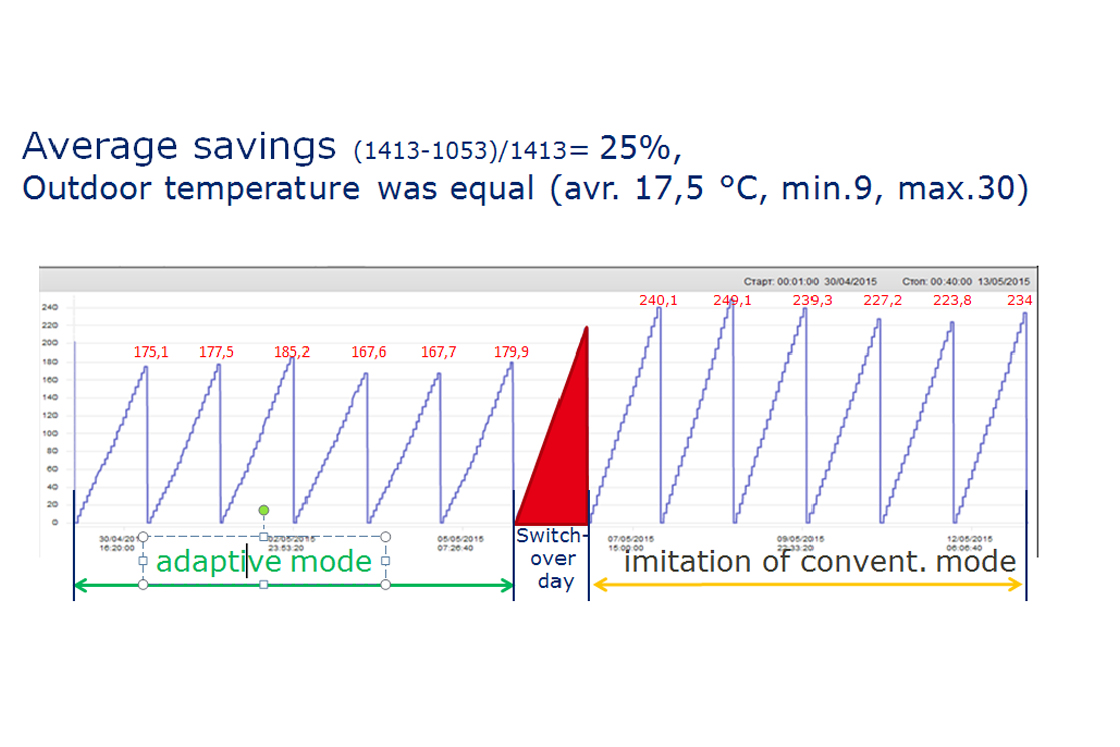
Test Site 2 – Adaptive Solution Returns Energy Savings of 25%
- Convenience store in Ukraine operated by one of the leading players in the country's retail sector as part of a major review of sales technology and equipment.
- The purpose of the test was to uncover potential solutions to decrease operational costs even further by benchmarking high-end adaptive systems with conventional systems using thermostatic expansion valves.
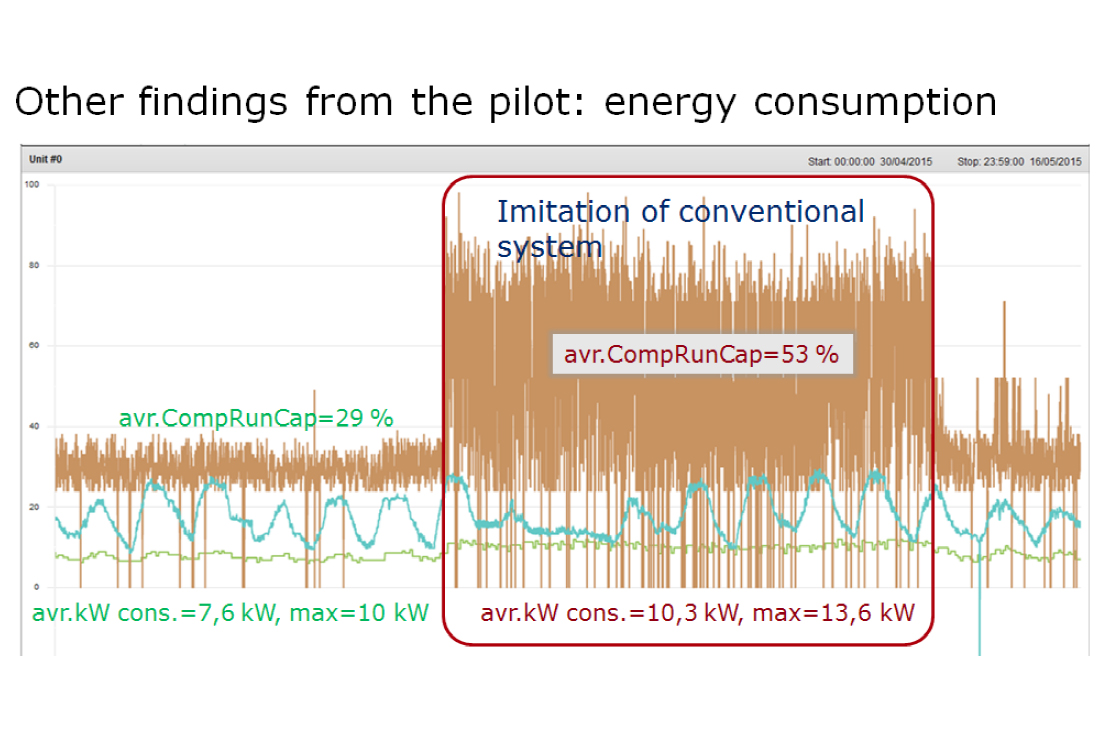
- The test was performed on the same system equipped with AKV valves but operating in two modes: fully adaptive and imitation of traditional mode.
- The test comprised 15 MT cases and powerpack with two compressors; one MT cold room and one LT room with individual Compressor Unit and 10 LT case with built-in Compressor Unit.
- The test ran for six days with adaptive control and for six days with conventional control. The test took place in the month of May, which is representative for average temperature levels in a climate with large temperature fluctuations summer/winter, day/night.
- The test proved energy savings of 25 % with adaptive technology despite the fact that frequency converters contributed to decreasing on consumption in both modes
- When adding Frequency Converters (FC) to the compressors, the energy saving potential rose to 32-35%.
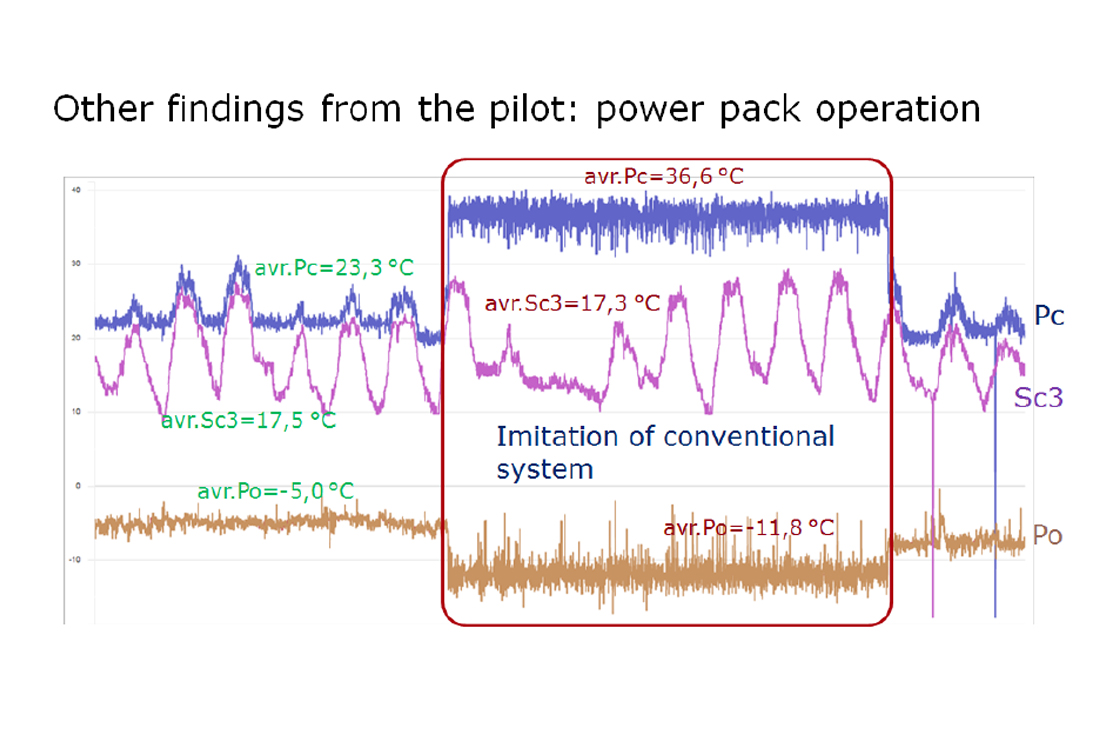
Improving Evaporating Temperature by 7ºC
Other interesting findings emerged from test site 2. When operating in conventional mode, the Po (suction temperature) was close to minus 12º C, a much favored level in traditional systems to ensure that the cases are kept at an even, low temperature at all times regardless of ambient temperature and use. The adaptive mode kept the Po on just minus 5º C without compromising the temperature level of the cases.
Longer Service-Life and Less Service Costs
The test installation at site 2 also revealed a drastic reduction in compressor run capacity from 53 % in conventional mode to only 29% in adaptive mode. This means significantly less running time and fewer starts/stops of the compressors. These factors result in longer life-time of the power pack and less service costs. Furthermore, adaptive technology combined with compressor FCs opens new possibilities to decrease the compressor size in the first place.
Conclusion
Test Site 1
Average energy savings of 34 % in fall/winter, 25% during summer Pay-back time of adaptive technology estimated at 2-3 years
| Conventional | Adaptive | |
| Po | -12°C | -5°C |
| Pc | ? | ? |
| SH (Superheat) | 12K | 7.5K |
Test Site 2
Average energy savings of 25%, up to 32-35% if frequency converter installed on compressors Pay-back time of adaptive technology estimated at 2-3 years
| Conventional | Adaptive | |
| Po | -11.8°C | -5°C |
| Pc | 36.6°C | 23.3°C |
| SH (Superheat) | ? | 5.5K |
| SC3 | 17.3°C | 17.5°C |
| Average compressor run capacity | 53% | 29% |
"Our test installations in Ukraine have proved that when combining adaptive superheat control featured in Adap-Kool® controllers with suction pressure optimization and floating condensing pressure control you can achieve significant energy savings. The reduced energy consumption does not in any way compromise food safety, since high refrigeration performance is maintained during all load conditions is one of the main conclusions of the study", says Sergiy Kolinchuk.