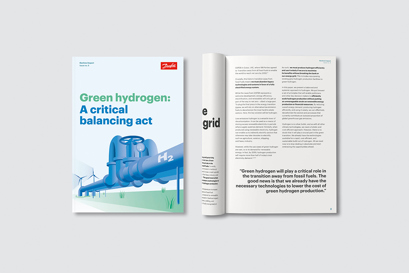

Green hydrogen will play a critical role in the transition away from fossil fuels and in decarbonizing hard-to-abate sectors, such as long-distance shipping and international aviation.
Download the Impact paper now
To keep global average temperature increases under 1.5°C, we must replace fossil-fuel technologies with ones powered by renewable electricity. Energy efficiency, electrification, and renewables will only get us part of the way to net zero. To plug the final piece in the energy transition, we will rely on alternative low-emission fuels to decarbonize the hardest-to-abate sectors. The key solution will be hydrogen.
Low-emission hydrogen is a versatile lever of decarbonization. It can be used as a means of storing excess renewable electricity in periods where supply outstrips demand. Similarly, when produced using renewable electricity, hydrogen can enable us to indirectly electrify sectors that otherwise may take decades to electrify, such as agriculture, aviation, shipping, and heavy industry.
However, while the use cases of green hydrogen are vast, so is its demand for renewable energy. By 2050, hydrogen production will require more than half of today’s total electricity demand. We must produce hydrogen efficiently and use it wisely if we are to maximize its benefits without breaking the bank or our energy grid.
By reducing overall energy demand, producing hydrogen efficiently, and using it wisely, we can effectively decarbonize the sectors and processes that currently contribute an outsized proportion of global greenhouse gas emissions.
Green hydrogen production is energy-intensive and expensive, and the renewables needed to produce it are not a free resource. Before deploying hydrogen, we must implement all available electrification and energy efficiency measures. Energy efficiency is the most cost-efficient way to reach net zero.
By 2050, hydrogen production will require more than half of today’s total electricity demand, so how efficiently we convert electricity into hydrogen is critical if we are to limit energy waste. Similarly, timing matters. Producing hydrogen when there is excess (and cheap) renewable energy in the grid can reduce costs and stress on our electricity grids. Finally, where we produce it also matters; by placing electrolysis plants near existing or planned district energy systems, we can repurpose excess heat to heat water, homes, and other buildings instead of just wasting free energy. We must also plan for proximity to clean water without jeopardizing water use for other purposes, such as drinking and agriculture.
Despite projections for major increases in the future hydrogen supply, its energy-intensive production process means it will still be a scarce and expensive resource. Therefore, we must use hydrogen wisely and judiciously. When machinery and processes can be directly electrified, they should be. Hydrogen currently remains concentrated in traditional applications, and we need to see a rapid upscaling in hard-to-abate sectors like heavy industry and long-distance transport.
Green hydrogen will play a critical role in the transition away from fossil fuels. The good news is that we already have the necessary technologies to lower the cost of green hydrogen production.

By signing up for our newsletter, you will receive updates on the latest insights on competitive decarbonization.
Now is the time for decision-makers to set the right regulatory and economic framework for an efficient, large-scale rollout of hydrogen. Public support is needed at the local, regional, and national level to address regulatory barriers and improve implementation plans. Similarly, we must stimulate more international cooperation and cross-industry collaboration, and synergies. These are also likely to be a driving force behind the innovation, demand, and growth of green hydrogen.
Read more here.
While green hydrogen can open doors for the transition to a green economy, focus should remain on direct electrification of as many elements of our energy systems as possible. Next, a rapid scale-up of green hydrogen as opposed to high-emission hydrogen is needed.
Green hydrogen provides a means to decarbonize and indirectly electrify sectors in which full decarbonization is not yet possible. This includes decarbonizing heavy industry, ammonia to decarbonize agriculture, and using green hydrogen for e-fuels.
Electrolysis will have a significant pull on the electricity grid, and hydrogen production must not overload an increasing demand. Renewable energy sources driving hydrogen production must be auxiliary.
Electrolytic hydrogen production generates a substantial proportion of heat loss. If hydrogen production is planned strategically, much of the excess heat can be repurposed in district heating or microgrids.
Green hydrogen production has a large electricity pull, high water consumption, and vast amounts of excess heat accessible. Before building facilities, thorough sector integration due diligence must be conducted. For instance, areas with water scarcity issues might benefit from optimized desalination facilities, which are critical in providing the pure water needed for electrolysis as well as drinking water.
High production costs limit the economic feasibility of electrolysis facilities. Investment costs are estimated to be reduced by 80% if electrolyzers become cheaper (see page 7). Lowering tariffs and creating tax incentives, such as the tax credit on green hydrogen in the Inflation Reduction Act is pivotal (IRA Clean Hydrogen Production Credit). Financing instruments like the EU Hydrogen Bank can also play an important role in facilitating investments into the green hydrogen value chain. On the demand side, research and development into novel applications such as green hydrogen for steel-making or heavy transport should also be supported.
Clear goals supported by national hydrogen strategies create predictability and stability for investors. Ensuring future demand for green hydrogen – especially in hard-to-abate sectors – is key to de-risk projects today and incentivize upstream investments. Accommodating a lack of long-term viability is therefore essential in creating a green hydrogen market.
Address barriers limiting trade and investment in the entire green hydrogen supply chain. Tariffs on electrolyzers and hydrogen derivatives create barriers for promoting green hydrogen. To increase green hydrogen demand and incentivize investments, green hydrogen and its derivatives should benefit from tax and tariff exemptions. Phasing out subsidies on fossil fuels would further close the economic gap between grey, blue, and green hydrogen.
In many use cases, infrastructure will inform applicability. Lack of ambition and planning of hydrogen infrastructure limit investors and market actors’ ability to predict green hydrogen applicability. In some cases, it is both possible and feasible to retrofit existing natural gas pipelines to enable them to transport hydrogen.
Introduce requirements for hard-to-abate sectors’ deliveries on government contracts like green steel in new buildings and long-haul shipping imports running on e-fuels.
Many developing economies have access to vast amounts of renewable energy and will thus be able to produce a lot of green hydrogen when they receive the investments needed to scale up production. Apart from sparking developing countries’ economies by exporting, it can support other economies’ hydrogen import requirements.
To lower the amount of renewable energy used in green hydrogen production, standards should dictate the efficiency of production. For example, regulation incentivizing the use of high-efficiency grid converters and eliminating inefficient pressurization methods and technologies could be considered.
All forms of hydrogen production are water-intensive. For example, conventional, carbon-intensive methods of hydrogen production, as well as production utilizing carbon capture and storage, require large amounts of water for steam generation and cooling. But despite requiring water for electrolysis, green hydrogen is actually the least water-intensive production method. Careful planning of production and the use of efficient desalination technologies is pivotal.
Efficient hydrogen production is not just about how we produce it, but also when we produce it. Producing green hydrogen in periods of high renewable electricity supply and low demand means we can store it for peak demand periods, accelerating a phase-out of fossil-fuel power plants. Flexible hydrogen production can also balance and stabilize the grid, meaning renewable electricity generation does not have to be curtailed.
Energy efficiency, electrification, demand-side flexibility, conversion, storage, and sector integration are integral for a future energy system enabling an energy grid powered by renewables.
Our roadmap for decarbonizing cities outlines the technologies available to meet global climate goals and accelerate the green transition.