

Variable frequency drives for data centers
Variable frequency drives (VFDs) control the speed and torque of electric motors by adjusting the frequency and voltage supplied to them. In data centers, VFDs are used to control fans, pumps, compressors, and other motor-driven equipment, helping match energy use to actual demand while supporting reliable operation of critical power and cooling infrastructure.
Solutions
Where VFDs make the biggest difference in a data center
VFDs play a critical role in both the electrical and thermal infrastructure of modern data centers. From power conversion and distribution to fans, pumps, compressors, and liquid cooling, Danfoss drive technologies help match system performance to changing demand while supporting efficiency, power quality, reliability, and future scalability.

Improve power quality, support stable operation, and enable more efficient electrical infrastructure with drive and power conversion technologies designed for demanding data center environments.
Our solutions help you:
- Improve power quality and grid stability
- Support 800 VDC/+/- 400 VDC and microgrid architectures
- Reduce harmonic distortion
- Increase resilience and operational reliability
- Integrate battery energy storage and renewable sources

Optimize cooling performance, reduce energy consumption, and support uptime of air- and liquid-cooling systems with intelligent VFD control for fans, pumps and compressors. Our VFDs support:
- Chillers, CRAH units, cooling towers, coolant distribution units (CDUs), and pumps in air- and liquid-cooled data centers
- Demand-based control of pumps, fans, and compressors
- Efficient heat removal
- Reliable cooling for mission-critical environments
Impact papers

The 8th edition of Danfoss Impact explores how data centers can become active contributors to the energy system instead of simply consuming power.
Discover practical insights into improving efficiency, supporting grid stability, reducing emissions, and enabling future-ready operations.
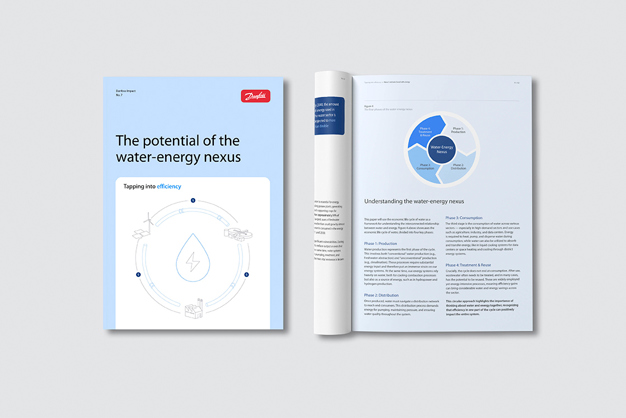
Danfoss Impact Issue No. 7. Our latest Impact paper emphasizes the critical importance of seeing water and energy as interdependent resources.
Read about the trends affecting the responsible use of water in data centers.
Built for mission-critical data center infrastructure and uptime
Data centers demand more than efficient motor control. They require technologies that maximize uptime, protect critical infrastructure, and support long-term operational excellence.

Protect critical cooling and power infrastructure with VFDs designed for secure operation.
The iC7-portfolio from Danfoss Drives is developed with cybersecurity from the very beginning, helping operators prepare for evolving regulations while reducing operational risk.
- Hardware-based security architecture
- Secure communication via OPC UA
- IEC 62443-4-1 certified development process
- Designed to support Security Levels up to SL2

Reliable power quality is essential for sensitive data center equipment.
Our harmonic mitigation portfolio helps reduce electrical distortion, protect infrastructure, improve transformer utilization, and support compliance with power quality requirements.
- Ultra-low harmonic drives
- Active harmonic filters
- Application-specific mitigation guidance
- Digital sizing with MyDrive® Harmonics

Modern VFDs are more than just power converters. They are intelligent sensors.
Integrated condition monitoring continuously analyzes drive and motor performance, helping operators detect developing issues before they become failures.
- Early fault detection
- Predictive maintenance support
- Improved operational visibility
- Reduced unplanned downtime
DrivePro® services help protect uptime across the lifecycle of your power conversion assets. From start-up and preventive maintenance to spare parts, remote monitoring, and lifecycle planning, Danfoss helps you tailor a service strategy to your operational needs.
See all DrivePro® services

Explore resources
Danfoss data center brochure
As data center cooling demands grow, efficient control of pumps, fans, and chillers becomes increasingly important. Discover how Danfoss VFDs and cooling technologies work together to support efficient, reliable, and scalable data center operations

On-demand webinar: Future-ready data centers
Watch Danfoss experts discuss how intelligent VFDs and modern power management technologies help data centers improve efficiency, strengthen energy resilience, and support sustainable growth.
Learn about:
- Improving energy efficiency, power usage effectiveness (PUE) and water usage effectiveness (WUE)
- Smart grid integration
- Scalable power management
- Future-ready data center infrastructure


